



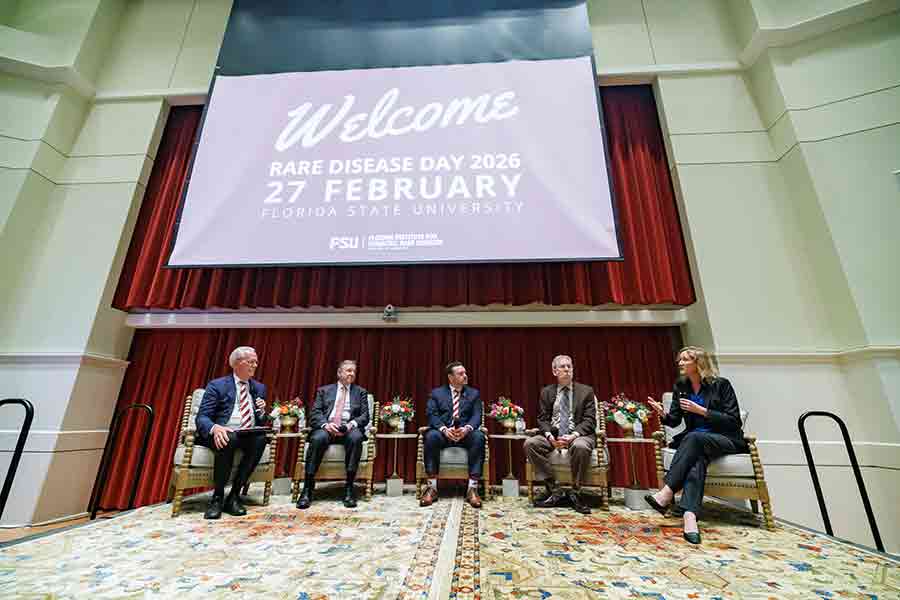
As the Florida State University College of Medicine and Florida Institute for Pediatric Rare Diseases recognized Rare Disease Day last week, reminders of the urgency of their mission were all around the College of Medicine rotunda — the patients and families whose lives can be changed thanks to improved screening and care.
Observed annually on the last day in February, Rare Disease Day is a global movement raising awareness for the millions of people with one of more than an estimated 7,000 identified rare diseases. Its goal is to ensure equitable access to diagnosis, treatment, healthcare and social support for those affected.
FSU recognized Rare Disease Day on Feb. 27 with a symposium and panel discussion featuring experts in genomics and its clinical applications.
Although each rare disease affects few people, together, they impact an estimated 30 million Americans, many of whom are children. Genetic medicine offers an opportunity to improve diagnosis and treatment for those patients.
“Rare diseases may be individually uncommon, but together, they affect millions of people, families and children,” said Pradeep Bhide, director of the Florida Institute for Pediatric Rare Diseases, or Florida IPRD. “Therefore, our responsibility has always been, and will always be, to ensure that scientific innovation translates into faster access, better care and real hope.”
The small patient population for each rare disease often means that private companies don’t consider those diseases when deciding where to invest limited research and development spending. Solving those long-term, difficult problems is where university research can play an important role, said President Richard McCullough.
“That’s what we do at FSU, and we’re really proud to be part of that,” he said.
From idea to treatment
The work at FSU and partner institutions will help to make diagnoses and possible treatments that were once only an idea, said Dr. Eric Green in his keynote address to the symposium.
A physician-scientist, Green spent more than three decades at the National Human Genome Research Institute at the National Institutes of Health, serving as its director from 2009-2025. He is now chief medical officer at Illumina, where he leads global efforts to advance the clinical application of genomics.
The Human Genome Project — an international collaboration that sequenced the human genome of around 3 billion DNA base pairs — was the scientific foundation for research that continues today and is bearing fruit in medicine such as improved diagnosis and gene editing.
“The good news is that we will get better at this every year,” he said. “This is helping so many areas of medicine in which rare diseases have an influence.”
That means everything from dramatically reducing the “diagnostic odyssey” for families with a child who has a difficult-to-pinpoint rare disease to getting answers for undiagnosed genetic conditions in adults who find themselves in emergency care without a clear explanation.
Since completing the Human Genome Project in 2003, “we have made a remarkable pivot from having a blurry concept of what genomic medicine might be, to now bringing it into focus,” he said. “There are so many exciting things that will happen in genomic medicine, but there are enough examples already to convince people that we can really do this. Now, we just need to expand our repertoire of examples for using genomics in medicine.”
In the rare disease and genetic medicine world, Florida and FSU stand out for their willingness to “skate to where the puck is going to be” in pioneering new avenues for research and treatment.
“This is becoming an epicenter of activities and progress in rare disease work,” Green said.
Legislative support, private partnerships, and academic progress
The work at FSU began with a handshake between President McCullough and Rep. Adam Anderson (R-Palm Harbor). Since then, the project has grown tremendously thanks to support from the state and private companies.
In 2025, the Florida Legislature enacted and Gov. Ron DeSantis signed the Sunshine Genetics Act, a partnership between FSU and the state to advance genomic medicine for children across Florida. Under this initiative, the Florida IPRD serves as the hub of the statewide newborn genomic sequencing program, enabling early diagnosis and intervention for genetic conditions and positioning Florida as a national leader in precision medicine and pediatric health.
To meet these ambitious goals, Florida IPRD has established new programs to address every stage of the rare disease journey. New programs focus on early detection, genomic diagnosis, specialized clinical care, research and innovation to discover diagnostic and therapeutic measures, and programs to train the next generation of professionals to become national leaders in this field.
One program is the Florida IPRD diagnostic lab, which offers whole-genome and whole-exome sequencing of clinical samples. The institute partnered with Quest Diagnostics to establish the CLIA-certified clinical genomics laboratory.
“Advances in comprehensive genomic sequencing now allow a single test to provide insights across thousands of rare diseases – accelerating our pursuit of truly personalized diagnostic insights,” said Dr. Sarah South, executive scientific director at Quest Diagnostics. “This is a significant public health opportunity, and we are pleased to support FSU’s Institute for Pediatric Rare Diseases and the Sunshine Genetics Act.”
“We are proud to support FSU IPRD’s program to provide early genetic screening and intervention for children with rare diseases, advancing timely diagnosis and care,” said
Gaurav Malik, a vice president of business development & patient services with Quest Diagnostics in Tampa.
In addition to diagnostic and clinical tools, the institute is training healthcare professionals who will provide the guidance to deal with some of the most difficult news parents can face.
The university’s first master’s students in a new genetic counseling program are expected to begin their classes in the 2027 fall semester. As research provides more information about genetic diseases, expert counselors are crucial for helping families and patients navigate medical complexities.
The training and research at Florida IPRD is giving hope to families across Florida and the country, said Anderson, whose son Andrew died in 2019 at age 4 from Tay-Sachs disease.
“Gene therapies are working and even more of those therapies are showing promise,” Anderson said. “Real change is on the horizon.”
###
FSU Health brings together researchers, educators and clinical partners under one umbrella to transform health and health care in Florida. To learn more, visit fsuhealth.fsu.edu.
Visit the Florida IPRD website to learn more about the institute and its life-changing work.