



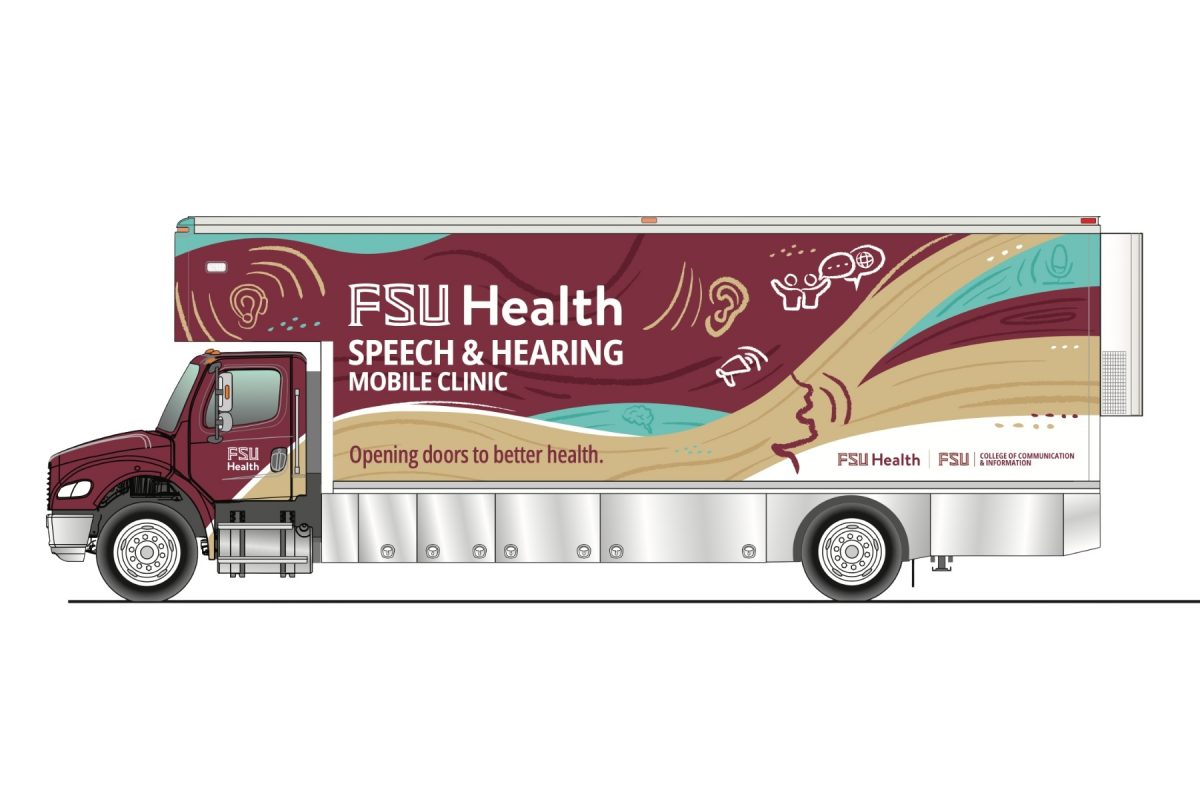
Florida State University’s College of Communication and Information, through its School of Communication Science and Disorders, will launch the FSU Health Mobile Speech and Hearing Clinic later this summer, expanding healthcare services that the university has provided to Floridians since the 1950s.
The mobile clinic will bring screenings, evaluations and therapy to underserved communities throughout North Florida and the Panhandle, while also providing hands-on clinical training for FSU students.
Led by Director Becky Greenhill, a speech-language pathologist and clinical instructor, the fully accessible clinic builds on the longstanding work of FSU’s Speech and Hearing Clinic, which serves children and adults with communication disorders, cognitive challenges and hearing conditions.
Greenhill discussed the growing need for speech and hearing services, the role the mobile clinic will play in rural communities and how the effort reflects Florida State’s broader healthcare mission through FSU Health.
What is the FSU Mobile Speech and Hearing Clinic, and how did it come to life?
“So, this has been a journey for me. I’ve been a speech-language pathologist for 30-something years. I’ve always had a heart for reaching people about speech therapy services. I just know there’s a huge need to get people to the services that they need. I had been thinking about this project for a while, and I started talking about it out loud with students and other faculty members. And I would call it the bus; I really want to have a bus and be able to take it out to people in the community.”
“I had someone I knew that I was riding an elevator with, who asked me about another project. I said, ‘At my stage in my career, I have other dreams.’ I started explaining that I would love to have some type of mobile unit that we could take out into the community. That was a person who said, ‘That sounds like an incredible idea,’ and came on board. Fast forward, here we are. It was November of 2024 when we started talking about that, and it’s been incredibly fast — to go from an idea in an elevator to writing a proposal, securing funding from a generous benefactor, and now a custom-built unit in the final stages of construction.”
Who is the mobile clinic designed to serve?
“We want to serve the underserved. In the city of Tallahassee, relatively, you have people who have access to services. But I know that’s not the case for many outside of our city limits — and some inside our city limits as well. We want to be able to reach North Florida and the Panhandle. We’ve outlined from Pensacola to Lake City but really trying to get in touch with those rural areas that don’t have ready access to services.”
What has it taken to build a mobile clinic from scratch?
“When it comes to a custom-build anything and thinking about this from a business perspective, that was all brand new to me. It started with me just making cold calls — grassroots efforts. I started calling around to other places that had mobile clinics. I found a national consortium of speech and hearing mobile clinics that I didn’t know existed, and that was amazing.”
“We thought about purchasing something and renovating it, but the more I investigated, it seemed just as cost-effective to custom build. We searched out multiple companies, got several quotes, and ended up settling with Lifeline Mobile Incorporated. It’s been everything you can imagine — from blueprints and floor plans to picking out all the details. We’re really excited that we’re in the last month or two of that process.”
How will the mobile clinic work for patients once it’s on the road?
“We are an extension of the speech and hearing clinic that already exists here at Florida State University. We’ll be considered a secondary site. Ideally, we want to bring a social work aspect to this so that if we go into a community, we know what local services we can connect people to. We might be the first to reach someone and help identify that there is a need and then help them connect with that help. If there’s not something in their community, we want to develop relationships so we can come back regularly or stay in touch through tele-services.”
“We’re definitely in the phase of trying to determine how we can best serve the community. We’re researching agencies that already exist within the Panhandle — private businesses, state agencies — but we want to connect with community partners. It’s going to be just a couple of partners right at the beginning and then branching our way out. We’re considering all options — Department of Health, local churches, physicians’ offices, etc.”
How will the mobile clinic support student training at Florida State University?
“We are a teaching university, so clinical student training is a key emphasis of what we already do. Students would be involved in screenings, evaluations, therapy — and they’re supervised for that entire process. When we get our students outside of the walls of our brick-and-mortar clinic, it helps them see patients as a whole person. They learn how disorders impact daily life and how much of an impact we can have on functional, everyday living. The identification process and differential diagnosis training are really accelerated with this kind of environment. I take students into the community now, and they always come away amazed and having learned so much from meeting people where they are.”
Additional information about the mobile clinic will be available on the FSU Speech and Hearing Clinic website later this summer.