



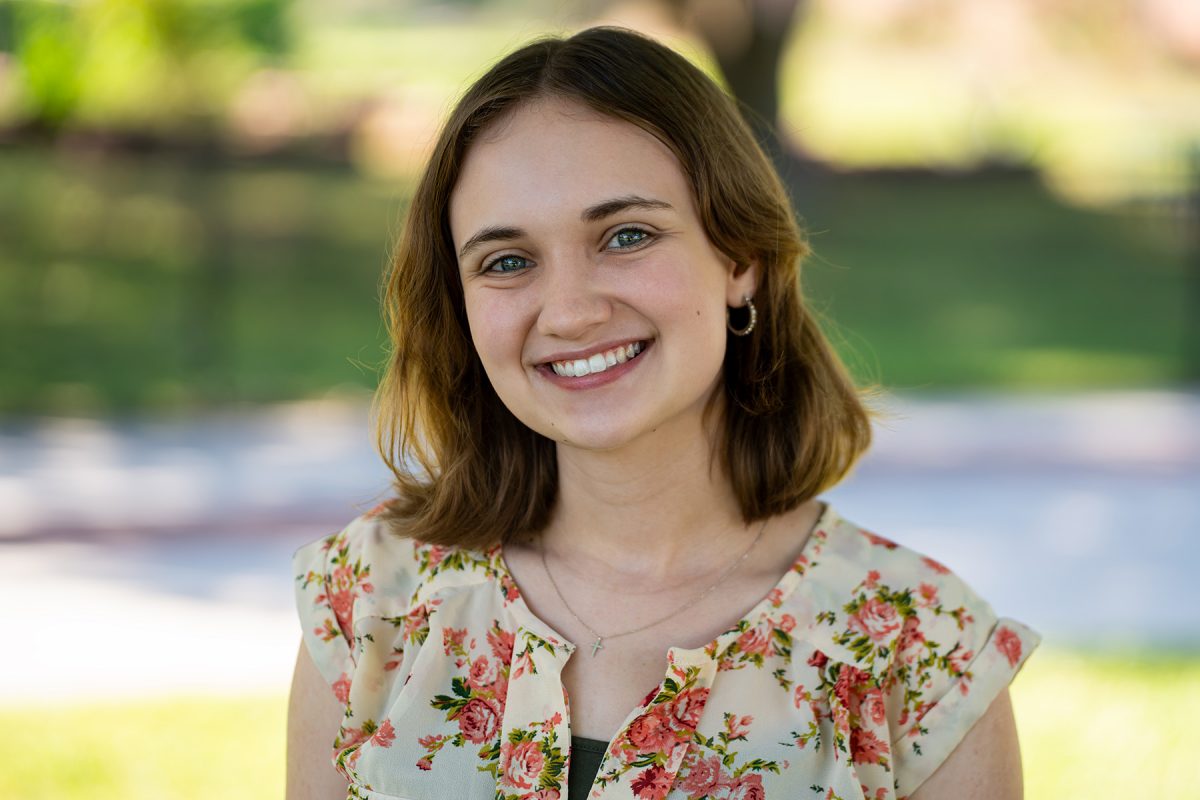
“FSU has prepared me for my future by exposing me to a variety of different people from around the state of Florida and the world, and I've been able to make really positive connections with people who have different experiences, ideas and perspectives.”
Fast Facts
- Nature: Has hiked in the Alps, the Appalachians, and other mountains
- Traveler: Dreams of visiting every country in the world
- Go-to Sweet Shop Order: Iced jasmine tea with milk and sugar
- Focused: Works best on campus around a buzzing environment
- Plot Twist: Has never been to an FSU football game
Charlotte Stuart-Tilley, a Tallahassee native, chose to attend Florida State University because of the opportunities for undergraduate research and the beautiful campus and Gothic architecture, which she has admired throughout her life.
During her time at FSU, Stuart-Tilley has been involved in research projects, ranging from archiving and tracking historical mentions of Dante, the 13th century Italian author of “Divine Comedy,” in popular media, to understanding how West Africans conceptualize human rights and discrimination.
The latter culminated in a Tyler Fellowship, which provided Stuart-Tilley with an IDEA Grant in addition to support from the Center for the Advancement of Human Rights to conduct fieldwork in Ghana.
How did you engage in academic research at FSU?
My first university research experience was with Elizabeth Coggeshall, professor in the Department of Modern Languages and Linguistics, who has an incredible public access database of physical and digital references to Dante worldwide called Dante Today. My work with her was simple; she needed students to update the database with some technical tasks. For our final presentation, she allowed us to pick a subject related to the database and complete independent research. I chose to search for additional Dante references to add to the database from West Africa, a region that has interested me since I was in high school. One of my favorite references was from a Ghanaian artist, so perhaps the project influenced my decision to do my research in Accra, Ghana last summer.
How was your experience conducting research in Ghana?
Building on my earlier research, I traveled to Ghana to study how Fulbe communities conceptualize human rights and discrimination. The idea connected to my work on West African cultural references during the Dante Today project, which sparked my interest in the region and led me to conduct fieldwork in Accra.
In Ghana, I interviewed Fulbe individuals (a historically nomadic and Muslim minority), asking questions such as “Who are Fulbe?,” “What is your ideal world?” and “What do you think of human rights?.” I initially expected responses to center on concepts like “pulaaku” and “seemtende,” words that mean “responsibility” and “shyness” and are tied to Fulbe identity. Instead, a different theme emerged: “need.” Many participants emphasized their needs, in particular for access to education and land for cattle grazing, reflecting both economic realities and cultural traditions. Another recurring idea was “peaceful coexistence,” which interviewees described as the foundation of an ideal society.
What did you gain from majoring in a second language?
My dual degree in French has helped me to make interdisciplinary connections that I don’t think I would have otherwise made. The classes I took on French culture and history tied into the classes I took on political science, terrorism and other disciplines. Making those connections between both majors has helped me to come to class with a different perspective and to relate to the material in an alternative way.
I also love our French faculty’s style of teaching and the small classrooms that we have in our upper division courses. I really got to know everyone in my classroom, and many of us had multiple classes together from one semester to the next. One of the French courses which I took was centered around a book called Afrotopia by Senegalese economist Felwine Sarr. The professor who taught the course organized a conference on the book here at FSU where we had the opportunity to meet Sarr in person and talk to him about his work.
What are your plans after graduation?
Long-term, I would love to work in human rights or sustainable development, especially as an analyst trying to understand big-picture environmental and sustainability issues. For now, I would like to work in Florida, either in the public or private sector. I love the natural environment here, and it is important to me that we can enjoy it for generations to come.