



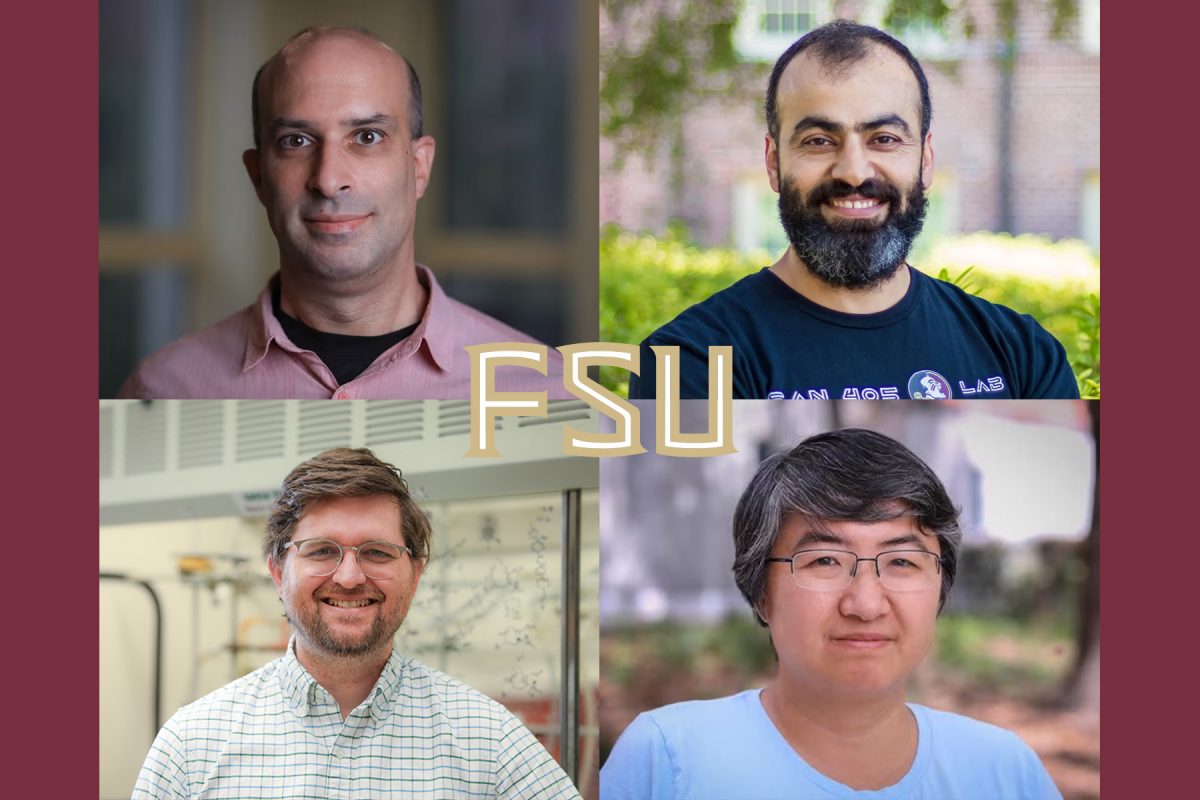
Florida State University recognized the research contributions and creative work of associate professors with this year’s Developing Scholar Awards.
The awards are sponsored by the Council on Research and Creativity, and they include funding to promote the awardee’s program of research and creativity. Faculty were nominated by their respective academic departments.
“These faculty members exemplify excellence in scholarship, and we congratulate them on this well-earned recognition,” said Vice President for Research Stacey S. Patterson. “FSU is honored to celebrate their accomplishments and to support their ongoing research and creative work.”
This year’s awardees are:
David Braithwaite, Department of Psychology, College of Arts and Sciences
In his “Queen of the Sciences” lab, Braithwaite investigates mathematical thinking and logical reasoning and how people learn and develop these skills. Using behavior studies and computational modeling, he aims to improve our understanding of cognitive processes involved in math and logic to advance psychological theory and improve education.
Ravinder Nagpal, Department of Health, Nutrition, and Food Science, Anne Spencer Daves College of Education, Health, and Human Sciences
Nagpal researches the role of the gut microbiome in age-related intestinal and neurocognitive health. His research examines how beneficial and pathogenic microbes and their metabolites function, with the goal of developing nutritional and pharmacological interventions to improve the microbiome and reduce conditions such as obesity, type 2 diabetes and Alzheimer’s disease.
Joel Smith, Department of Chemistry and Biochemistry, College of Arts and Sciences
The Smith Lab is focused on improving synthetic approaches to assemble some of nature’s most complex molecules. Smith and his team investigate the most concise way to assemble naturally occurring molecules, which often inspires the invention of brand-new chemical reactions and improves the synthesis, function, and translational potential of organic molecules and transformations.
Qian Yin, Department of Biological Science, College of Arts & Sciences
Yin studies how individual proteins or protein assemblies intervene in related biological processes such as membrane transport, the innate immune response, and host-pathogen interactions. Her work illuminates the interactions among inflammation, infection, cellular cleanup processes and rearrangement of protein filaments in cells. A recent focus is on the endomembrane system, which is the focal point of both antimicrobial defense and cell maintenance.