



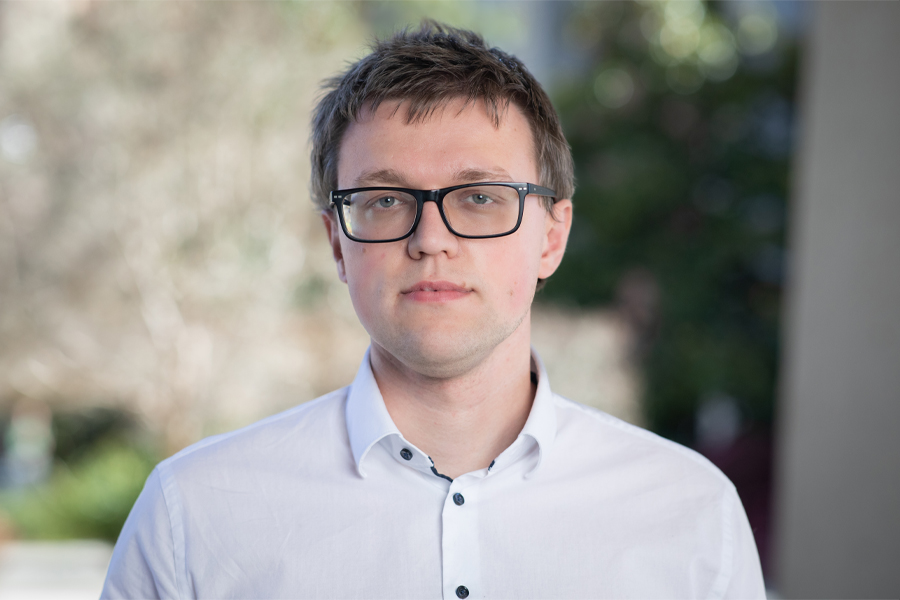
A Florida State University physicist has been awarded one of the most prestigious awards available to early career faculty for his work in condensed matter physics.
Assistant Professor of Physics Cyprian Lewandowski is a recipient of a 2026 Faculty Early Career Development Award, or CAREER Award, from the National Science Foundation for his research into emergent electronic phenomena — effects that manifest in condensed matter systems when interactions occur among particles — such as new superconducting or insulating states in quantum materials.
The CAREER Awards Program offers NSF’s most significant awards in support of early-career faculty who have the potential to serve as role models in research and education and to lead groundbreaking advances in their fields. The award provides faculty with five full years of funding to support students and conduct research while granting them an opportunity to work closely with NSF staff on developing their professional endeavors.
“While this award lists my name, it really belongs to all the people who contributed to and helped me throughout my journey,” Lewandowski said. “I still can’t believe I’ve earned it. It’s significant validation that what I’m doing is indeed of interest to a broad audience of scientists.”
After earning his doctorate from the Massachusetts Institute of Technology in 2020, Lewandowski spent two years as a postdoctoral fellow at the California Institute of Technology. Since joining FSU’s faculty in 2024, he’s taught classes ranging from beginner physics for non-majors to advanced graduate-level quantum many-body physics courses.
In his research, Lewandowski analyzes moiré materials, which are quantum materials that look like tiny, patterned quilts at the atomic level due to their unique crystalline structure. They’re composed of two or more atomically thin sheets of elements that create a repeating — moiré — pattern when slightly offset at a particular angle or when the two materials slightly differ in their crystalline structure.
This moiré structure creates special conditions in which electrons move slowly and interact strongly — yielding specific physical conditions known as the flat-band regime — and leads to surprising physical phenomena, such as novel types of superconducting states or unexpected optical effects. These unexpected phenomena have the potential to enable transformative technologies, such as new quantum computing platforms or more advanced sensors.
“I want to uncover what other effects these materials can exhibit by focusing on additional properties of these systems aside from the propensity for electrons to interact strongly with one another,” Lewandowski said. “This multi-part project looks beyond the flat-band aspect of these systems to examine other unique features of these quantum materials, such as their multilayer structure or the impact of the moiré structural patterns, which I aim to investigate with funds from the CAREER Award. The broad goal is to discover how these additional features can unlock new physics and functionalities that can lead to novel quantum and technological advances.”
The first branch of Lewandowski’s project involves studying plasmons — collective electron oscillations that can carry energy at ultrafast speeds — to open pathways for next-generation terahertz electronics and communication methods. A second component focuses on light-matter interactions and developing new design principles for improved solar-cell technologies. The project’s third part investigates the origins of superconductivity in multilayer moiré systems, an open question in the field.
“While my focus is on moiré materials, my ultimate goal is to uncover fundamental design principles and ideas that I can implement in other quantum materials that might be more industrially viable and can be manufactured on a large scale,” Lewandowski said. “My goal isn’t to solve every problem using moiré materials, but I want to develop potentially transformative ideas based on the moiré materials that can be leveraged in technological applications.”
Lewandowski, who is also affiliated with the FSU-headquartered National High Magnetic Field Laboratory and the FSU Initiative in Quantum Science and Engineering, is an American Physical Society Career Mentoring Fellow and serves as the adviser for the Society of Physics Students at FSU. Currently, he advises two doctoral students and two postdoctoral scholars.
Alongside research activity, the CAREER Award will support an educational component designed to improve visibility, accessibility and participation in condensed-matter physics through the development of a series of at-home, do-it-yourself experiments emphasizing condensed-matter principles as well as a series of National MagLab events to stimulate undergraduate interest in condensed-matter research.
The education plan also includes a component dedicated to addressing stuttering in academia featuring videos and resources that include examples of role models in academia who stutter and techniques for managing stuttering.
“Cyprian is a brilliant physicist and a remarkable educator who opens his heart to his students, and students respond to this,” said Department of Physics chair Paul Cottle. “He led the FSU chapter of the Society of Physics Students, an organization for undergraduate physics majors, to some terrific accomplishments, including winning the Outstanding Chapter Award from the national SPS organization for the third year in a row.”
To learn more about research conducted in the Department of Physics, visit physics.fsu.edu. For information about the FSU Initiative in Quantum Science and Engineering, go to quantum.fsu.edu.