



Florida State University’s College of Communication and Information hosted the 12th annual South Asian Media and Cultural Studies (SAMCS) Conference, a premier international forum for researchers, scholars and practitioners engaged in dialogue surrounding media and culture in South Asia.
The hybrid event Jan. 29 and Jan. 30 took place at The Globe Auditorium and online at the College of Communication and Information’s YouTube channel and the SAMCS YouTube channel. Attendees from around the world joined both in-person and virtually to discuss topics including contemporary challenges in journalism, cultural preservation and resilience, different demographic groups’ media engagement and identity expression through media in South Asia.
This year’s conference theme “Resilience and Renewal: Tradition, Innovation, and Media Futures in South Asia” explored the role of media and communications in preserving identity, sharing knowledge and responding to change across local, Indigenous and urban communities.
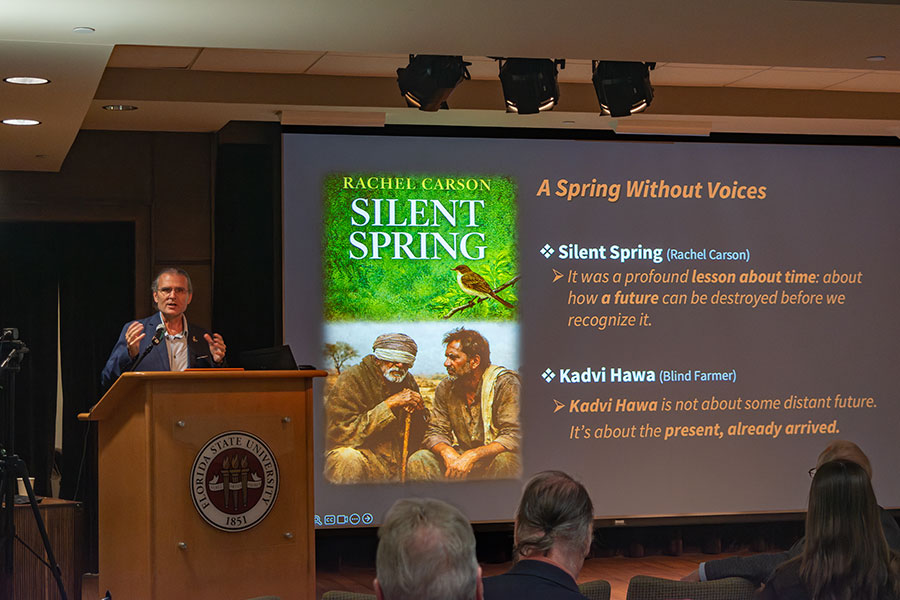
Michael R. Ogden, dean emeritus of the College of Humanities and Social Sciences at Zayed University in Dubai, delivered the keynote address, “Indigenous Responses to South Asia’s Climate Crisis,” that focused on Indigenous documentary, climate resilience and the role of South Asian perspectives in shaping global media futures.
An accomplished scholar, storyteller and documentary filmmaker originally from Oregon, Ogden served two years as a Peace Corps volunteer in Fiji before earning a Ph.D. in political science and pursuing an academic career. His work focuses on Indigenous communities, media and long-term responsibility in the context of a changing climate.
“If we are serious about the theme of this conference — resilience and renewal, tradition, innovation and media futures in South Asia — then we owe the pathfinders a new politics of representation,” he said.
He explained that the challenges faced by the world today really have to do with how we think about time. Through examples from South Asia, Ogden demonstrated the Seventh Generation principle, an Indigenous philosophy that says every decision made today should consider its impact on people living seven generations in the future.
“When you make a decision today, you are accountable to descendants seven generations into the future,” he said. “If we assume that one human generation is roughly 25 years, that’s a decision horizon of nearly 175 years.”
The conference continued Friday, Jan. 30, with opening remarks from Michelle Kazmer, dean of the College of Communication and Information.
“This marks the 12th year that a group of students, faculty, alumni and friends have worked together to organize this important forum,” Kazmer said “I hope that this is a chance to learn more about South Asia, make new connections, get in touch with old friends, and to build relationships with colleagues from around the world.”
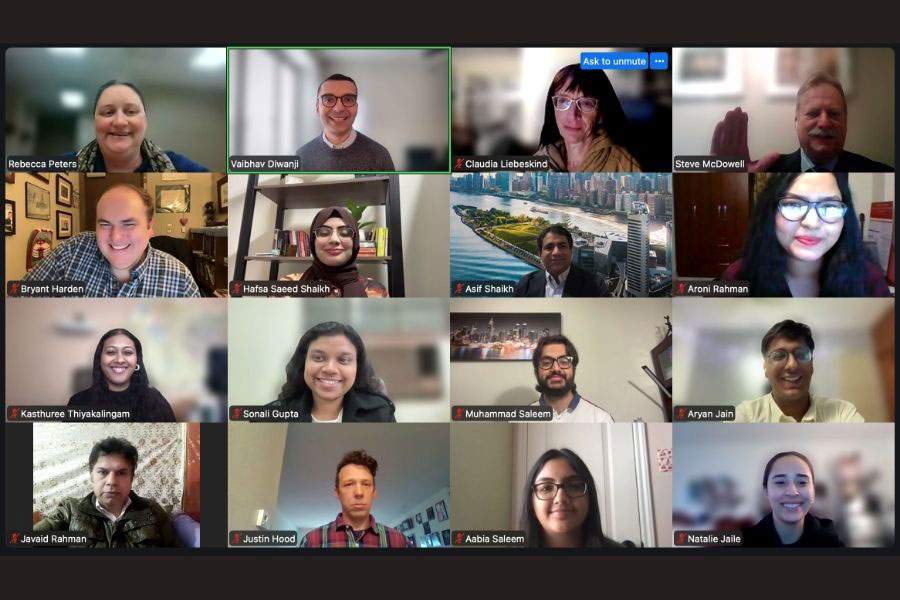
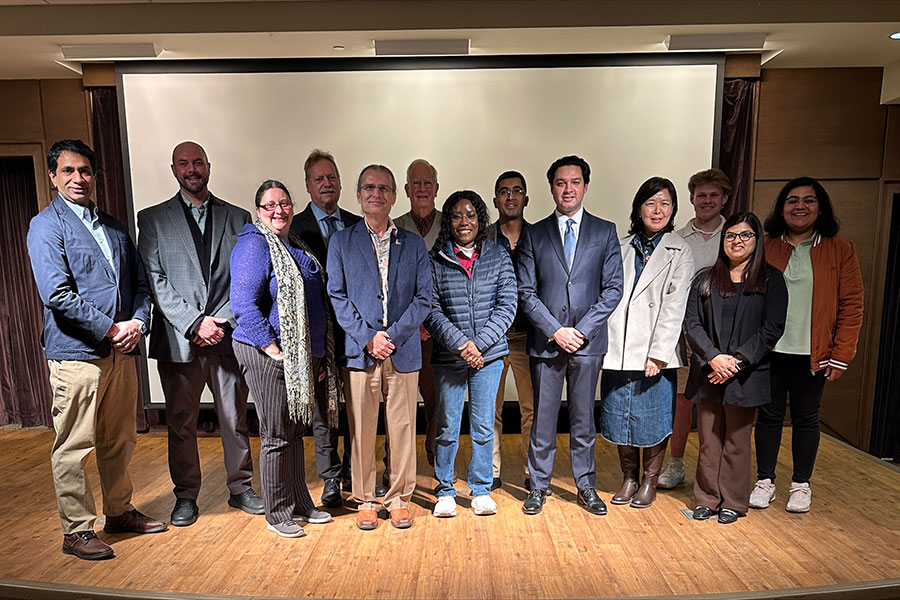
The program consisted of four presentation panels, where speakers representing universities from around the world including countries like India, Pakistan, Belgium and Bangladesh spoke on topics ranging from media innovation in South Asia to resilience and representation. The panels are available to watch on the SAMCS YouTube channel.
Taimur Shamil, a national security and foreign policy expert from Pakistan and based in New York, delivered the closing keynote. His talk, “The Narrative Power: Mapping South Asian Think Tanks and Their Influence on Policy Formulation,” focused on how South Asian think tanks shape public debate and influence policy formation.
“Think tanks are the architects of reality,” Shamil said.
He described South Asia as a politically complex region shaped by geography, security disputes and development challenges, and argued that think tanks help create the language and data used in public debate. During the question-and-answer portion of his talk, Shamil emphasized the importance of grassroots engagement and including multiple perspectives while acknowledging ongoing concerns about bias and how research gets translated into real policy.
“Ideas actually generate from the grassroots level, and a researcher must be connected with the people because that is where the ideas are,” he said.
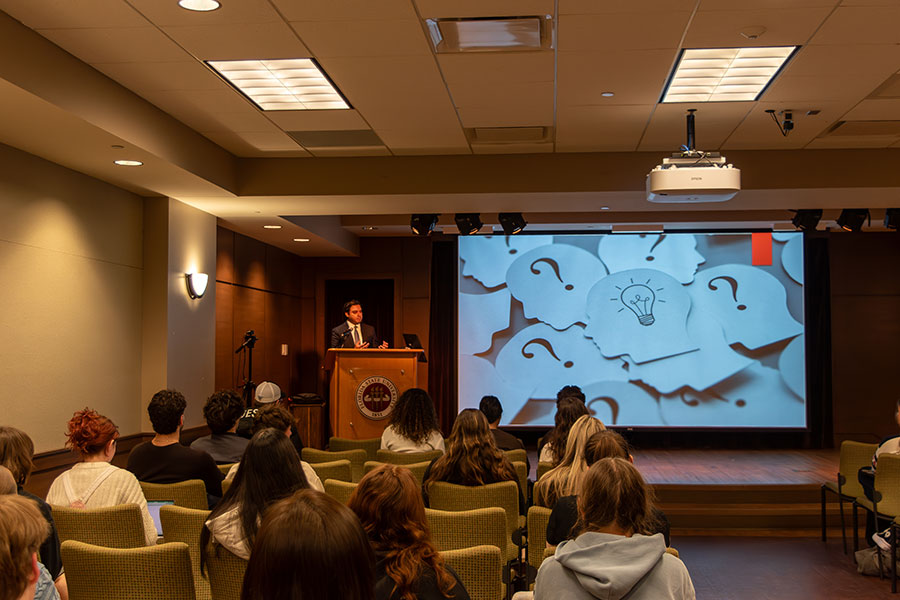
From journalism and film to digital storytelling, strategic communications and grassroots media, the conference included a range of perspectives on how tradition and innovation intersect in everyday practice.
“This annual conference brings together students, scholars and practitioners to create space for deeper understanding and long-term collaboration,” said Steve McDowell, FSU’s assistant provost for International Initiatives and interim dean of The Graduate School. “The conversations that happen here continue to shape research, teaching and global engagement at FSU, in South Asia, and beyond.”
McDowell, who also serves as the John H. Phipps Professor of Communication in the College of Communication and Information, planned the conference alongside a committee led by Vaibhav Diwanji, a research assistant professor at the University of Kansas and two-time alumnus of FSU’s School of Communication. Originally from India, Diwanji said he’s proud to continue offering a global platform that brings together scholars, practitioners and policymakers without any registration cost.
“As an FSU alumnus, it’s especially meaningful to see this space continue to grow as a platform for dialogue, collaboration and new ways of thinking about media and culture in South Asia” he said.
The conference was also hosted in collaboration with the College of Social Sciences and Public Policy’s Ruth K. Shepard Broad International Lecture Series and the Center for Global Engagement’s Engage Your World Speaker Series.
The conference also included a photo exhibit and book launch highlighting the work of Kids of Kathmandu, a nonprofit organization connected to Bhushan Dahal, a doctoral candidate from Nepal pursuing a Ph.D. in Educational Leadership and Policy at the FSU Anne Spencer Daves College of Education, Health, and Human Sciences. The photos and book document a decade of the organization’s work building schools in Nepal in partnership with local community groups.
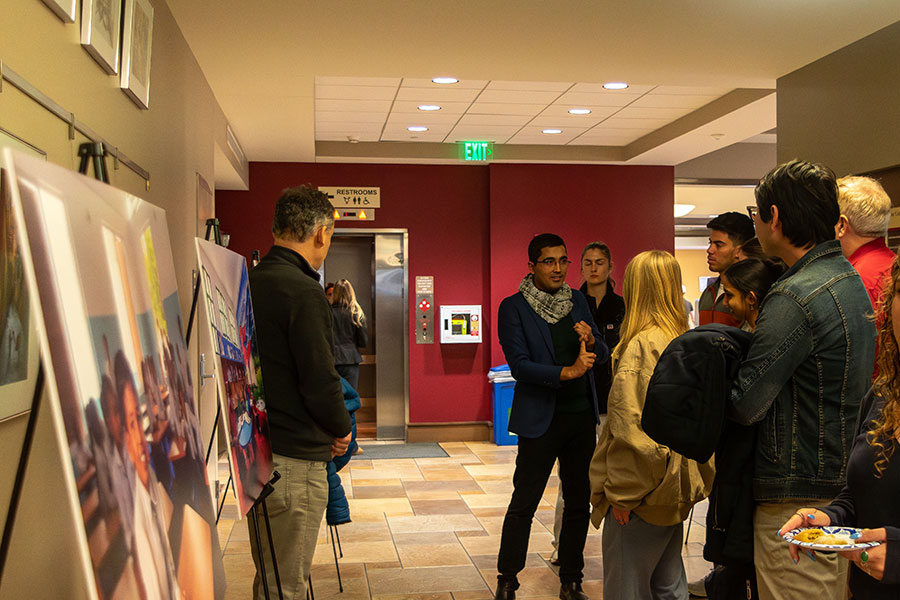
The annual event aims to spark new ideas, conversations and scholarly collaborations through engaging presentations, discussions and shared experiences to celebrate and amplify underrepresented voices in South Asia, and beyond. The modern nations of South Asia include Afghanistan, Bangladesh, Bhutan, India, Maldives, Nepal, Pakistan and Sri Lanka.
To learn more about the College of Communication and Information at FSU, visit cci.fsu.edu. For more information about the SAMCS Conference, visit comm.cci.fsu.edu/faculty-research/south-asian-media-studies/south-asian-media-studies-conference/.