



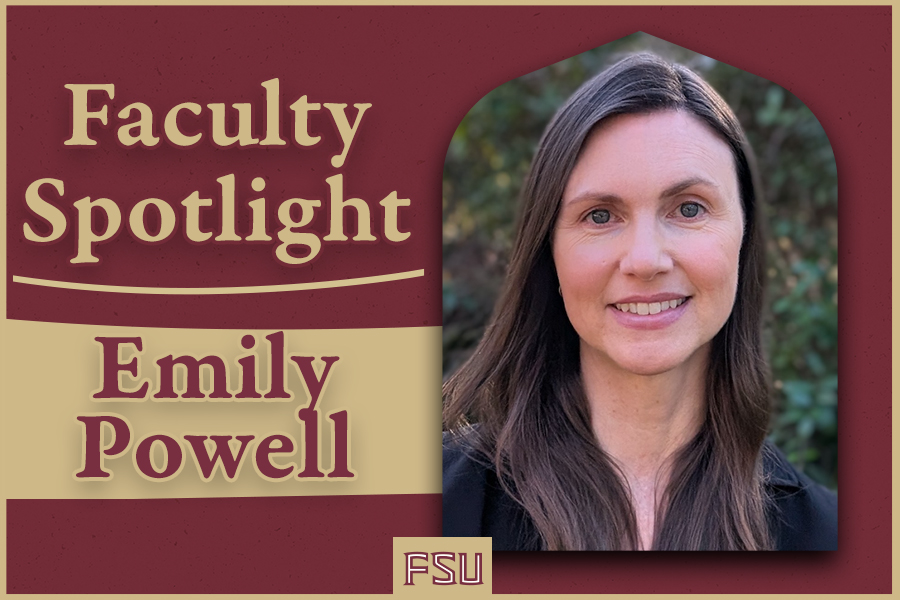
As Floridians brace for the peak of hurricane season in September, terms like El Niño and long-range forecasts can feel distant and abstract. For Emily Powell, Florida state climatologist at the Florida Climate Center within Florida State University, those forecasts are essential tools for helping communities understand weather risks and make key decisions before disaster strikes.
Powell’s work sits at the intersection of climatology, emergency management and urban planning, three critical areas in a hurricane-prone state like Florida. Her interdisciplinary approach helps small and at-risk communities build practical roadmaps for resilience.
As state climatologist for the State of Florida, Powell turns complex historical weather trends into clear, decision-ready data for policy and planning. The Florida Climate Center provides official weather data, climate research and public outreach for the state of Florida.
“The mission of the Florida Climate Center is to monitor, disseminate and analyze weather and climate data and information to serve the people in the state,” Powell said.
The center’s work includes three main components: data services; research and applications that support weather-sensitive sectors such as agriculture, forestry, water resources, emergency management, public health and urban planning; and outreach and education. The center translates information to the public by highlighting climate events, informing media and maintaining an active social media presence.
Serving the public is what first drew Powell to studying weather patterns and continues to drive her research.
“I wanted to take my interest in weather and society and my academic training and apply it to understand how weather and climate affect people and their environment,” Powell said. “For instance, how weather and climate impact people’s lifestyles, public health and safety, a community’s economic solvency, how it affects our food supplies, and how it drives ecosystem change.”
Powell’s expertise comprises the drivers of seasonal hurricane forecasts, including the El Niño/La Niña cycle. Known as the El Niño Southern Oscillation, or ENSO, the pattern affects temperature, precipitation, storm tracks and hurricane activity around the world.
According to Powell, the heating and cooling of the equatorial Pacific Ocean influence atmospheric pressure patterns and the position and strength of the jet stream. That helps shape where storms track and can lead to persistent temperature and precipitation anomalies, including in Florida.
El Niño is drawing heightened attention because 2026 is predicted by the National Oceanic and Atmospheric Administration (NOAA) to reach record levels, with sea surface temperatures potentially rising nearly 3 degrees Celsius by winter. Powell cautions that increased risk does not guarantee a specific outcome.
“One thing to keep in mind is that a strong or very strong El Niño event does not guarantee we’ll see stronger or bigger impacts from the event,” Powell cautioned. “It does, however, considerably increase the odds, or the likelihood that those expected impacts will occur.”
Powell said Floridians could see the effects most strongly from late fall through winter and into spring. Wetter, cooler than normal weather is expected during colder months, along with an increased risk of severe weather, including tornadoes and more frequent rain, as El Niño favors a more active southern storm track.
Besides providing crucial climate intel, another focus area is community resilience. Powell has worked with Florida Sea Grant and the University of Florida Institute for Food and Agricultural Sciences to provide technical assistance and resilience support to low-capacity communities across the state, reinforcing the demand for credible, science-based information.
“We’ve seen demand for weather and climate services go up over the years, and we try to communicate information and contextualize that information, particularly from national and local authorities, to ensure people have the right information and can make sense of that information so they can make well-informed decisions,” Powell said.
“We’ve seen demand for weather and climate services go up over the years, and we try to communicate information and contextualize that information, particularly from national and local authorities, to ensure people have the right information and can make sense of that information so they can make well-informed decisions.”
– Emily Powell, state climatologist for the State of Florida
Powell’s community impact also extends to Florida’s Community Collaborative Rain, Hail & Snow Network, where she serves as the state’s co-coordinator. The grassroots precipitation-measurement network relies on volunteers who take daily measurements in their own backyards.
Powell embraces the citizen science approach because it provides real-time data that can support precipitation forecasts, flash-flood monitoring, extreme storm tracking, drought monitoring and more.
“It’s great to have a network of citizen scientists who are passionate about the weather,” Powell added. “We get to work with people around the state who do this on their free time, and the data that they produce is freely available almost immediately to anyone who wants to look at it.”
Even with NOAA forecasting a below-normal hurricane season, Powell said one storm can still exploit a window of opportunity and cause widespread damage. She encourages the public to prepare early, regardless of the quieter forecast.
“People always need to be aware of the risk and stay prepared, no matter what the overall trend says,” Powell advised.
And while weather conditions change daily, Powell’s mission remains constant: helping Floridians understand the risks ahead of time so that communities can make informed decisions before the next challenge arrives.