



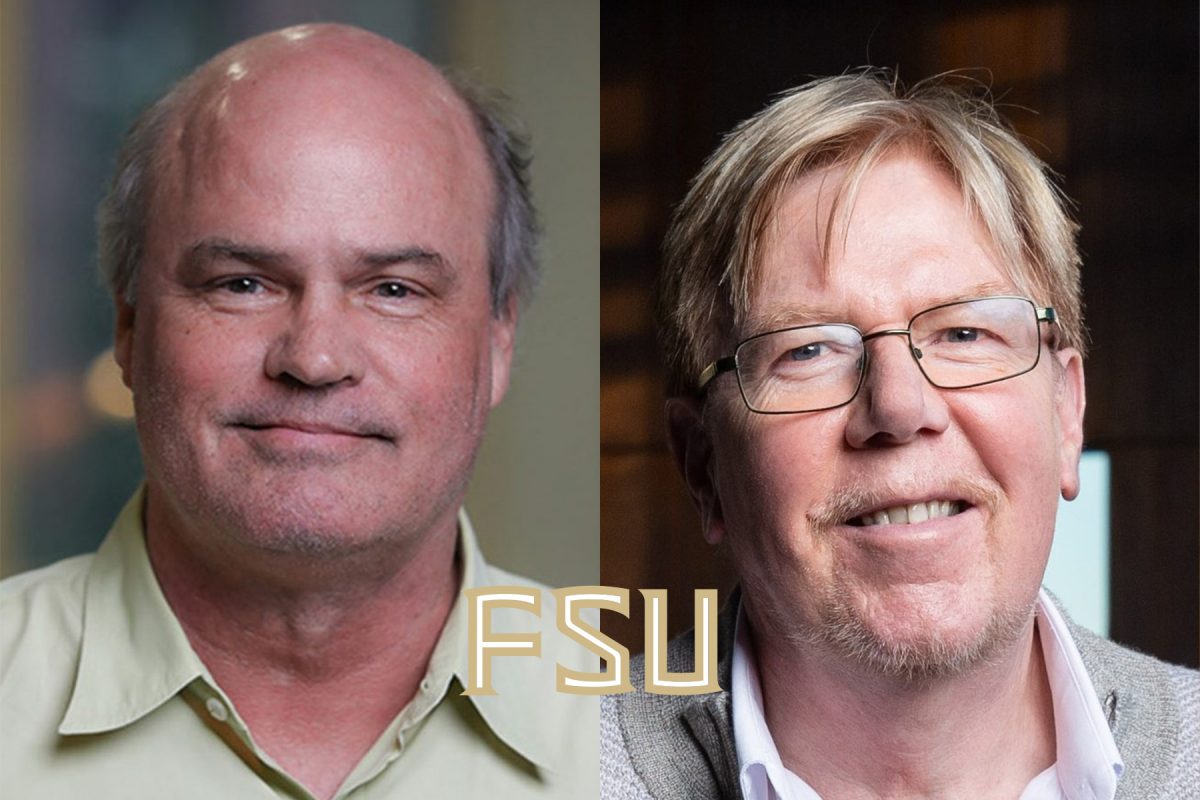
Two Florida State University faculty members have been named among the world’s most highly cited researchers, a distinction that places them in the top 1% of scientists and scholars whose work has had the greatest influence in their fields.
Department of Psychology Professor Thomas Joiner and Department of Geography Professor A. Stewart Fotheringham were recognized by the analytics company Clarivate for producing multiple highly cited papers over the past decade, reflecting exceptional research impact in suicide prevention and spatial data analytics.
The designation identifies researchers whose publications rank in the top 1% by citations for their field and year in the Web of Science Core Collection and is awarded to roughly one in every 1,000 researchers worldwide.
Together, Joiner and Fotheringham exemplify FSU’s growing research profile, with scholarship that informs clinical practice, public policy and real-world decision making.
Thomas Joiner
Robert O. Lawton Distinguished Professor of Psychology
Director, FSU Psychology Lab
Joiner’s research spans psychology, neurobiology and clinical treatment, with an emphasis on understanding the mechanisms that lead to suicide and identifying effective strategies for prevention across diverse populations, including military personnel and first responders. He is known for developing and empirically testing the interpersonal theory of suicide, a foundational framework in contemporary suicide research.
At FSU, Joiner directs the Laboratory for the Study and Prevention of Suicide-Related Conditions and Behaviors, where faculty, clinicians and students collaborate on research examining suicidal ideation and diagnoses and safety around access to lethal means. His work at the university also extends to large-scale, federally funded initiatives, including his role as co-director of the Department of Defense-funded Military Suicide Research Consortium, which is focused on reducing suicide risk among service members.
Joiner’s influence extends beyond academia into clinical practice and public health policy, reshaping how suicide risk is understood and addressed.
“Thomas is not only a prolific researcher, but his work has profoundly influenced practicing clinicians,” said Brad Schmidt, chair of the Department of Psychology in the College of Arts & Sciences. “We are doing a better job assessing for suicide and bringing it out of the shadows because of the bright light that Thomas has shone on it with his theory and empirical work over his career. His research, including the many students he has inspired, has substantially influenced the way we think about, assess and treat suicide risk.”
A. Stewart Fotheringham
Krafft Professor of Spatial Data Science, Department of Geography
Director, Spatial Data Science Center
A. Stewart Fotheringham is a member of the National Academy of Sciences and a pioneer in the application of advanced statistical and computational methods to spatial data. His research focuses on how location and spatial relationships shape social, economic and health-related outcomes, with widely recognized contributions to spatial interaction modeling and local statistical analysis.
At FSU, Fotheringham is the founding director of the Spatial Data Science Center in the College of Social Sciences and Public Policy, where he leads interdisciplinary research that applies spatial analytics to real-world challenges including public health, crime patterns, migration, urban development and the environment.
“Stewart has transformed how researchers and policymakers understand the role of location in complex societal issues,” said Anne Chin, chair of the Department of Geography. “His innovative work in spatial data analytics has not only advanced our tools, but it has also provided practical insights into a range of issues that include public health, urban development and social patterns. Through his research and mentorship, Stewart has shaped a generation of scholars and left a lasting mark on the field of geography. The advances and approaches that he has championed will continue to lead us into meeting the global challenges of tomorrow.”