

Key Points
- FSU chemist Bryan Kudisch and collaborators developed a light-powered reaction that transforms difficult-to-repurpose sulfonamides into useful chemical building blocks, potentially giving previously discarded compounds a second chance in drug discovery.
- Using advanced laser spectroscopy, Kudisch’s team observed how the reaction unfolds at extremely short timescales, providing insight that could help chemists develop new light-driven methods for reshaping molecules and creating future medicines.
Throughout the drug development process, which can take a decade or more, tens of thousands of chemical compounds are produced that never go on to become medicines. A Florida State University researcher is part of a team that has discovered a new way to give some of these “dead-ends” a second chance at becoming the foundation for tomorrow’s blockbuster drugs.
Assistant Professor of Chemistry and Biochemistry Bryan Kudisch and his collaborators have developed a light-powered chemical reaction that can transform a difficult-to-repurpose class of compounds known as sulfonamides into useful building blocks for future drug discoveries. Their research was published in Journal of the American Chemical Society.
“Dr. Kudisch is a molecular spectroscopist who develops and applies laser-based techniques to measure extraordinary short time processes, particularly chemically important processes induced by light,” said Wei Yang, Department of Chemistry and Biochemistry chair. “His work demonstrates both exceptional technical ability and extraordinary insight to some of the most fundamental and complex processes in chemistry. This publication addressed an important problem closely related to drug discovery, which is a major strategic area of the FSU ASPIRE initiative.”
A target for repurposing compounds
Sulfonamides — which appear in and give rise to the name “sulfa drugs” — are one of the most important molecular substructures in medicinal chemistry. These synthetic medications were some of the first widely used antibiotics almost 90 years ago. Today, they’re still used and found in a variety of medicines that treat diseases and symptoms including Type 2 diabetes, high blood pressure, HIV and melanoma.
Despite their usefulness in many pharmaceuticals, sulfonamides are difficult to repurpose because they are chemically inert. Chemists have developed recipes to interconvert many other functional groups that change the biological properties of a compound, but relatively few options are available to do this with sulfonamides — especially for the sulfur atom that lies at the center of these substructures. Removing this atom or replacing it with a new chemical group could allow researchers to create new versions of existing compounds while preserving their other useful features.
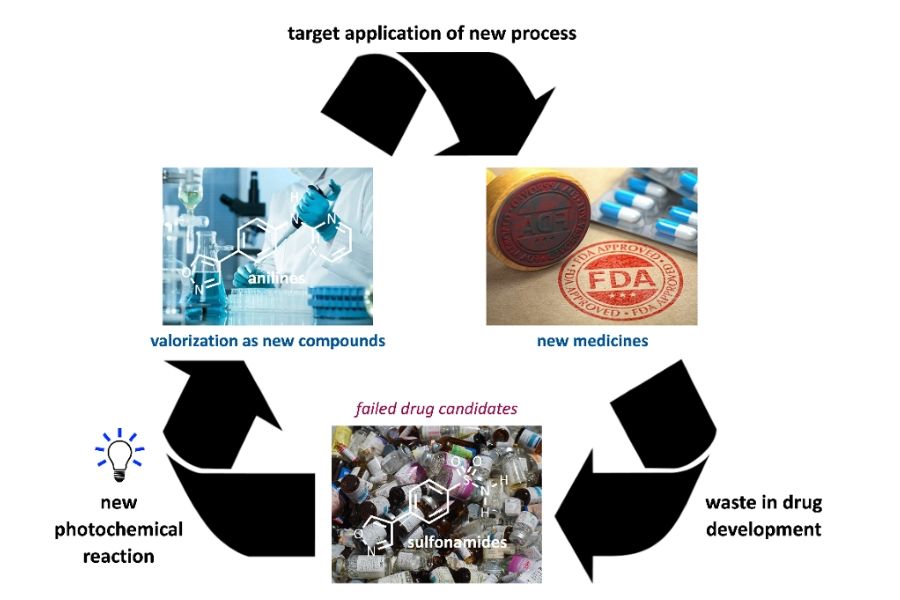
Kudisch and his collaborators addressed this challenge by using a photochemical reaction that converts sulfonamides into anilines, a different class of chemical compounds that serves as the foundation for some cancer-fighting medicines. By transforming part of the molecular structure, otherwise dead-end compounds once again become potential starting points for developing new medicines.
“This outcome was achieved through a chemical ‘surgery’ that uses light to excise a sulfur atom from a sulfonamide,” Kudisch said. “We’re optimistic these types of photochemical surgical tools could underpin a range of powerful processes for reshaping molecules that could advance the development of new medicines.”
How it works: Light transforming molecular structures
To better understand the molecular reaction during this excision, Kudisch used advanced laser spectroscopic methods to observe the reaction as it happened within a single picosecond — a millionth of a millionth of a second.
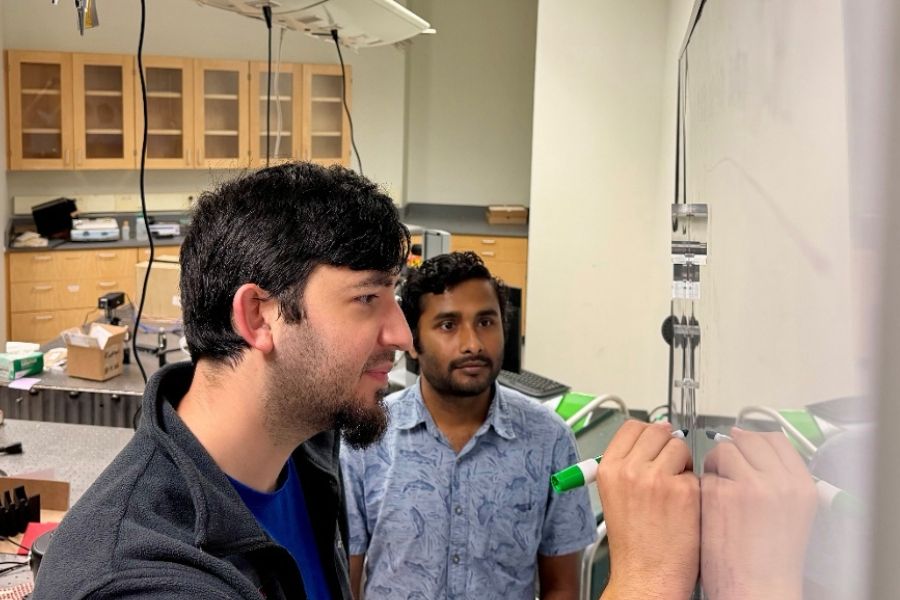
“We essentially spy on what the light is doing to sulfonamides,” Kudisch said. “Our research focuses on what photochemistry secrets are encoded in this transformation. We can track the molecules to understand how they transition into structures that eventually become the desired product or unwanted side product.”
Kudisch collaborated with assistant professors of chemistry Eric Nacsa and Elvira Sayfutyarova at Pennsylvania State University as well as pharmaceutical company GSK on the research. Kudisch’s group conducted experimental studies to investigate the reaction’s mechanism while Sayfutyarova completed computational studies explaining how the reaction occurs. Nasca’s group discovered and optimized the reaction, demonstrated its broad applications and conducted additional mechanistic studies. GSK helped show the potential application of the new reaction in drug discovery.
“Experimental contributions from the Kudisch Lab at FSU combined with computational work by the Sayfutyarova group at Penn State were critical for understanding the reaction’s mechanism,” Nacsa said. “We anticipate these results and ongoing collaborations with the Kudisch group will provide new fundamental insight into how light can transform molecular structures.”
Why it matters: A new tool for drug discovery
With structure-based drug design becoming more essential for efficient medicine development, this technique can play a key role in contributing to new drug discoveries when applied to different groups of molecules.
“We’re just scratching the surface in learning new ways to make, break and remodel molecules to make them do what we want them to do,” Kudisch said. “There are so many fascinating opportunities in modern chemistry as long as you have the breadth of experience to understand how other chemists talk about their research and the depth of expertise to spot the beautiful new questions that come about with every discovery.”
Kudisch’s work also supports FSU Health, an academic health system combining the expertise of hospitals, physicians, clinics, research, education and innovation to improve the health of our community.
To learn more about research conducted in the FSU Department of Chemistry and Biochemistry, visit chem.fsu.edu.