



Key Points
- The inaugural event brought together students from FSU’s College of Law and Herbert Wertheim College of Business to apply their legal, financial and technological skills.
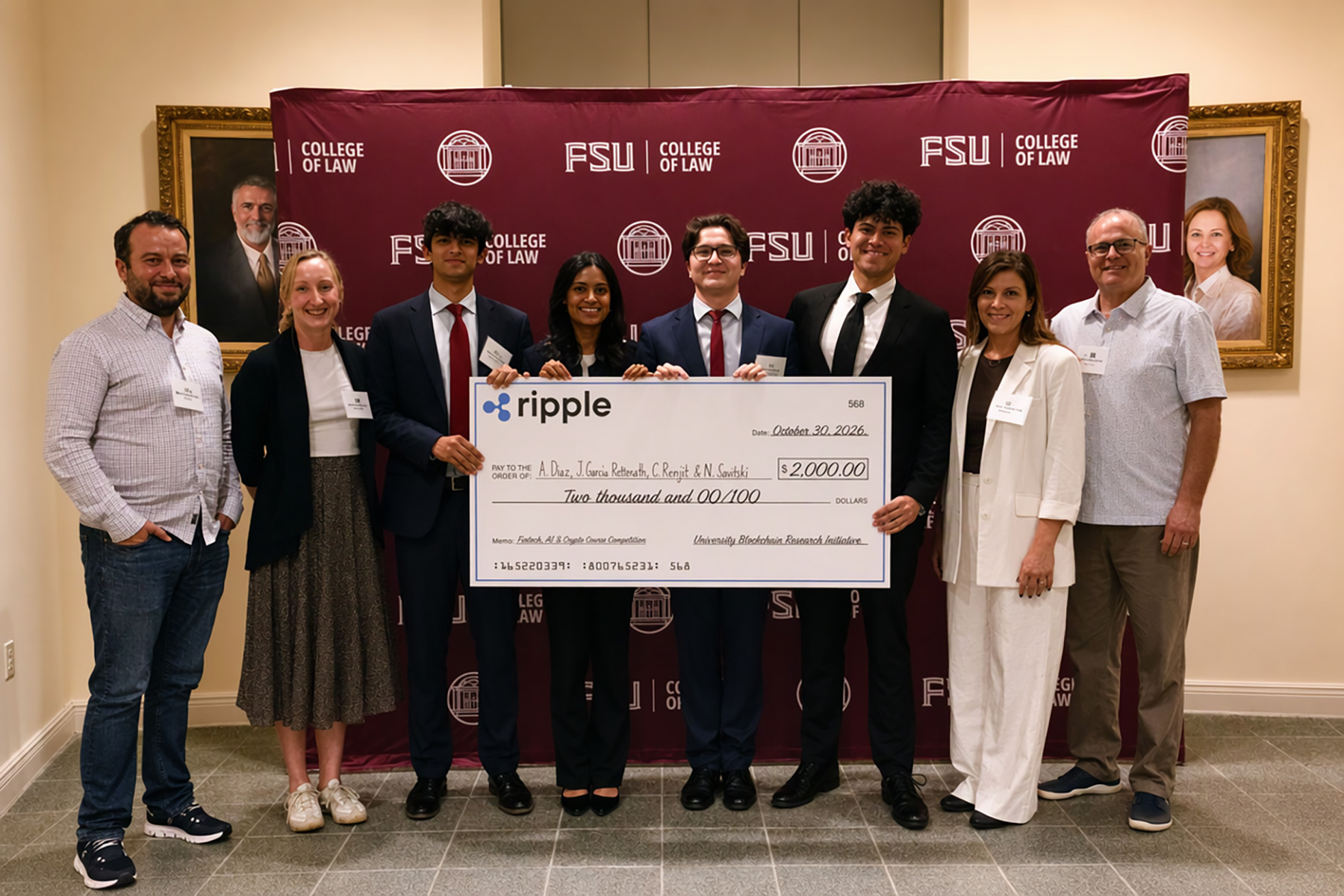
- A team of four students won the $2,000 grand prize after presenting their findings to a panel of industry and legal experts.
Armed with artificial intelligence tools, Florida State University law and business students investigated a simulated cryptocurrency fraud case, built legal arguments and presented their findings to industry experts during the university’s inaugural FinTech, AI, and Crypto Hackathon Competition.
The competition, held Oct. 30 at the College of Law’s D’Alemberte Rotunda, brought together students from FSU’s College of Law and Herbert Wertheim College of Business to test their legal, financial and technological skills.
Law students Joaquin Garcia Retterath and Nazar Savitski, both second-year students, and finance students Christine Renjit and Alvaro Diaz won first place and a $2,000 grand prize.
“By combining legal analysis, financial expertise and hands-on experience with emerging technologies, this initiative reflects FSU Law’s commitment to preparing students for rapidly evolving fields,” said Erin O’Hara O’Connor, dean of the FSU College of Law. “Collaborating with the Herbert Wertheim College of Business gave our students a unique opportunity to tackle complex, real-world problems while building their analytical strengths.”
The competition was hosted by the College of Law’s Institute of Law, Technology & Innovation, part of the Stoops Center for Law and Business, in partnership with the Herbert Wertheim College of Business. It marked the culmination of a new interdisciplinary course co-taught by Yuliya Guseva, the Kevin Wood and Mary Jo Peed Professor of Law, and Chungsang “Tom” Lam, assistant lecturer at the Herbert Wertheim College of Business. The course introduces students to financial technology, artificial intelligence, cryptocurrency and the regulations governing those fields.
During the competition, students used AI tools to analyze financial filings from the U.S. Securities and Exchange Commission’s EDGAR database as part of a simulated investigation involving a fictional company called Tombase. They evaluated potential violations of federal securities law, drafted legal complaints and presented their arguments over three rounds to judges acting as senior law firm partners. Teams refined their cases based on feedback from the judges.
“To shape the future of tech regulation, legal professionals must first understand how the technology works,” Guseva said. “Having law students lead this investigation challenges them to explore not only what AI can do, but also the legal, ethical and regulatory boundaries that must govern its use.”
Lam said the competition gave students practical experience applying emerging technology to complex financial and legal questions.
“This experience pushed students beyond classroom theory and required them to demonstrate how advanced tech tools are applied in corporate practice,” he said. “It is no longer enough to know what AI is. Future industry leaders must know how to leverage AI to solve complex financial cases.”
The judging panel included Deborah McCrimmon, vice president and deputy general counsel at Ripple; Brian Spahn (’14), senior director of regulatory compliance at Ripple; Lee Schneider, general counsel at Ava Labs; Justin Gunnell, partner at Sher Tremonte LLP; and Lilya Tessler, partner at Sidley Austin LLP. In addition to evaluating the teams, judges offered feedback based on their experience in law, technology and corporate regulation.
“Having national leaders travel to Tallahassee to mentor our students is an extraordinary opportunity,” Guseva said. “It offers our students direct insight into where technology is taking the legal and financial sectors.”
The course and competition received support from Ripple’s University Blockchain Research Initiative, which promotes academic research and education related to blockchain technology.