



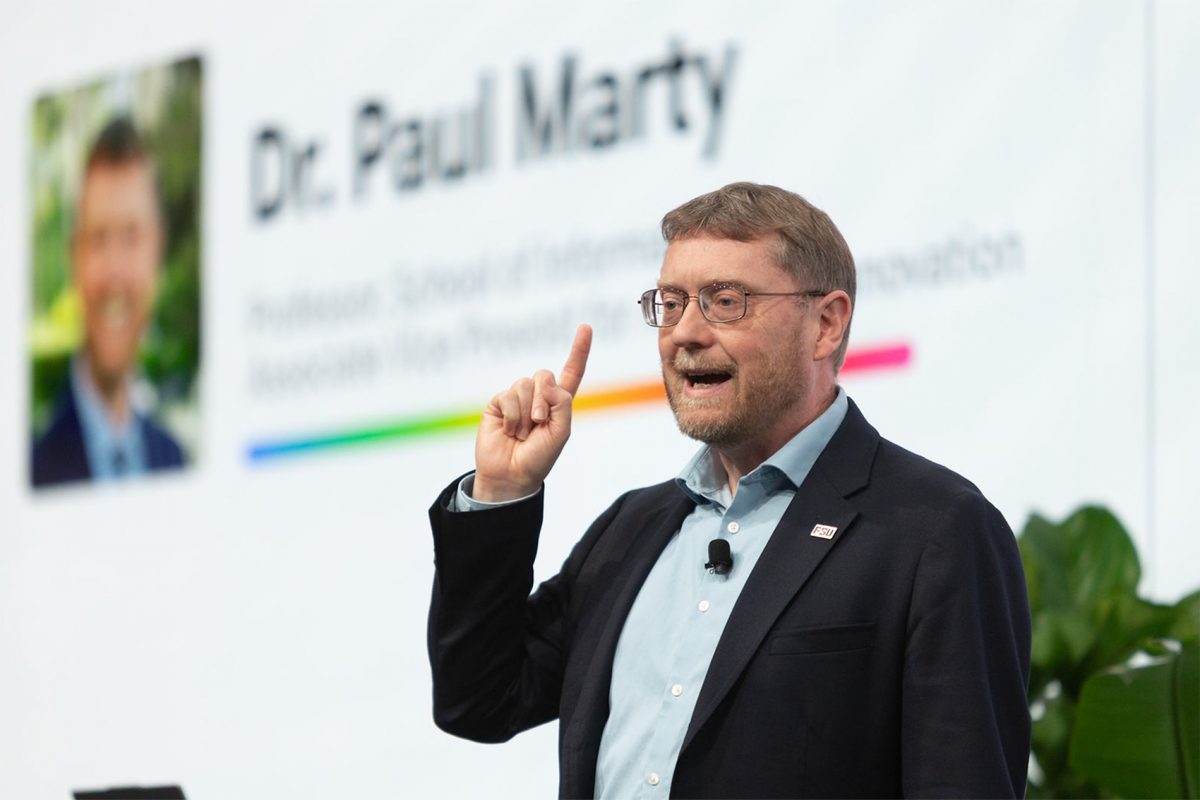
Florida State University brought its approach to artificial intelligence in teaching and learning to national higher education conversations this summer, including back-to-back gatherings at Google’s North American headquarters in New York City.
Paul Marty, professor in the School of Information within the College of Communication and Information and associate vice provost for Academic Innovation, represented FSU at Google’s gatherings as well as leadership workshops with the Association of Public and Land-grant Universities (APLU).
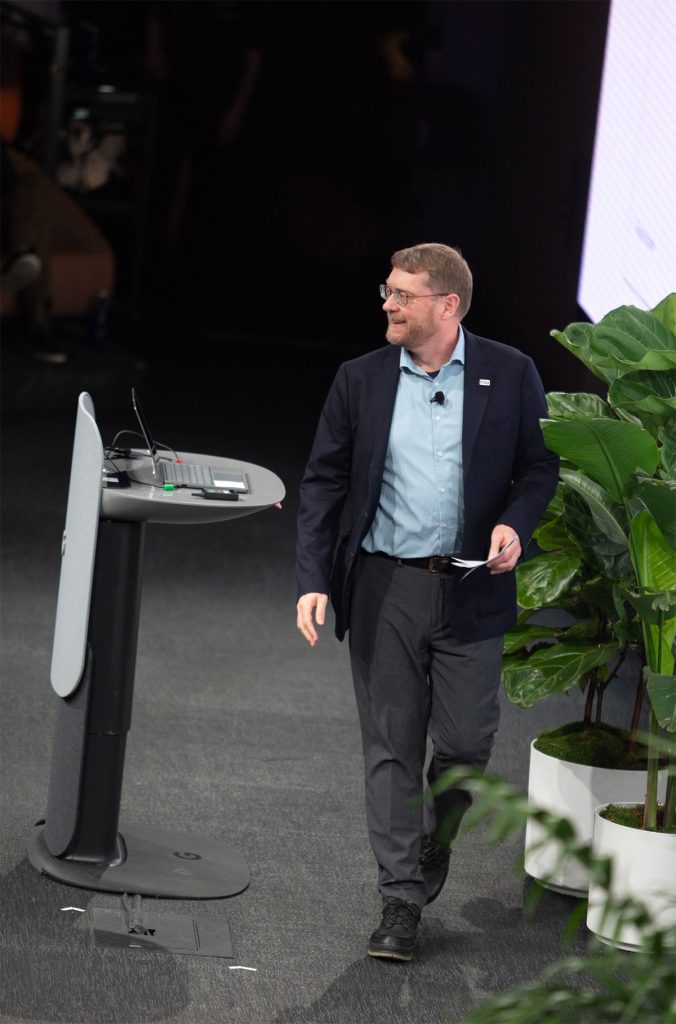
“When other public universities look at what FSU is accomplishing — from our data-driven campus culture to our deeply engaged faculty, staff and students — they see a path forward,” Marty said. “We are proving that a top public research university can lead the nation in adopting disruptive innovations while keeping student learning and the public good at the center of everything we do.”
FSU is part of Google’s AI for Education Accelerator program and a Gemini for Education partner. The accelerator provides students and educators with AI tools designed to support productivity, personalized learning and prepare students for a technology-driven workforce.
Students can use Gemini for Education to support inquiry-based learning, brainstorm projects and explore complex concepts in a university-managed environment.
Marty spent a week at Google’s facility at St. John’s Terminal headquarters, participating in two AI gatherings focused on Gemini and the future of higher education: the Google GSV Higher Ed Leader Fellowship and the Google Higher Ed Leader Series Conference.
Marty is a member of the 2026 cohort of Google GSV Higher Ed Leader Fellows, a group of 30 academic leaders selected from across North America. The fellows meet monthly to examine how AI is reshaping postsecondary education and met recently in New York for a two-day summit.
“We may be there ostensibly to talk about AI in higher education, but what we’re really talking about is the future of higher education,” said Marty. “Generative AI is prompting us to really buckle down and answer core questions about the value proposition of higher ed — for example, how can we move away from transactional relationships and reposition higher education as a public good where students engage in meaningful, transformative learning experiences.”
Following the fellowship, Marty attended Google’s annual Higher Ed Leader Series Conference, which brings together university presidents, provosts and chancellors to discuss AI integration and higher education strategy.
During the Higher Ed Leader Series, Google showcased a feature video about how Florida State University faculty and students are integrating Gemini Notebook (formerly NotebookLM) into coursework. Filmed on FSU’s Tallahassee campus, it features Chief Information Officer Jonathan Fozard and examples of AI use across disciplines.
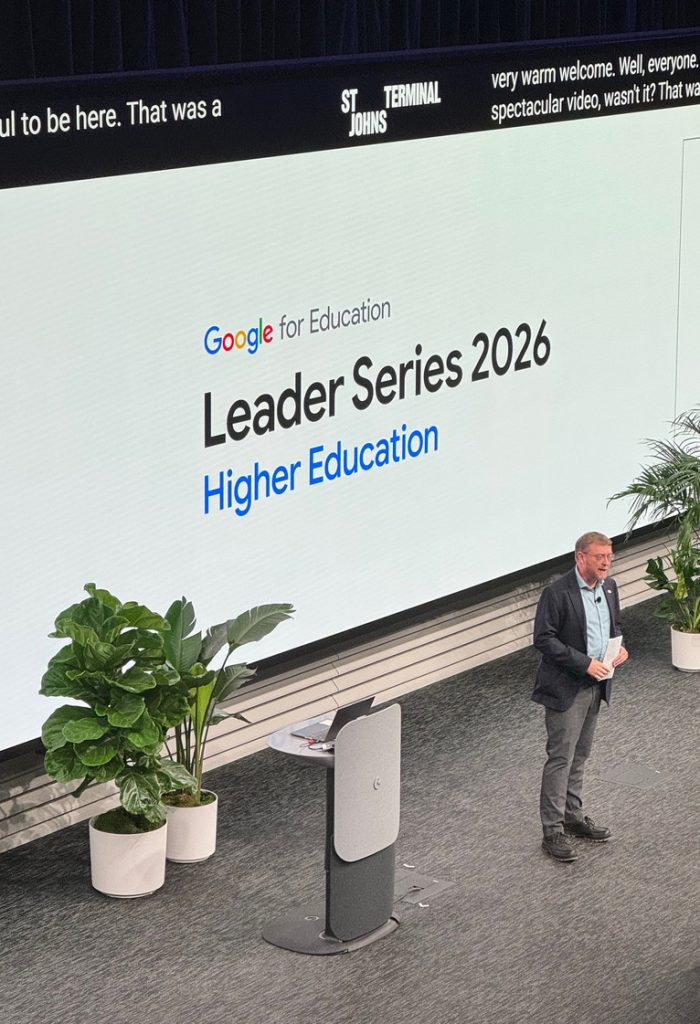
During the conference, Marty demonstrated an FSU classroom notebook for higher education leaders, featuring a custom thermodynamics notebook created by Ralm Ricarte, an assistant professor of chemical engineering in the FAMU-FSU College of Engineering. Ricarte built the notebook with lecture notes, course materials and problem sets from his Introduction to Thermodynamics course, giving students an AI study tool grounded in materials from the class.
“When it comes to AI in education, it’s important to remember that the person who does the work does the learning,” Marty noted. “If all a student does is copy and paste, they aren’t learning. But when used properly, these tools can act like an extremely well-read digital assistant available 24/7. As educators, we can show students how to harness that capability ethically to become better learners.”
Gemini Notebook restricts its answers strictly to user-uploaded sources, providing precise citations for every response. Students can use course materials to create study guides, practice quizzes, video overviews and audio overviews. FSU faculty and academic support staff have found that these kinds of interactive learning tools help boost classroom participation.
FSU’s Academic Center for Excellence (ACE) Learning Studio also hosts regular workshops that teach students how to use AI tools responsibly and effectively as part of their learning.
“FSU’s Academic Center for Excellence (ACE) helps students integrate innovative AI tools into their weekly study and test preparation routines while maintaining responsible and ethical learning strategies,” said ACE Director Holly Hunt. “Through our ‘Using AI Tools to Help You Study’ workshops and Gemini Notebook drop-in hours, Study Skills Tutors and STEM Student Specialists aid students in synthesizing course content, building personalized study guides and organizing class materials. Our goal is to teach students how to incorporate foundational learning strategies with FSU-supported AI tools to reach academic success.”
For more information about AI at FSU, visit ai.fsu.edu. To learn more about the services available for FSU faculty, staff and students, visit its.fsu.edu.