



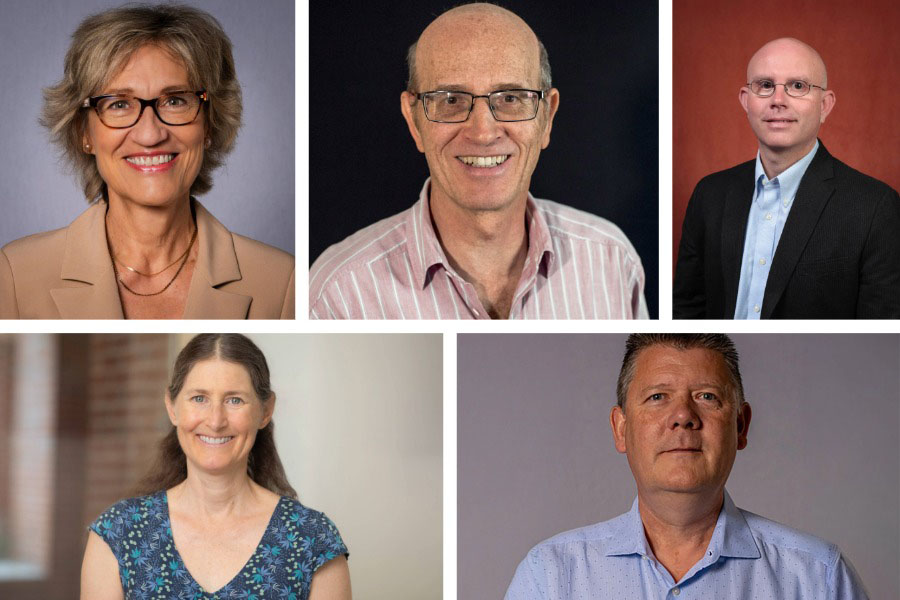
Five outstanding Florida State University faculty members have been named fellows of the American Association for the Advancement of Science, one of the world’s largest organizations dedicated to the promotion of science, engineering and innovation.
This year’s class includes FSU professors Stephen Hill, Michael Roper, Theo Siegrist, Nora Underwood and Dragana Popović.
“We are incredibly proud to see our faculty recognized as AAAS Fellows,” said Vice President for Research Stacey S. Patterson. “This distinction speaks to their commitment to discovery and to the meaningful impact of their work across the scientific community. Their accomplishments strengthen Florida State University and inspire our students, peers and partners.”
Election as an AAAS fellow is a lifetime honor and a tradition dating back to 1874. Past distinguished honorees from across the nation include Ellen Ochoa, Steven Chu, Grace Hopper, Alan Alda, Mae Jemison and Ayanna Howard.
For more on this year’s FSU Honorees:
Stephen Hill
Department of Physics/National High Magnetic Field Laboratory
Hill is a professor of physics and chief scientist for quantum information science at the National MagLab. His research primarily explores the properties of molecular nanomagnets, focusing on quantum information processing and the behavior of single-molecule magnets. He is a Fellow of the American Physical Society and was recently selected to serve on the National Academies of Sciences, Engineering, and Medicine Committee on Identifying Opportunities at the Interface of Chemistry and Quantum Information Science.
Michael Roper
Department of Chemistry and Biochemistry
Roper is a professor of chemistry and biochemistry at Florida State. His work sits at the intersection of chemistry and biology, specifically focusing on microfluidics and bioanalysis. His team develops “lab-on-a-chip” technologies to study cell clusters in the pancreas known as islets of Langerhans. By measuring how these cell clusters secrete hormones like insulin in real-time, his research provides critical insights into the underlying mechanisms of diabetes. Roper has received multiple awards for his research and teaching including the American Chemical Society Young Investigator Award in Separation Science, Developing Scholar Award from FSU, and the Mid-Career Award from the American Electrophoresis Society.
Theo Siegrist
FAMU-FSU College of Engineering/National High Magnetic Field Laboratory
Siegrist, a professor of chemical and biomedical engineering, is a leading expert in materials science and crystallography. His research focuses on the structure-property relationships of complex materials, including organic semiconductors and superconductors. By understanding how atoms are arranged within a crystal, his work helps pave the way for the next generation of electronic devices and energy-efficient materials. Siegrist is a fellow of the American Physical Society. Prior to working at FSU, Siegrist served as a researcher at the famed Bell Laboratories.
Nora Underwood
Department of Biological Science
Underwood is a population biologist who investigates the ecology and evolution of plant-insect interactions and the relationship between climate and the timing of biological events. Her research examines topics such as how plant diversity influences insect damage on plants, and how temperature has influenced the timing of spring growth over decades and centuries. Her work helps us understand biodiversity, how ecosystems change, and the natural management of agricultural pests and pollinators. Underwood received the 2021-22 Distinguished Teacher Award from FSU and was named a U.S. Fulbright Scholar for the 2024-2025 year.
Dragana Popović
National High Magnetic Field Laboratory/Department of Physics
Popović is a condensed matter physicist known for her experimental studies on electronic transport and magnetic properties in disordered systems. She focuses on phenomena such as the metal-insulator transition, high-temperature superconductivity, and charge dynamics. Her research often involves cooling materials to temperatures near absolute zero to observe how electrons behave under extreme conditions. She was named a Fellow of the American Physical Society in 2012 and a Distinguished University Scholar in 2013. She is being honored for outstanding experimental contributions to the physics of strongly correlated electron systems, and especially for seminal work on out-of-equilibrium behavior of two-dimensional electronic systems near quantum phase transitions.
###