


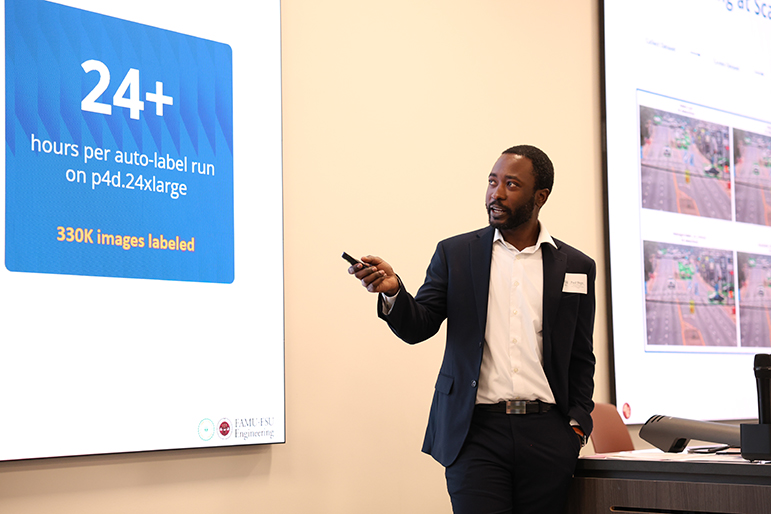
Florida State University researcher Paul Bupe is developing an interactive intersection safety system, a project for which he must analyze thousands of satellite images, fisheye camera photos and maps — more than 1.7 million unique objects each with its own metadata.
To handle all that data, he uses Amazon Web Services, or AWS.
Bupe earned seed funding for AWS through an internal FSU program last year and accessed the tools through a partnership with FSU Information Technology Services.
On Tuesday, he shared his experiences at the FSU-AWS Researcher Showcase and Awards, a celebration of research excellence and an opportunity for the FSU community to learn more about the high-powered research tools available through the partnership.
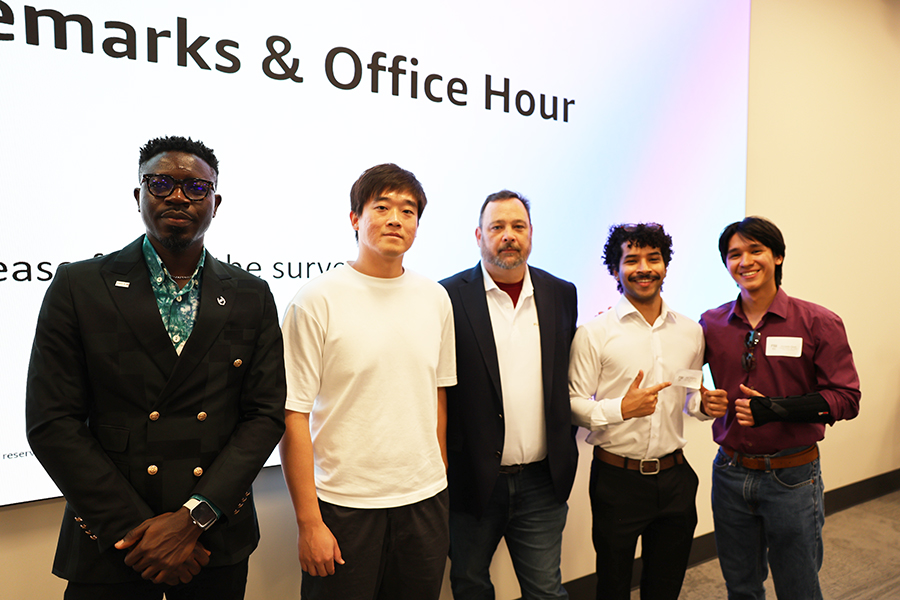
“Without AWS, we wouldn’t have been able to make this research happen,” said Bupe, who works with FAMU-FSU College of Engineering Associate Professor Moses Olugbenga on PREDISS, a Predictive Intersection Safety System project.
Bupe and Olugbenga used Amazon’s cloud computing tools for data storage, object detection, autolabeling and other tasks. Their goal is to improve safety at intersections by predicting collisions between vehicles and pedestrians with enough time to allow for interventions to stop a crash.
Through the partnership, they were able to access more computing power on their schedule to train their own models to handle millions of objects.
“In AI and machine learning, data is the most valuable thing,” Bupe said. “This gave us the capabilities that truly allowed for innovation.”
Other researchers from the Department of Industrial and Manufacturing Engineering and the Department of Computer Science who have used AWS in their work shared their experiences with fellow researchers at the event.
“Our goal as a technology provider and an industry partner is to help accelerate researchers’ work at a low cost,” said AWS Senior Leader Michael Curry. “As one of our presenters said, ‘I don’t need this to be a six-month project. I want it to be a six-day or six-week project.’ They’re trying to accelerate that time to science, and that is what this technology is helping to accomplish.”
Setting the stage for innovation
The showcase opened with remarks from FSU leadership, emphasizing the growing role of cloud computing in accelerating research and the university’s commitment to expanding access to advanced computational resources.
“This partnership is a powerful example of how Florida State is delivering on the strategic vision of President McCullough by investing in the technology infrastructure that drives cutting-edge research,” said Associate Vice President & Chief Information Officer Jonathan A. Fozard. “Removing traditional compute barriers and broadening access to secure cloud and AI tools allows our researchers and scholars to move faster, design transformative research and secure the large-scale grants that empower long-term impact.”
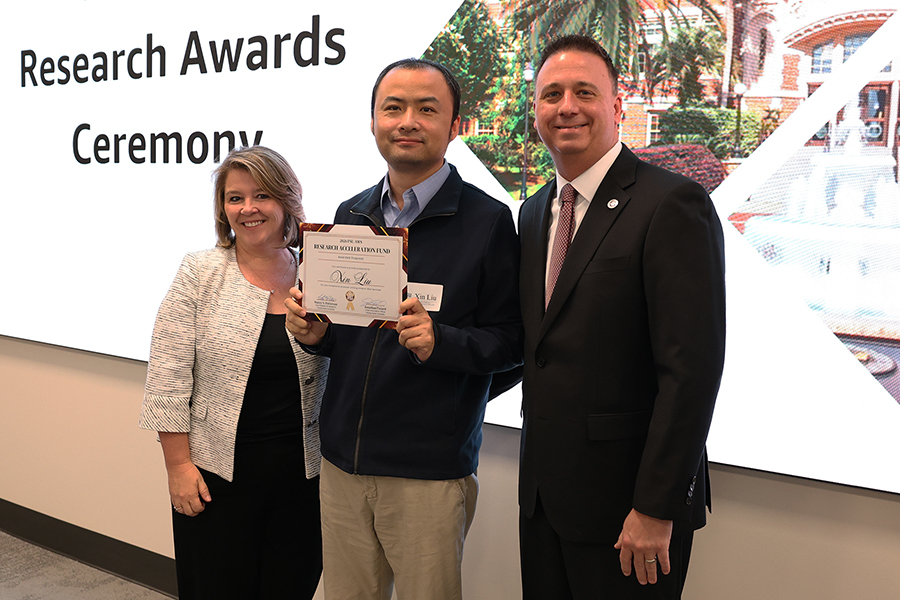
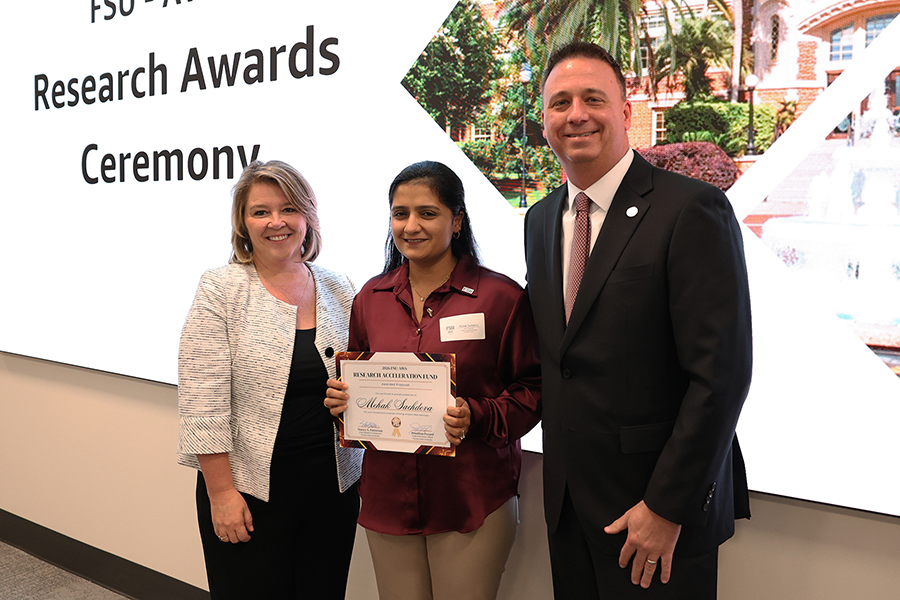
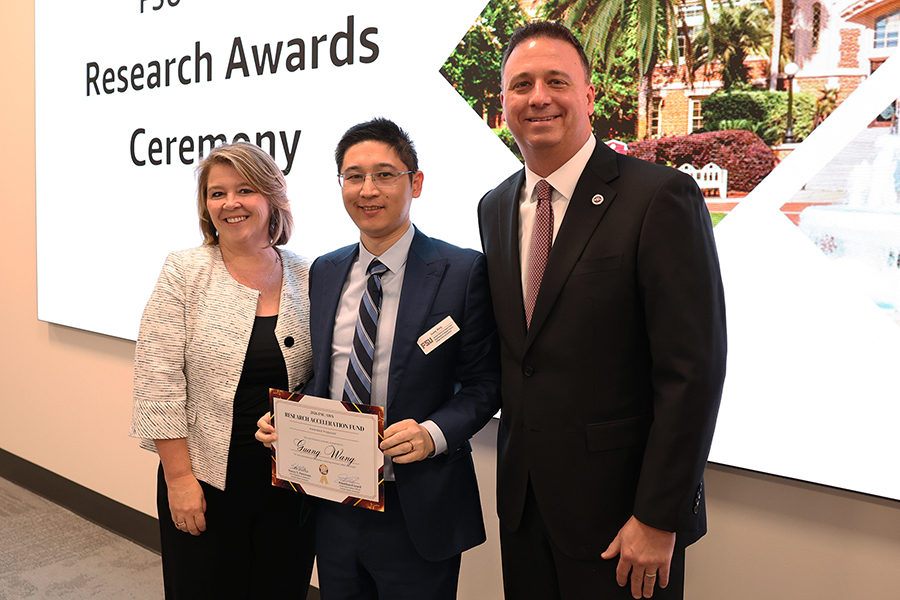
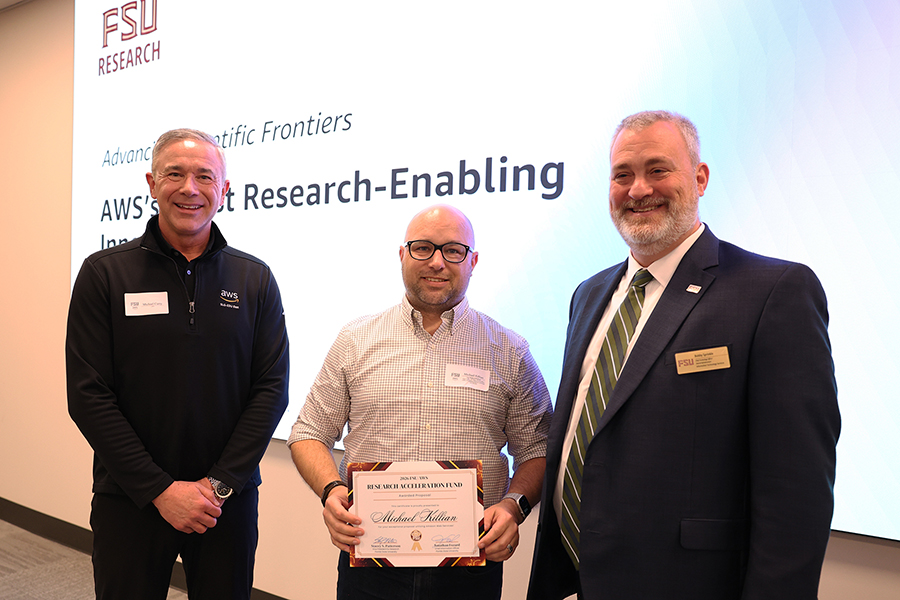
The FSU Office of Research and FSU Information Technology Services recognized 11 researchers from across campus as 2026 FSU/AWS Research Acceleration Fund Awardees for their exceptional creativity, impact and technical excellence in leveraging AWS cloud computing to advance scientific discovery. Winners came from departments across campus: social work; computer science; educational psychology and learning systems; geography; urban and regional planning; scientific computing; health, nutrition and food science; civil and environmental engineering; and communication science and disorders. Each received up to $20,000 in AWS credits.
“Modern research is increasingly data-intensive. Whether we are talking about quantum materials, generative AI or predictive safety systems, the lab is no longer just a physical space — it is a digital one,” said Vice President for Research Stacey Patterson.
Cloud computing tools help researchers turn those piles of information into impactful discoveries.
“This partnership demonstrates the art of the possible,” Patterson said. “Our goal is simple but ambitious: we want to provide FSU researchers with a world-class environment that accelerates discovery.”
Finding solutions with AWS
The event featured a look at the latest cloud computing tools AWS offers and a panel with an FSU staff member, doctoral student, and faculty researcher who are already using the technology to solve problems in their work.
ITS staff shared information about free cloud services training available for faculty and staff who want to start using AWS tools.
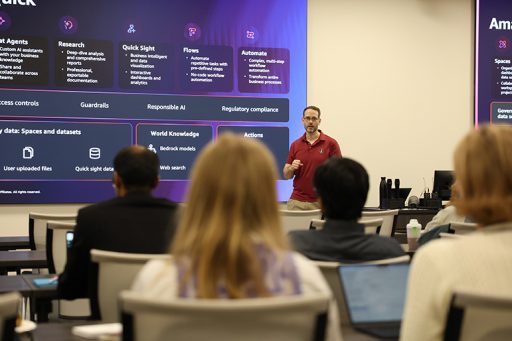
Gabriel Brackman, a solutions architect with AWS, highlighted new services and features to support high-performance computing, artificial intelligence and data-intensive research.
Curry led a panel discussion featuring participants from the FSU-AWS Researcher Accelerator pilot program. Alex Townsend, a scientific applications specialist with ITS, Teja Potu, a doctoral student and research assistant at the National High Magnetic Field Laboratory, and Balu Bhasuran, a faculty researcher in the College of Communication and Information, shared how they collaborate and manage workflows using AWS tools.
Bhasuran builds prediction models to improve patient outcomes, which requires handling sensitive data such as electronic health records and clinical notes. Any information that needs regulatory compliance, such as health records, can be difficult and expensive to handle in-house.
“Sharing our models and patient-based information extraction were problems for us, but working with AWS cloud, it seems that the problem is solved,” he said.
FSU AI Maker Challenge
The event concluded with presentations from winners of FSU’s AI Maker Challenge, a 48-hour development sprint that saw FSU students learning about artificial intelligence tools and using them to create new programs.
The winning team, Agentic Avengers, built a program to match researchers with funding opportunities based on their interests.
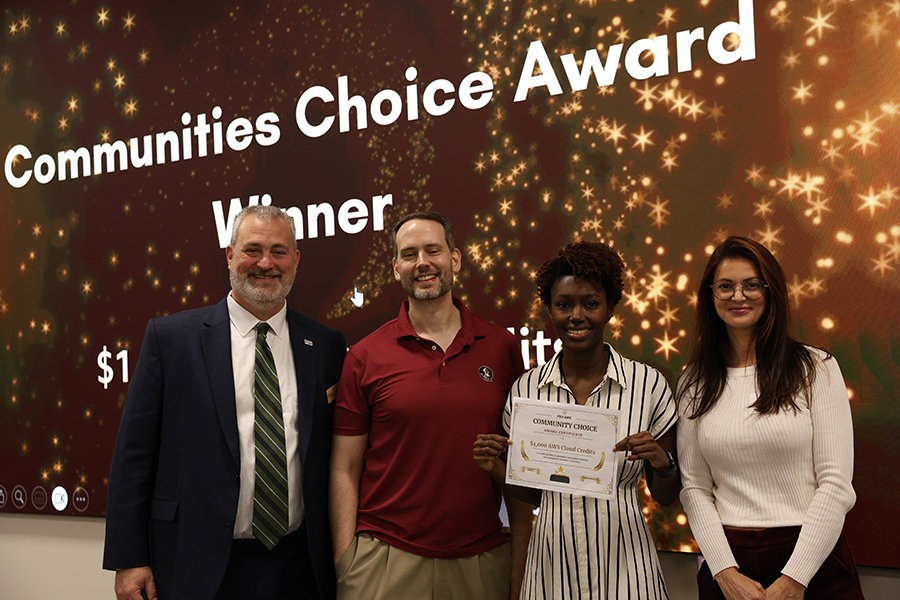
Alexis Gollman, a senior studying retail entrepreneurship at the Jim Moran College of Entrepreneurship, won the Communities Choice Award as voted on by event attendees for her personal health information app, Numa.
Her own experiences inspired her to create a platform that would better account for a user’s unique health history. She came to the challenge with no coding experience and built the program with AI tools.
“Despite never having written a single line of code, the ‘agentic’ capabilities of AI and the guidance of my mentors made it possible for me to build this platform,” she said. “I’m incredibly honored that the community saw the passion behind my pitch. It is surreal to be able to use these AI tools as a student to bring a deeply personal vision to life. Being perhaps the only non-computer science or engineering student in the challenge, I’m grateful to FSU for opening doors to information and technology that I otherwise wouldn’t have accessed.”
Students in the challenge used some of the same cloud computing tools that FSU faculty are using in their research.
“It’s exciting to see what students can do when they get their hands on just a little bit of training and these tools,” said AWS Account Manager Marisa Halluska. “These are very accessible, and that’s what these students are proving.”
Visit the FSU Information Technology Services website for more information about cloud computing training and see the Research Development website to learn more about the FSU-AWS Acceleration Fund.