



Key Points
- Florida State University researchers developed a method to make advanced radiation detection materials more durable.
- The breakthrough opens the door to safer medical scans and cheaper space-grade radiation detectors.
Florida State University researchers have developed a method to make a class of materials more robust and potentially easier to manufacture for advanced radiation detection devices, including those used in medical imaging and radiation therapy as well as space technologies.
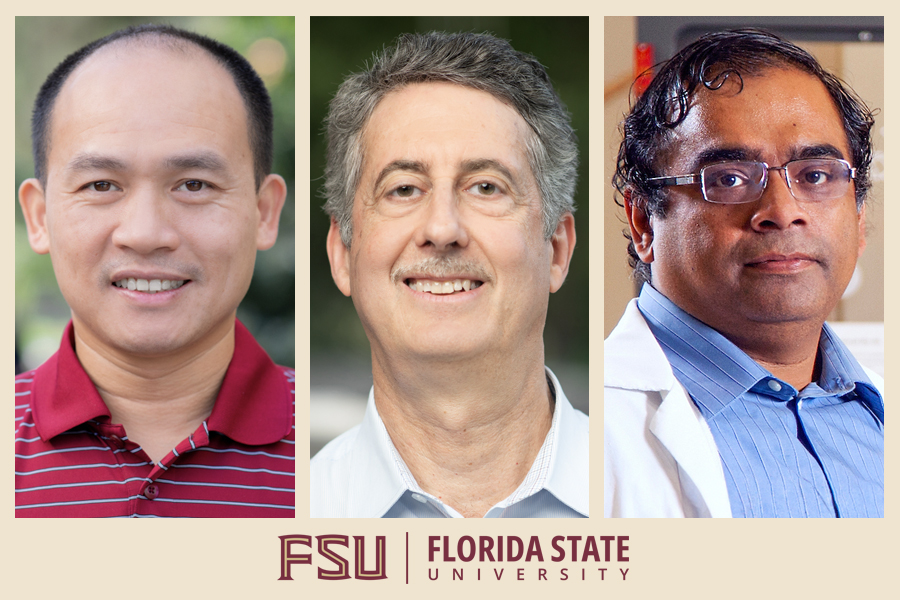
Nearly a decade ago, FSU Professor of Chemistry and Biochemistry Biwu Ma and his lab pioneered research on low-dimensional organic metal halide hybrids, or OMHHs, and have since expanded the materials’ structures, properties and applications across a range of technologies and industries. Now, in collaboration with Robert O. Lawton Professor of Chemistry and Biochemistry Joseph Schlenoff and 3M Distinguished Professor of Chemical and Biochemical Engineering Subramanian Ramakrishnan, the team has developed a novel technique to stabilize the materials and expand their potential for practical applications. Their joint findings were published this month in Advanced Functional Materials.
“Using a technique called crosslinking, we’re shaping OMHHs before locking them into a more durable form,” Ma said. “A familiar example is rubber in car tires. Crosslinking transforms rubber into a much more robust and durable material capable of withstanding demanding conditions. Our chemistry is different, but the fundamental idea is similar: Connecting individual molecular components into a network can dramatically improve the physical robustness and stability of a material.”
Promising materials made more practical
OMHHs combine organic and inorganic components whose optical, electrical and magnetic properties can be tailored through molecular design. Researchers design these materials for technologies ranging from LEDs and solar cells to direct X-ray detectors and scintillators — materials that convert X-rays or other high-energy radiation into visible light.
Despite their versatility, some OMHHs can be challenging to process into stable, durable structures because they can dissolve or degrade when exposed to water or common polar solvents. In this study, Ma and his team developed zero-dimensional, or 0D, OMHHs in which individual metal-halide units are isolated from each other, and they incorporated reactive groups directly into the organic components of the 0D OMHH. After the material was solution-processed into a film, exposure to UV light connected these components into a covalent network that locked the isolated metal-halide units in place.
This provided an important combination of processability before crosslinking and robusticity afterward, while retaining the material’s useful properties. In testing, un-crosslinked films dissolved quickly in water and other solvents while crosslinked films remained intact after prolonged exposure.
“A material may perform well as a small laboratory sample, but real-world applications require reproducible manufacturing, long-term stability, integration with other components, and competitive cost and performance,” Ma said. “Our research is increasingly focused not only on discovering materials with better properties, but also on how those materials can be processed, stabilized, manufactured, and integrated into practical devices. The crosslinking strategy is an important step in that direction because it addresses processability and stability at the molecular-design level.”
Building upon interdisciplinary research
Graduate students played important roles in advancing the research. Tunde Shonde, a former doctoral student in Ma’s group and current scientist at BASF, the world’s largest chemical producer, conducted initial experiments that established the feasibility of crosslinking 0D OMHHs. Sahel Moslemi, a third-year doctoral student and the study’s first author, further developed the materials and led much of the experimental work and characterization.
Ramakrishnan and his team at the FAMU-FSU College of Engineering collaborate with Ma’s group to explore how OMHHs could eventually be processed using 3D-printing techniques. Supported by NASA’s In-Space Manufacturing program, the broader effort combines molecularly engineered materials with additive manufacturing to develop functional devices, including radiation detectors with customized structures and technologies that could eventually be manufactured in space.
Schlenoff and his lab, whose research includes polymer and surface chemistry, examined how crosslinking changed the properties of thin OMHH films, including how their surfaces interacted with water. Their analysis helped the team better understand how crosslinking affected the films’ durability.
“Developing new materials can change what technologies are possible,” Ma said. “The crosslinkable materials we created provide an interesting foundation for future developments. We envision applying our research to create printable formulations of OMHHs that can be deposited into customized patterns and 3D structures and then crosslinked to stabilize those structures. This could allow us to manufacture radiation detectors and other technologies with customized or complex structures for specific applications.”
Expanding OMHH research impact
This work is also supported by Inspiring the Generation of New Ideas and Translational Excellence at FSU, or IGNITE-FSU, through a Strategic Translational Research Program project aimed at moving OMHH technologies from fundamental materials discoveries toward practical applications and commercialization.
“Dr. Ma’s work has helped an important area of materials chemistry change direction, reaching neighboring fields of science and engineering,” said Wei Yang, Department of Chemistry and Biochemistry chair. “Our department has a deeply rooted tradition of fostering collaborative and interdisciplinary research, which provides a strong vehicle for producing high-impact science and extending research into new frontiers. Following this culture, Dr. Ma has developed a strong core research program and established collaborations across different disciplines to extend the impact and reach of his research.”
To learn more about research conducted in the Department of Chemistry and Biochemistry, visit chem.fsu.edu. For more on research in the FAMU-FSU College of Engineering, visit eng.famu.fsu.edu.