




A Florida State University computational scientist is paving the way for future medical breakthroughs by developing mathematical models and simulations to predict the behavior of a unique drug-delivery method, which aims to deploy treatments directly to targeted sites in the body.
Florida State University Associate Professor of Scientific Computing Bryan Quaife is part of a multi-institutional team of engineers, mathematicians and computational scientists who are conducting foundational research essential to the design of a drug-delivery system that could reduce medication side effects while increasing treatment efficacy. Their research expands upon work proposing the use of magnetic particles to guide cell-like drug carriers toward a specific target, like a tumor.
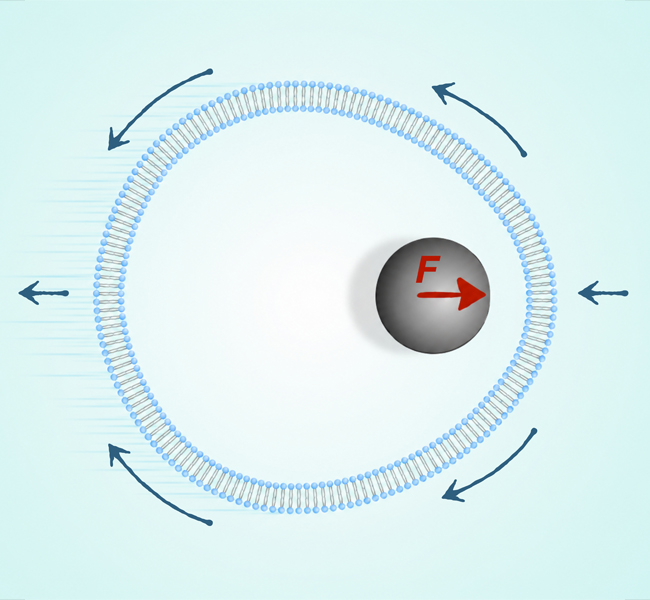
This work, which was published in Physical Review Letters, the American Physical Society’s flagship publication, reveals how tiny particles moving inside microscopic drug carriers can gradually stress and eventually rupture the enclosing membrane. These findings could help engineers design smarter drug delivery systems to protect therapeutic cargo during transport and release it on demand at the desired location.
“Our paper shows how mathematical models and computations can reveal processes that are difficult to measure experimentally,” Quaife said. “We needed to study how magnetic force affects the cell-like membrane that transports a drug to a specific site to prevent it from rupturing inside the body. Many measurements — such as the membrane’s ‘floppiness’ and the amount of magnetic force its internal walls can withstand — can’t be taken at such a small scale. I filled in the gaps by developing computer code that predicts experimental outcomes.”
How it works
Medicines like pills and injections circulate throughout the body, which can dilute potency and lead to side effects. For example, chemotherapy drugs are administered to kill cancer cells, but they often also cause severe exhaustion, nausea, hair loss, increased infection risk and anemia. By transporting drugs directly to the site they’re meant to treat, researchers aim to enhance drug efficiency while alleviating unnecessary strain on the body and potentially reducing debilitating side effects.
Researchers first encapsulate a magnetic particle and cargo, such as a drug molecule, within an artificial cell membrane called a vesicle. In this scenario, the vesicle is like a car, the magnetic particle provides the driving force, and the cargo are the passengers being transported. A magnet field outside the body guides the vesicle to the desired location where a specific stimulus, such as light, deteriorates the vesicle membrane and releases the drug into the body. The technique can be used in cases that benefit from pinpoint accuracy in treatment, such as delivering a drug directly to a tumor or to sites of localized inflammation.
“Beyond biochemical targeting, one targeted drug delivery approach is like a truck pulling a trailer, using a particle or microrobot to move the drug where they want it to go,” said On Shun Pak, a co-author on this work and associate professor of mechanical engineering and applied mathematics at Santa Clara University, California. “However, attaching and manipulating cargo can be challenging at the microscale. We instead employ a microparticle encapsulated within a drug carrier to generate propulsion from the inside, rather than towing it from the outside.”
This magnet-driven method was first explored last year in the journal Nanoscale by a research team including Pak, Yuan-Nan Young, professor of mathematical sciences at the New Jersey Institute of Technology, and Jie Feng, assistant professor of mechanical science and engineering at the University of Illinois Urbana-Champaign. Many aspects of the drug delivery system they conceptualized were too small for scientific instruments to measure without destroying the experiment. Young, who led this subsequent research, connected with Quaife to explore the underlying mechanisms using customized, sophisticated computer codes.
“The particle-driven vesicle configuration is so unique and challenging that it’s impossible to simulate using common commercial software,” Young said. “In the beginning stages, Bryan’s expertise helped us identify magnetic-driven drug delivery as something that’s actually possible. After the code was implemented, we did more analytic calculations to determine how the process can work without rupturing the membrane entirely.”
Why it matters
In addition to medicine, this research could eventually lead to new forms of environmental remediation. By swapping a drug for another type of active agent, the vesicle system could potentially be used to neutralize contaminants in water systems or clean up oil spills, especially in areas that are difficult to reach by traditional means.
“This is highly collaborative work at the intersection of fluid dynamics, soft matter and biophysics,” Quaife said. “Experiments informed decisions we made while developing the code, but when we discovered new things through computation and modeling, we relayed that back to the experimentalists. This allowed us to have a full-circle loop among the experiments, analysis, modeling and computation.”
Additional co-authors on this National Science Foundation-funded work include Hervé Nganguia, associate professor of mathematics at Towson University and Howard Stone, the Neil A. Omenn ’68 University Professor of Mechanical and Aerospace Engineering at Princeton University.
Visit the FSU Department of Scientific Computing website to learn more about the department’s research.