



In the air people breathe, the water on the Earth, the stars in the sky and more, atoms are the building blocks that make up the universe. Understanding the structure of the atomic nucleus is crucial for research with implications for astrophysics and in applications such as medical imaging and data storage.
A new study conducted by Department of Physics researchers using the John D. Fox Superconducting Linear Accelerator Laboratory at Florida State University examined titanium-50 nuclei and showed that a long‑standing explanation for where magnetism in atomic nuclei comes from does not fully work for titanium‑50. The research, which was published in Physical Review Letters, suggests that scientists may need to rethink how they explain nuclear magnetism.
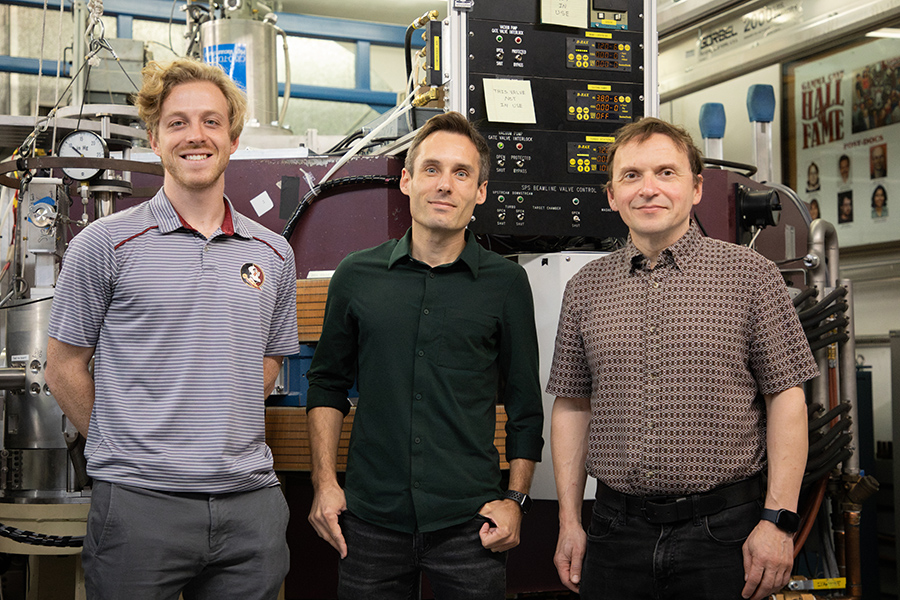
“What current models propose is that magnetic strength is largely generated by spin-flip excitations, that means when flipping proton or neutron spins from up to down between so-called spin-orbit partner orbitals,” said Associate Professor Mark Spieker, a co-author on the multi-institution study. “For the first time, we showed that this type of spin-flip cannot be the only mechanism that generates nuclear magnetism.”
How it works
Current nuclear models treat protons and neutrons as individual particles that can occupy fixed energy levels. A spin-flip occurs when these particles change the orientation of their spin as they jump between levels, generating magnetic strength in the process. For many years, scientists believed that this spin-flip mechanism was mainly responsible for magnetic strengths, or signals, in atomic nuclei. Advanced computer modeling also predicted this behavior.
The FSU experiments showed something unexpected: nuclear excited states that clearly showed this neutron spin-flip structure were not the ones producing the strongest magnetic signals. In other words, having more of this neutron “spin‑flip” structure did not automatically mean a stronger magnetic effect.
What they did
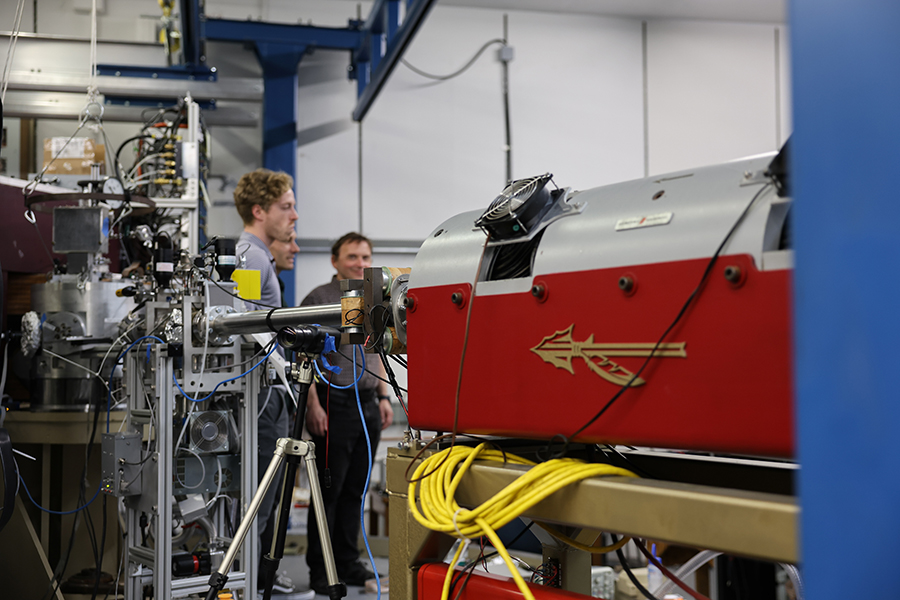
The researchers conducted a neutron-transfer experiment at the John D. Fox Superconducting Linear Accelerator Laboratory, using the facility’s Tandem Van de Graaff Accelerator to direct a deuteron — a nucleus made of a proton and a neutron — beam at a thin foil of titanium-49. During the reaction, the neutron from the beam was transferred to titanium-49, producing titanium-50 and leaving a residual proton.
Scientists used the Super-Enge Split-Pole Spectrograph at the Fox Lab to measure the different angles at which the proton was emitted in the reaction, allowing them to analyze how the neutron was transferred to titanium-49.
“You could say that the deuteron beam hits the titanium-49, transfers a neutron, and in this process kicks it up a set of stairs. Depending on the nucleus, that set of stairs looks very different,” Spieker said. “With the spectrograph, we can measure how high the different steps are. How high we get up the set of stairs depends on the excitation energy that we give to the nucleus.”
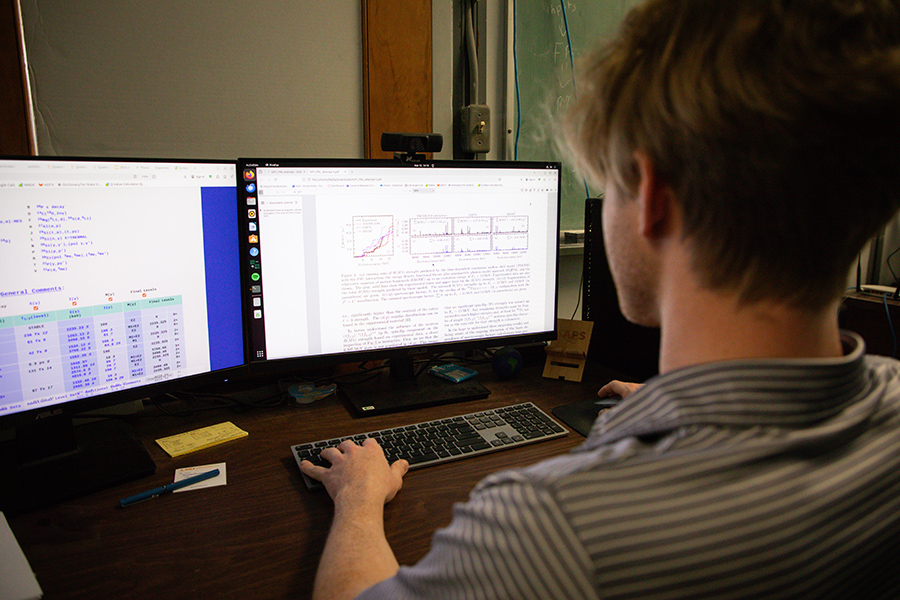
They combined their results with previously published electron- and proton-scattering data and with data from new photon-scattering experiments conducted at collaborating universities. By combining all these approaches, they were able to closely examine how neutrons flip their spin and how much those flips contribute to the nucleus’s overall magnetic behavior.
The researchers saw that the magnetic signal observed in their experiments was not of the same strength as models predicted — a sign that something else must be contributing to the magnetic signals they measured for titanium-50.
“Without combining all these data sets, the story cannot be stitched together cleanly,” said Bryan Kelly, a graduate student at FSU and study co-author. “Seeing the other magnetic excitations, that the other probes are sensitive to, allowed us to conclude that the spin-flip mechanism between spin-orbit partners is not the sole factor of magnetic strength generation.”
Why it matters and future directions
The study’s results challenge long-standing assumptions about the magnetic behavior of nuclei. Improving scientific understanding of the structure of atomic nuclei will refine current models used across nuclear physics and astrophysics and will help to link these with models used in high-energy physics. Such combined efforts between different fields of physics lead to a better understanding of the building blocks of ordinary matter that shape our universe.
“Developing a better understanding of the universe is exciting and fascinating on its own, and as we learn more, we can possibly apply these new insights to all sorts of new ideas,” Spieker said. “All ordinary matter is made of atomic nuclei, so the more we understand these ‘building blocks’ of nature, the more possibilities we have for what we can use them for to benefit society and drive progress.”
In future studies, the researchers plan to examine what accounts for the unexplained magnetism in titanium-50.
“This research showed that we cannot rely on magnetic strength measurements alone to understand excited states of nuclei,” Kelly said. “Magnetic strength is spread out across several nuclear states and understanding why will require further investigations of the nucleus.”
Acknowledgements
Researchers from Florida State University, the Technical University of Darmstadt in Germany and the Triangle Universities Nuclear Laboratory in North Carolina at Duke University contributed to this study.
This research was supported by the U.S. National Science Foundation, the U.S. Department of Energy Office of Science, the German Research Foundation, the Institute of Atomic Physics in Romania, the Romanian Ministry of Research and the Romanian Government.