



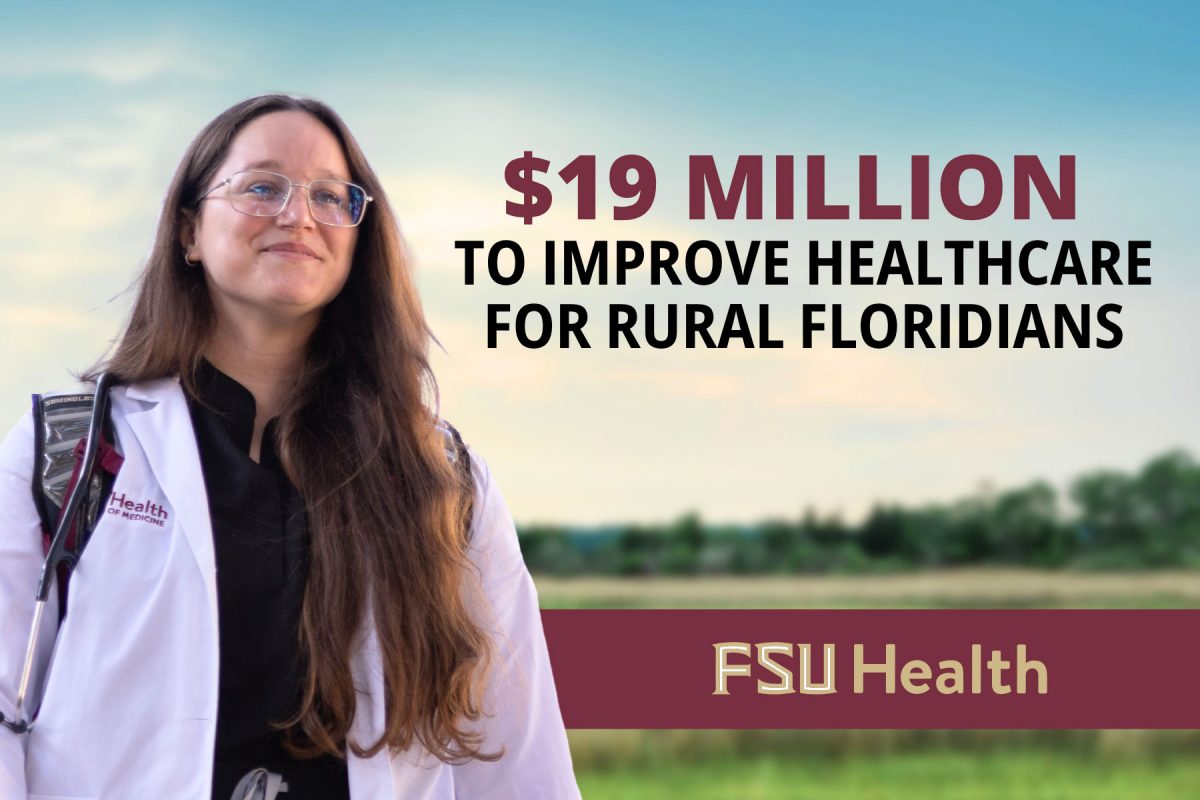
Florida State University has been awarded more than $19 million in grants through the Rural Health Transformation Program to launch six new projects and provide resources to improve the quality of life of individuals and communities throughout the state.
The five-year, $50 billion Rural Health Transformation Program, administered through the Centers for Medicare & Medicaid Services, was authorized by the One Big Beautiful Bill Act, signed into law in July 2025. The program is designed to help states transform and update healthcare delivery by improving access, quality and outcomes, thereby strengthening rural communities.
Florida received nearly $210 million this year and, through the Florida Agency for Health Care Administration (AHCA), awarded more than $180 million to fund proposals across the state.
“FSU received the largest award among Florida’s higher education institutions and was the state’s second-largest recipient overall,” said FSU President Richard McCullough. “This remarkable investment reflects the strength of our partnerships, the expertise of our faculty, and the important work being done through FSU Health and the College of Medicine to address healthcare challenges in communities across our state. These projects will expand access to care, strengthen local healthcare resources, and help deliver better outcomes for rural Floridians.”
The FSU College of Medicine was uniquely positioned to apply for these grants, as its community-based, collaborative structure is focused on developing partnerships with a special emphasis on providing care to medically underserved patients throughout Florida. Additionally, the Institute on Digital Health and Innovation, part of the FSU College of Nursing and led by Professor Lisa Hightow-Weidman, had a long track record of working with patients in a variety of locations by pioneering digital health tools and systems that could help improve individual health outcomes.
AHCA made collaboration a key requirement for the grant proposals, noting that partnerships should help expand reach, close gaps and make the most of shared resources.
“Community partnerships are essential to building a healthier Florida,” said Dr. Alma Littles, dean of the FSU College of Medicine and president of the Florida Medical Association. “We know how important it is to bring healthcare directly into the communities that need it most. I saw that firsthand as a family physician in rural Gadsden County in Florida’s Panhandle, and in my work across the state, I continue to see gaps in care that we can help close. Rural Floridians deserve access to high-quality, compassionate care. Meaningful progress will take collaboration, innovation and a sustained commitment to the people we serve.”
“FSU received the largest award among Florida’s higher education institutions and was the state’s second-largest recipient overall,” said FSU President Richard McCullough. “This remarkable investment reflects the strength of our partnerships, the expertise of our faculty, and the important work being done through FSU Health and the College of Medicine to address healthcare challenges in communities across our state.”
FSU’s grant proposals focus on key rural health challenges, including food insecurity, behavioral health, preventive care, workforce development and telehealth. To guide planning and funding, AHCA identified Florida’s rural counties, as defined by state law, and grouped them into four regions: Northwest, Northeast, Southwest and Southeast. The FSU College of Medicine, in collaboration with the FSU College of Nursing and IDHI, developed proposals for the Northwest and Southwest regions, where it already has established programs and partnerships.
The Northwest Region is a central hub for FSU Health, with a new FSU Health Hospital under construction in Panama City Beach and the FSU Health Research and Collaboration Building scheduled to open this fall on the Tallahassee Memorial HealthCare campus. In Southwest Florida, the college operates its Immokalee Health Education Site and sponsors residency and fellowship programs at several hospitals.
The two projects in Northwest Florida receiving funds will tackle food insecurity, preventive care and at-home care. Four new projects to launch in Southwest Florida will focus on workforce development, behavioral health, telehealth, food insecurity, preventive care and at-home care.
“These projects reflect exactly why FSU Health was created: to bring together research, clinical expertise and community partnerships to address some of the most pressing health challenges facing Floridians,” said FSU Vice President for Research Stacey S. Patterson. “By focusing on rural communities, we can help turn discovery and innovation into practical solutions that expand access, improve outcomes and strengthen the health of people across the state.”
Heather Flynn, professor and chair of the FSU College of Medicine’s Department of Behavioral Sciences and Social Medicine, played a key role in shepherding the grant process along and assembling teams of researchers, healthcare providers and community organizations to develop solid plans that will have a direct impact on the health and lives of Floridians. No stranger to collaborative work, Flynn is also director of the FSU Center for Behavioral Health Integration.
“One of the main things I learned through this process is that there are a lot of extremely dedicated, high-quality clinicians, staff and administrators in the rural areas that are doing everything they can to help the patients and families in their communities with a system that is not connected and one that needs a lot of improvement and innovation,” Flynn said. “You’ve got all of these different healthcare centers, sites, organizations — all doing the best they can with the resources they have — to provide access and quality care to patients and families — and they know they don’t have what they need to do that adequately. So, it’s very frustrating.
“I learned people are very eager to partner,” Flynn added. “Of course, there are always business considerations that may pose some barriers to those partnerships, but what I learned is people are willing to look past that and work together to fill those gaps in rural areas.”
Flynn said the work must move quickly: Sept. 30 is the federal deadline for demonstrating significant progress in launching the projects.
“We could not make this happen without the support of the university as well as the faculty and staff who are working diligently to ensure we meet this deadline and begin to make a positive impact on the health of people across the state,” she said.