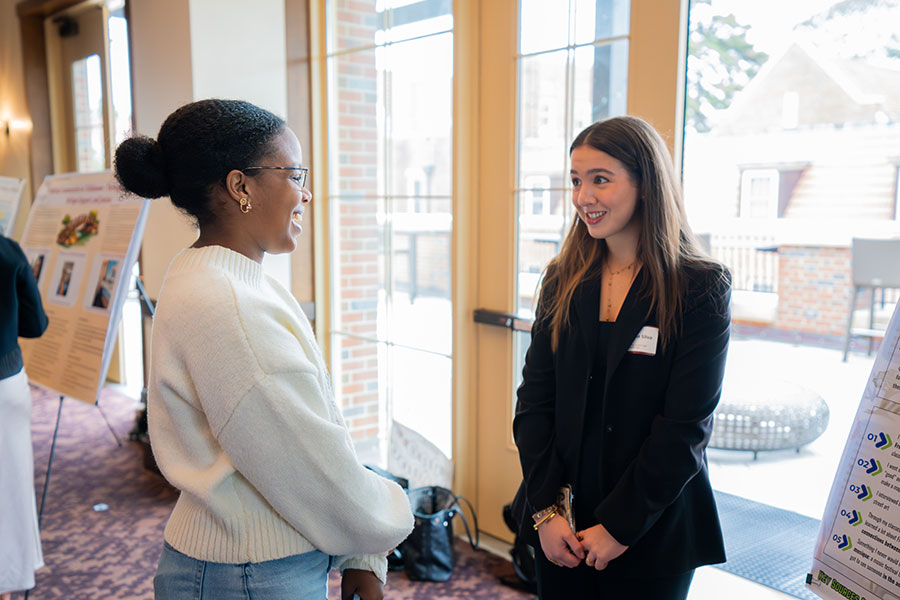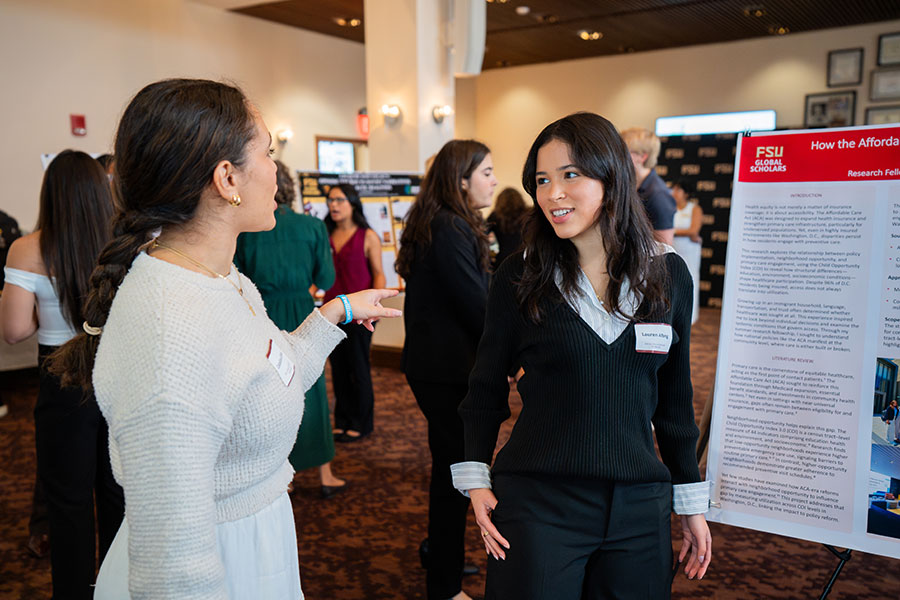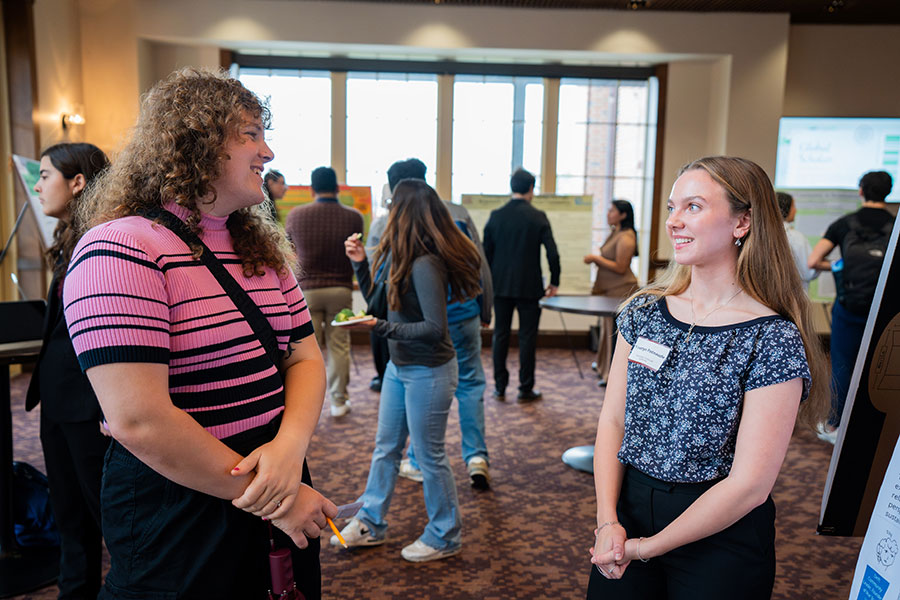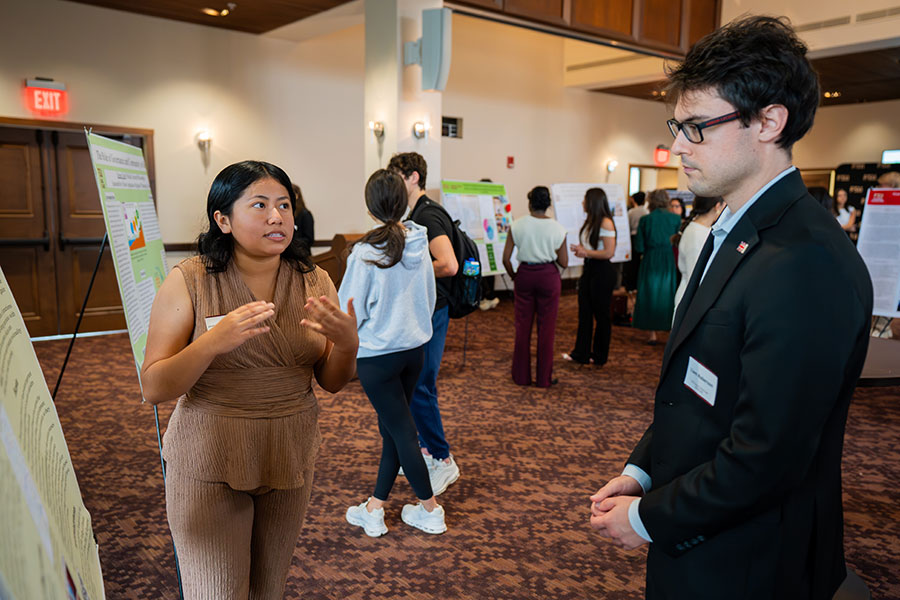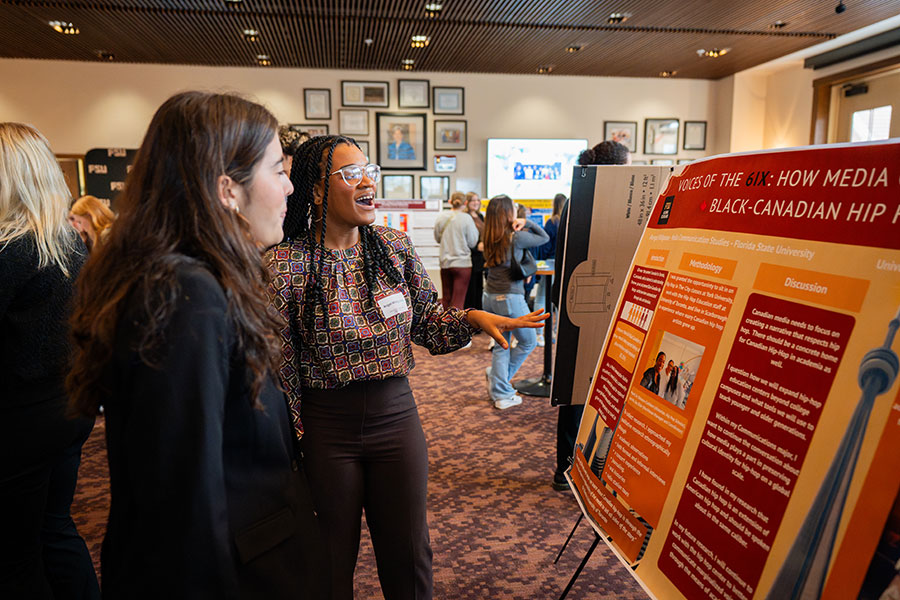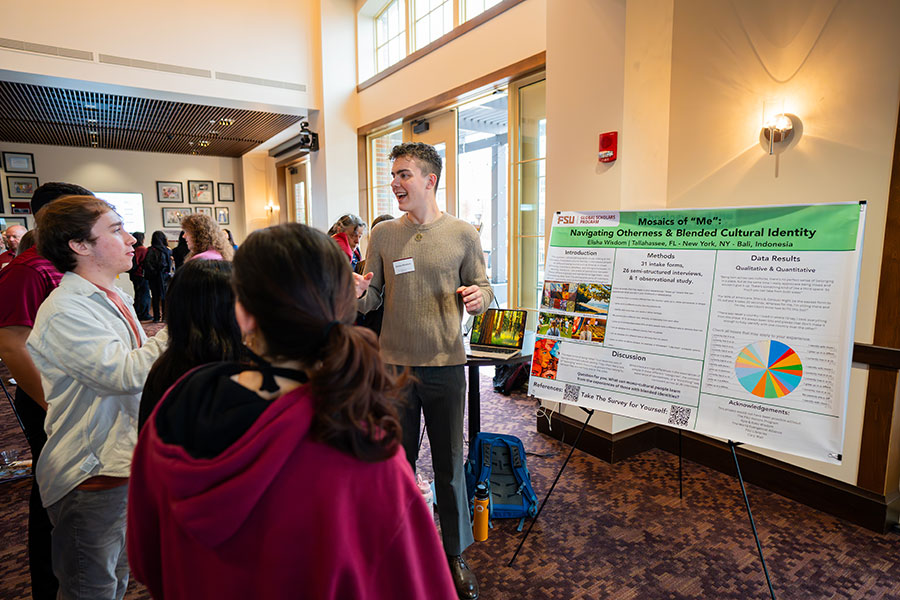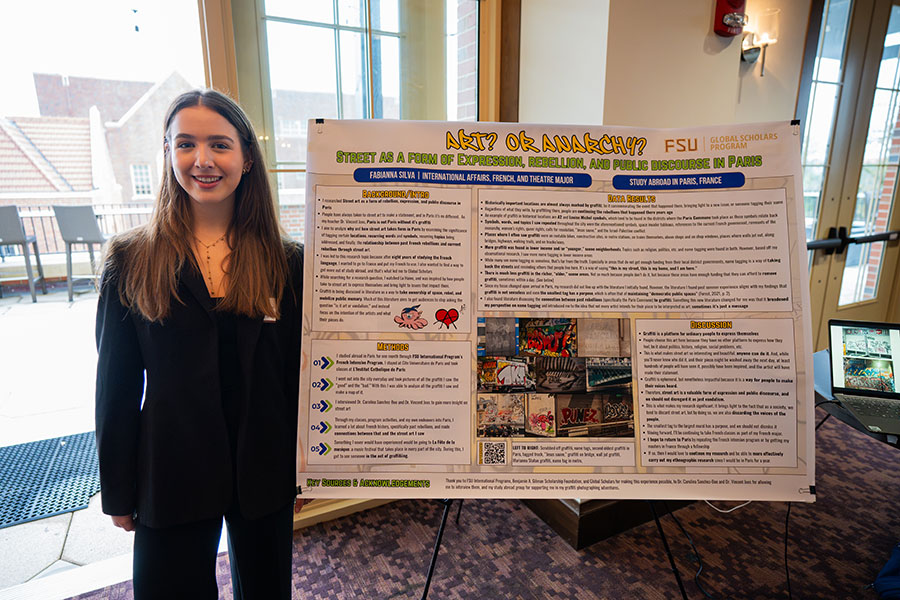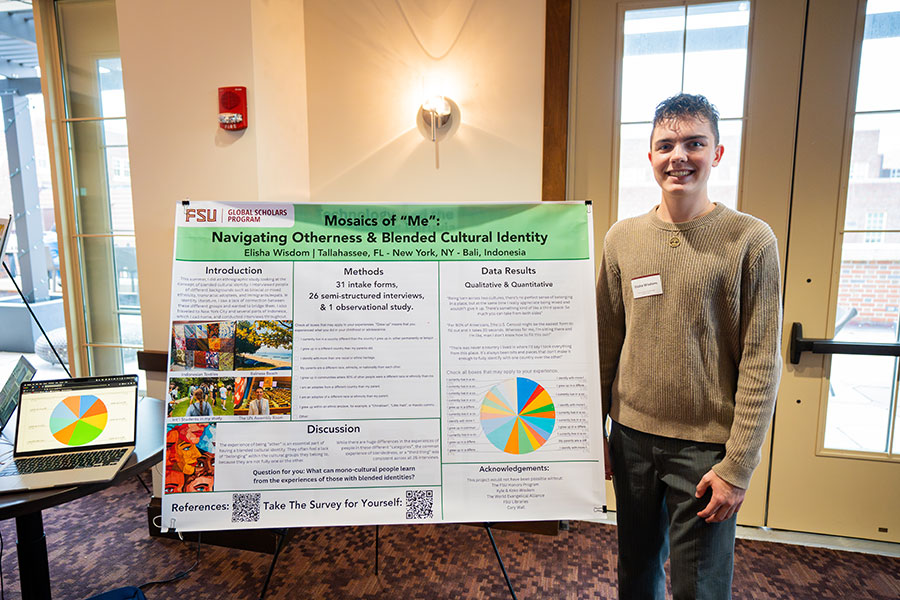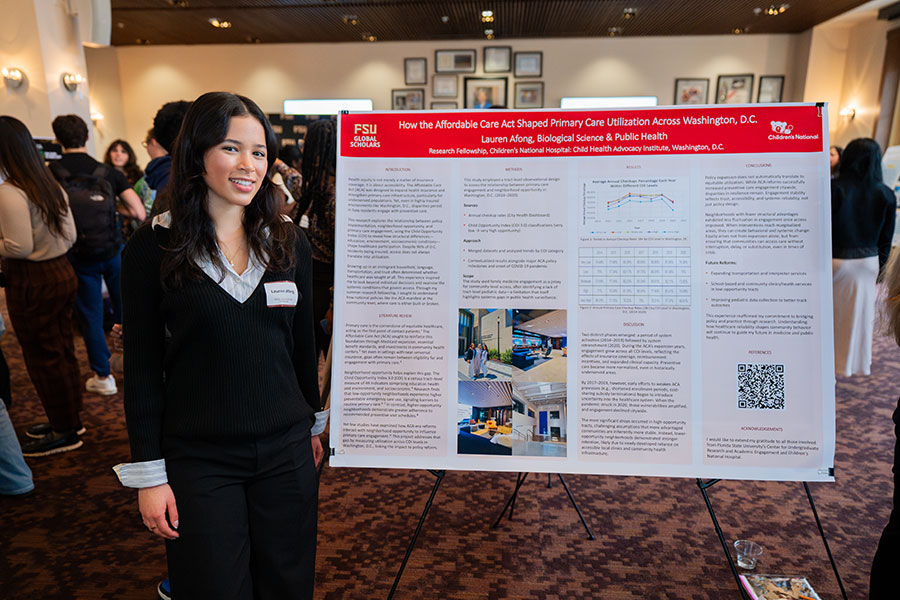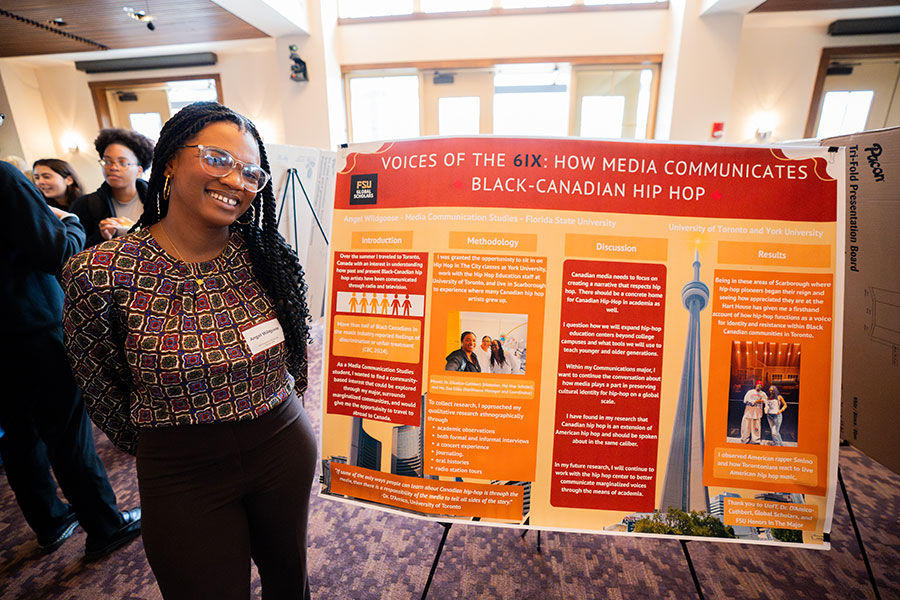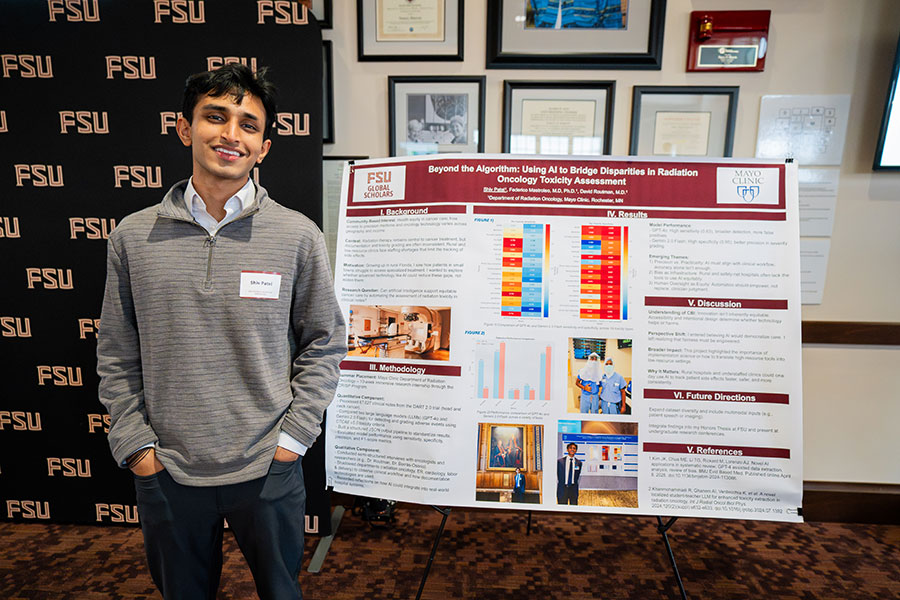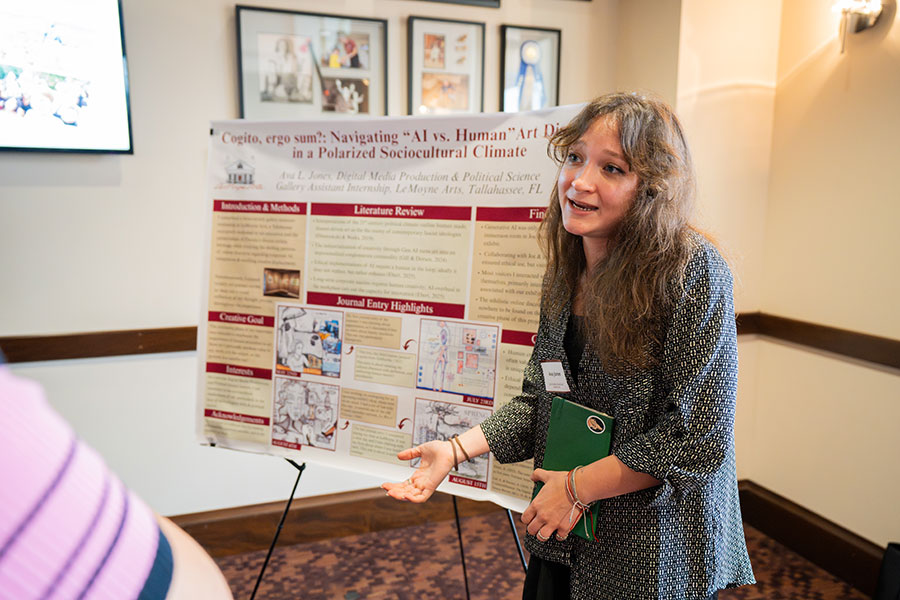



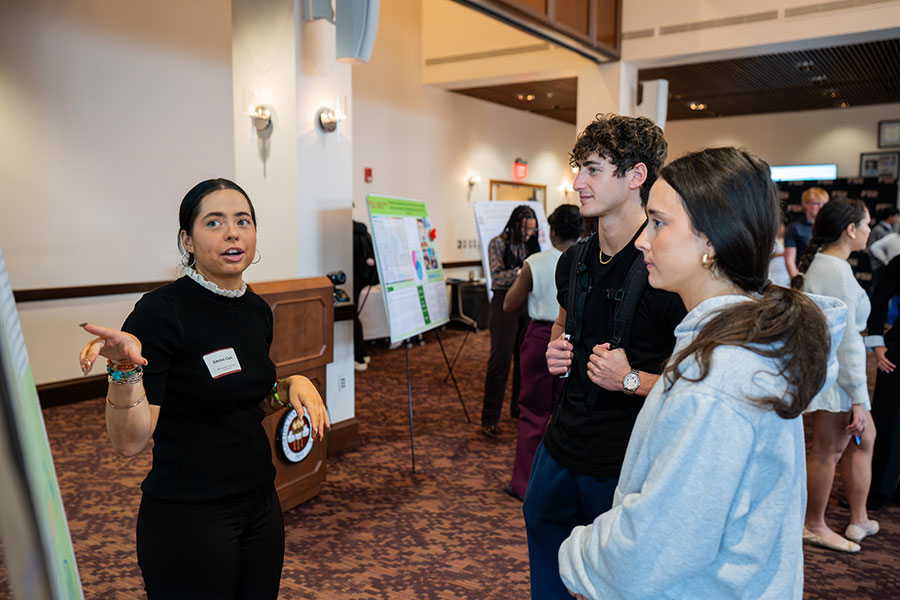
From refugee support in Central Europe to sustainability policy in Scandinavia, Florida State University students shared research shaped by firsthand global experiences at the annual Global Scholars Showcase.
Thirty-three undergraduates presented independent research and community-based projects Dec. 5, 2025, in the Nancy H. Marcus Great Hall, marking the culmination of a yearlong program that blends international engagement with inquiry.
Designing an independent research project or international experience is no simple undertaking. At Florida State, the Global Scholars Program helps students turn global interests into structured, ethical research through close mentorship and academic support.
This year’s cohort presented projects ranging from sustainability culture in Sweden and the Netherlands to Ukrainian refugee support in the Czech Republic and efforts to strengthen information technology (IT) infrastructure at mental health clinics in Peru.
As part of the Center for Undergraduate Research and Academic Engagement (CRE) at FSU, the Global Scholars Program supports students in designing and carrying out independent, community-based learning opportunities. The program offers undergraduate students the unique chance to engage in experiences tailored to their specific global interests. Through internships, research, and service-learning projects, students can explore questions related to social impact, social justice and social change.
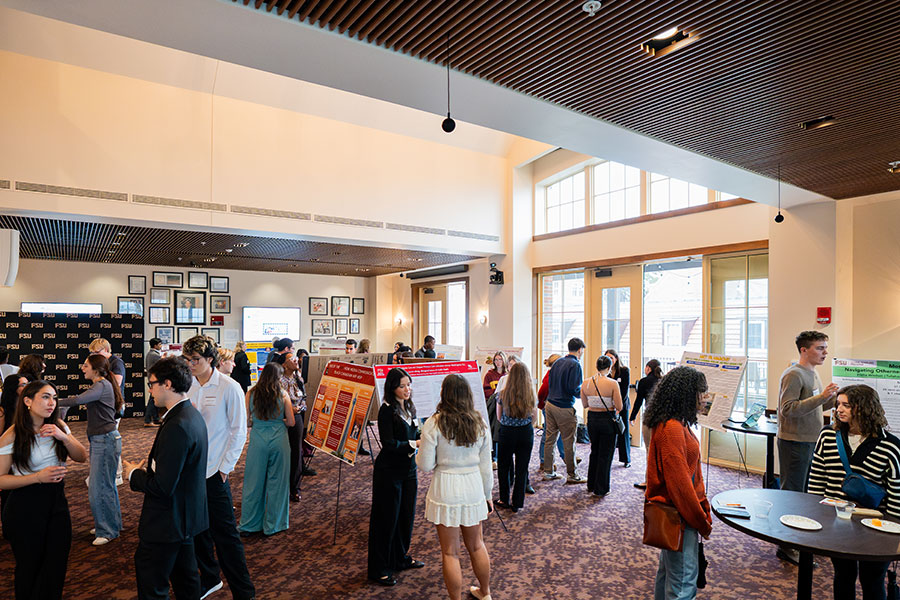
“Global Scholars is a sort of ‘choose-your-own-adventure program,’ where students are introduced to the idea that research is something that is inherently personal, yet still grounded to academic frameworks,” said Cary Wall, associate director for global programming at the CRE. “Students design their own research in global contexts, engage directly with communities and carry projects from early ideas through public presentation.”
The program follows a three-phase structure that supports students before, during and after their experiences.
In the spring semester prior to departure, students enroll in a preparatory course focused on the ethics of community-based work and qualitative research methods.
The following summer, students participate in their chosen experiences. This can include an in-person or online internship with a social-impact organization domestically or internationally, or a self-directed research project addressing a social issue in a local context.
The final phase takes place during the fall semester, when students reflect on their work, complete capstone projects and prepare to present their findings at the Global Scholars Showcase.
“At the heart of Global Scholars is an ethos that urges students to ask questions rather than propose solutions, and to leverage research as a tool for engaging with issues of global and collective importance,” Wall said.
This year’s cohort conducted research in 13 countries.
Jordyn Bain, a junior studying International Affairs and Economics, presented her project “From Arrival to Integration: The Role of NGOs in Assisting Ukrainian Refugees in Prague” at the showcase. She studied abroad in Prague, Czech Republic, through International Programs’ Human Rights and Social Work program.
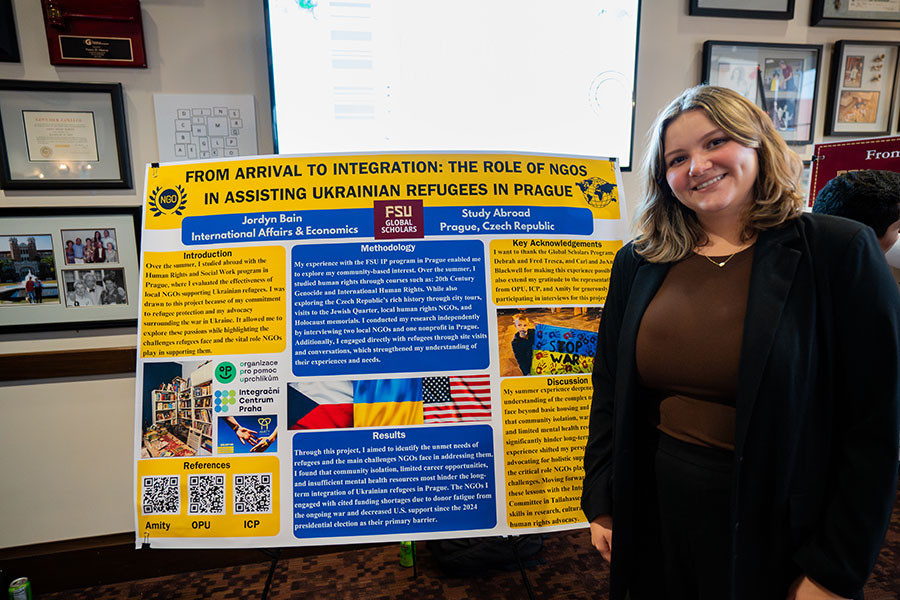
While there, she interviewed representatives from different non-governmental organizations (NGOs) in the area and found that community isolation, limited career opportunities and insufficient mental health resources most hinder the long-term integration of Ukrainian refugees in Prague.
“I’d never done a professional research project like this before, so this program really did help me learn how to go about it ethically, especially since I was dealing with people from a different culture,” she said.
Sebastian Abril, a senior majoring in Psychology and Information Technology, presented his project “The Health, Technology, and the Passion of a Community: Modernizing Peruvian Healthcare” at the showcase. He traveled to Cusco, Peru over the summer to intern at a mental health clinic through Proyecto Peru, an organization dedicated to supporting sustainable development in the country.
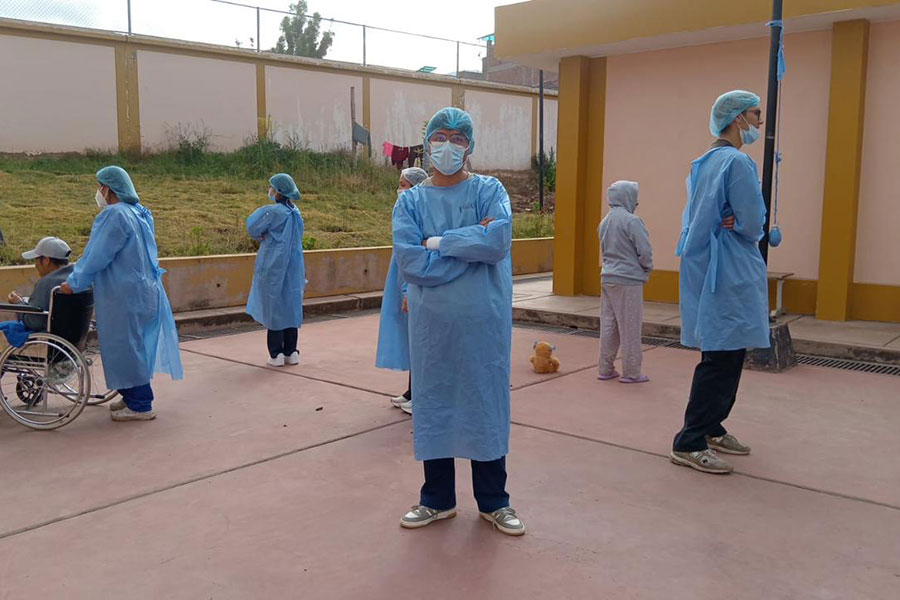
While there, he found that health care workers at the clinic were spending unnecessary amounts of time doing tasks that could be significantly expedited with digital services. He found that an increase in digital infrastructure, government policy and education could enhance the efficiency of the clinic.
“I like research and I like traveling, and this felt like the perfect blend of the two,” Abril said. “You really can design your own research, but you always know that they (the Global Scholars Program) are right there to push you, keep you going and make sure that you’re on the right track.”
Kaetlyn Patnaude, a junior studying Environmental Science and Urban Planning, presented her project “Allemansratten” at the showcase, which looked at environmental justice in Sweden and the Netherlands, focusing on how cultural values and citizen mindsets shape these nations’ approaches to sustainability.
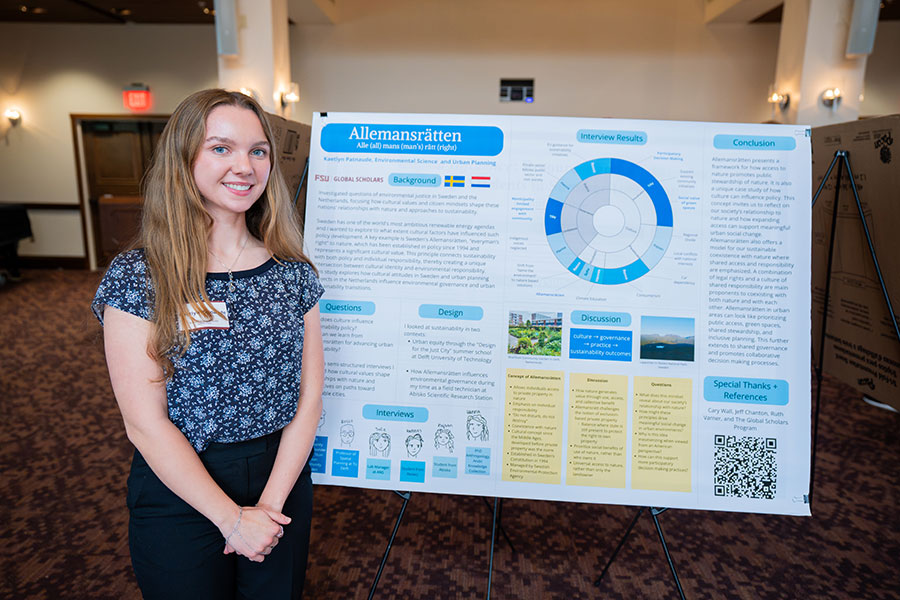
She started in Sweden, serving as a field technician at the Abisko Scientific Research Station. Located roughly 124 miles north of the Arctic Circle, the station hosts about 500 scientists annually who conduct research in ecology, biology and meteorology. Patnaude found this opportunity with the help of Jeff Chanton, Robert O. Lawton Distinguished Professor in the Department of Earth, Ocean and Atmospheric Sciences.
In Sweden, Patnaude conducted interviews to explore how cultural values shape relationships with nature and perspectives on paths toward sustainable cities. The phrase “Allemansratten” kept coming up, a Swedish saying meaning “every man’s right” to nature which refers to a cultural principle allowing free access to uncultivated nature. The phrase made Patnaude seek to further understand the shift from cultural concept to policy, so, she enrolled in an urban planning course at the Delft University of Technology in the Netherlands.
Next, Patnaude went to the Netherlands and enrolled in Delft University of Technology’s “Summer School Planning and Design for the Just City.” The program combines spatial planning, urban design and environmental technology to tackle issues of spatial justice, sustainability, climate adaptation and water management in urban transitions to sustainability.
For Patnaude, the course helped her understand how urban planning projects in the Netherlands influence environmental governance and urban sustainability transitions.
“I really learned a lot about communication and talking to people from different cultures,” Patnaude said. “I feel like I can talk to anyone now and approach interactions with curiosity.”
Natalia Arroyo, who graduated with her degree in Social Work and Political Science last semester, presented her project “Bridging Communities in Tallahassee: Through Education, Refugee Support and Justice” at the showcase. Focusing on how education, refugee resettlement and legal advocacy work together to strengthen community systems, Arroyo drew from three different experiences to combine the lessons learned.
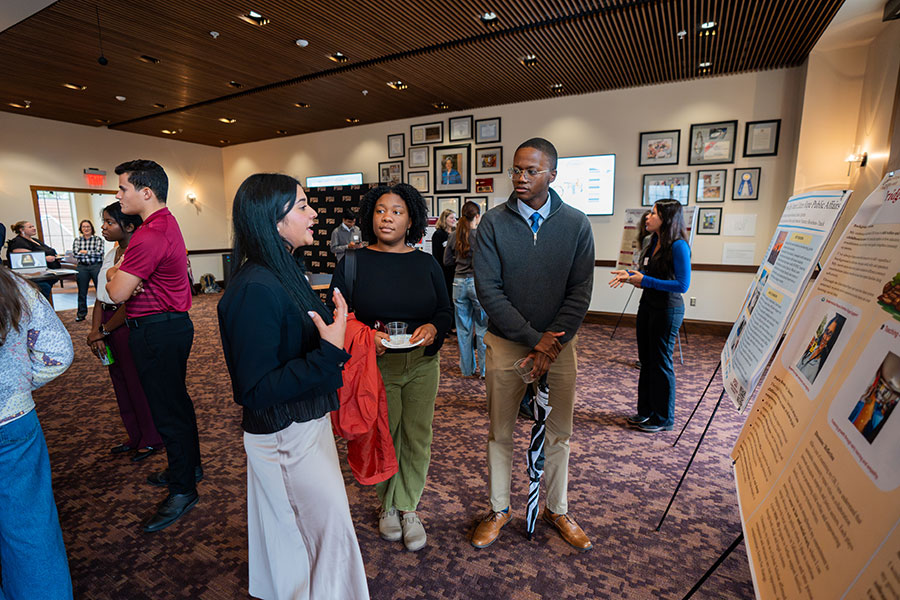
From working with the International Rescue Committee to supporting refugees in Tallahassee to serving as an early childhood educator for underprivileged kids and helping victims of violent crimes through the State Attorney’s office, Arroyo found one common theme: that compassion in the structures of social services is key to creating lasting change.
“Day-to-day things might be a little more difficult for other individuals,” she said. “Being empathetic and an advocate in the workforce, no matter what you decide to go into, can really make a difference.”
For more information about the Global Scholars Program, visit cre.fsu.edu/global/globalscholars. To read the Global Scholars blogposts, visit hsfhouseblogs.fsu.edu/blog/global-scholars/.