



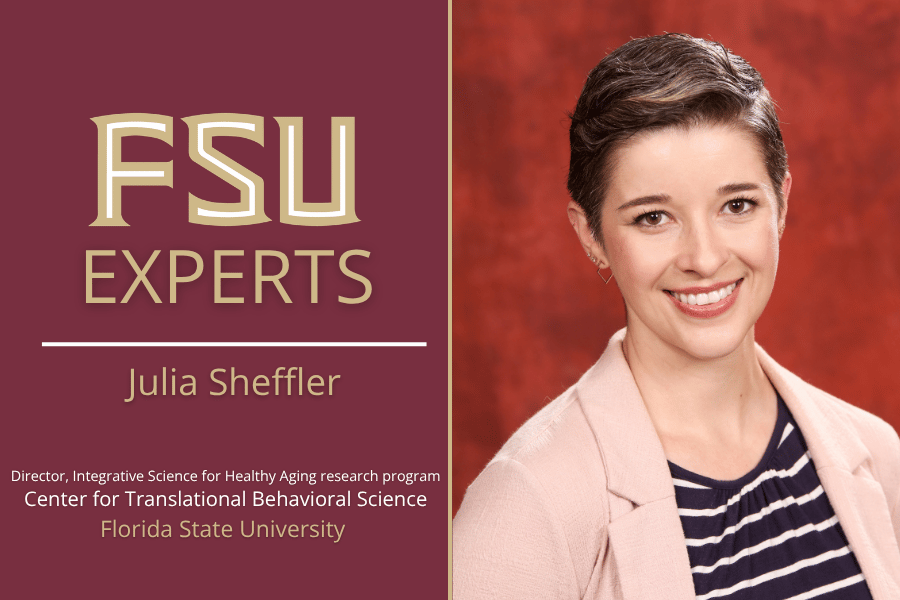
June marks Alzheimer’s and Brain Awareness Month, an opportunity to foster public understanding for the most proactive brain health habits. A Florida State University Behavioral Sciences and Social Medicine professor is reframing the way we look at brain health, helping individuals form a whole-body approach to reduce dementia risk.
Julia Sheffler is the director of the Integrative Science for Healthy Aging research program in the FSU College of Medicine. Her research focuses on improving scientific understanding of risk and resiliency factors related to late-life health and cognitive functioning.
According to the Alzheimer’s Association, more than 55 million people live with Alzheimer’s disease or other dementias worldwide. In the United States, approximately 7.4 million people aged 65 and older live with Alzheimer’s — an irreversible brain disorder that erodes memory and thinking skills.
Sheffler helps people build the knowledge, skills and confidence to make changes that are scientifically supported in combatting cognitive decline; while also paying attention to their own health, preferences, values and daily life to find an approach they can maintain over time.
“The best lifestyle change is often the one a person can realistically sustain,” Sheffler said of how individuals can best prevent cognitive decline through changes of their own. “For some people, improving diet may be the most impactful starting point. For others, it may be quitting tobacco, reducing alcohol use, increasing movement, improving sleep, or spending more time with friends and family. The reality is that even very healthy dietary patterns may not work the same way for everyone, in part because individuals differ in how their bodies metabolize and respond to nutrients.”
Sheffler’s research allows her to develop personalized strategies for individuals that integrate important factors such as nutrition, movement, mental health and social connection. By forming healthy habits that benefit the whole body, individuals are supporting their own brain health.
“The message I most want people to know is that brain health is not something we should only think about after memory problems begin,” Sheffler added. “Many of the same behaviors that support the heart, blood vessels, metabolism, mood, and sleep also support the brain. Even small, sustainable changes can be meaningful when they become part of a person’s everyday life.”
Media interested in understanding Julia Sheffler’s critical research and practical habits for promoting brain health may reach out to her via email at julia.sheffler@med.fsu.edu.
Julia Sheffler, assistant professor, Department of Behavioral Sciences and Social Medicine
Based on your research and understanding, how much does a person’s background dictate their lifetime risk for dementia?
A person’s background can play a meaningful role in dementia risk, but I would not say it “dictates” their future. Dementia risk is shaped by a combination of factors, including genetics, medical history, education, socioeconomic context, neighborhood resources, access to healthcare, stress exposure and lifestyle factors. Some of these begin very early in life and can accumulate over time. For example, opportunities for high-quality education, access to nutritious foods, safe places to be physically active and good preventive healthcare can all influence brain health across the lifespan.
At the same time, one of the most important messages is that dementia risk is not fixed. Even for individuals who may be at higher risk because of family history, vascular risk factors, or social and environmental barriers, there are still meaningful opportunities to support brain health. My work focuses on identifying realistic, accessible ways to help people make and sustain changes that may reduce risk, especially in communities where those resources have not always been easy to access.
You’ve done a lot of research on nutrition as it relates to Alzheimer’s and dementia. Would you consider nutrition the single-most important lifestyle change someone can make to help prevent cognitive decline in the future?
I would say nutrition is one of the most important lifestyle factors for brain health, but I would be cautious about calling it the single most important one for everyone. Brain health is influenced by many interconnected behaviors and health conditions, including diet, physical activity, sleep, stress, social connection, blood pressure, diabetes, heart health, and mental health. Nutrition is powerful because it touches many of those systems at once. What we eat can affect inflammation, vascular health, metabolism, gut health, and other biological pathways that are highly relevant to cognitive aging. We are not yet at the point where we can provide precise, individualized nutrition recommendations for brain health on a large scale.
Since establishing the Integrative Science for Healthy Aging Program, has there been an “a-ha” moment in your research? Something you’ve stumbled upon that you feel is most important for people to know when it comes to dementia and brain health?
One of the biggest “a-ha” moments for me has been appreciating just how closely brain health is connected to the rest of the body, especially metabolism. We often think about memory and thinking abilities as being separate from physical health, but the brain is an extremely energy-demanding organ. It depends on healthy blood vessels, stable metabolic function, and a steady supply of fuel to work well. When systems like blood sugar regulation, cardiovascular health, inflammation, or lipid metabolism are disrupted, those changes can also affect the brain over time.
That connection has shaped much of my work. I have become increasingly interested in how nutrition and other lifestyle behaviors may support brain health by influencing multiple systems at once, including vascular and metabolic health, inflammation, sleep, mood, and daily functioning. It has also made me think about dementia prevention as something that needs to be practical and whole-person focused. It is not enough to tell people that a certain diet or exercise routine may be good for the brain; we need to help them understand why these changes matter and support them in making changes they can actually sustain. The “best” intervention for one person may actually be very different for someone else.