



National AI Literacy Day is observed annually to educate individuals on navigating a world immersed in artificial intelligence. Held on March 27 this year, the day promotes ways in which humans, including educators, can embrace the technology and better prepare for its impact.
According to the adaptive learning company HMH, research is showing many educators are growing comfortable using AI, but few feel confident teaching students how to use it responsibly. The company’s Educator Confidence Report from 2025 shows 68% of educator respondents said AI saves them one to five hours per week, allowing more time for student connection and engagement.
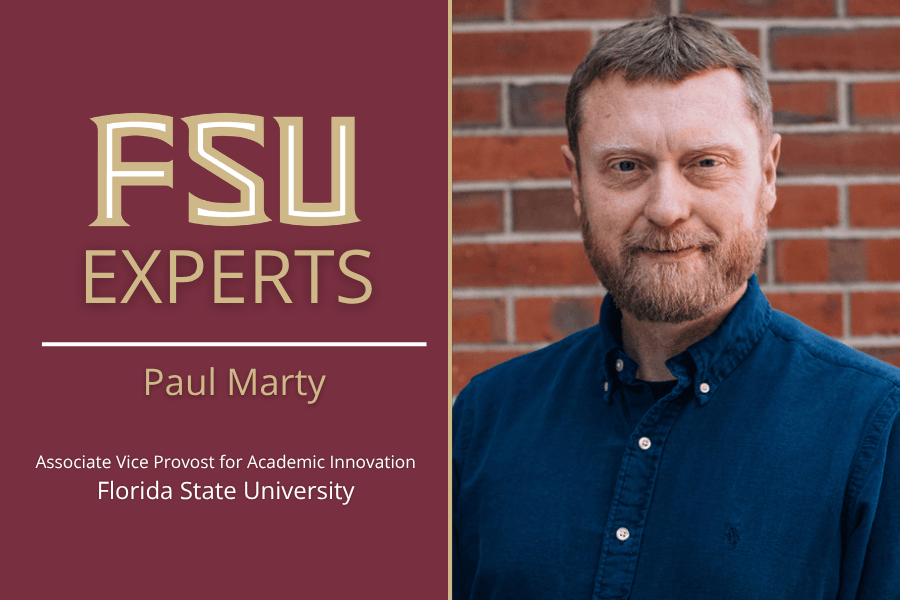
Florida State University’s Paul Marty is Professor in the School of Information in the College of Communication and Information and Associate Vice Provost for Academic Innovation. He works to coordinate, communicate and facilitate efforts among campus stakeholders to foster an environment that encourages and supports academic innovation at FSU. Marty serves as one of the university’s top experts in AI.
While AI’s impact on various industries remains to be seen, Marty emphasizes that human skills remain as important as ever.
“There are naturally a lot of worries right now about how artificial intelligence is going to reshape the workforce, universities and modern society,” Marty said. “You’ll hear people ask, ‘Why go to school, why study something new, why bother learning anything at all if AI already knows everything?’ In that environment, I think it’s important for us to remember that, for all its impressive capabilities, all AI can do is remix what humans already know how to do. When push comes to shove, what sets humans apart from AI is our creativity, our passion and our capacity to imagine new things. And that’s why our humanity, our curiosity and our ability to learn is so important.”
Media interested in gaining insight into AI literacy and understanding how universities like FSU are working with the technology may reach out to Paul Marty at marty@fsu.edu.
Paul Marty, associate vice provost for academic innovation, Florida State University
What is the value of human skills like critical thinking in an AI-driven world?
The most important skill our students need in an AI-driven world is their humanity. I tell our students all the time that what matters most – and what employers actually want – is their communication skills, their people skills, their management skills, their leadership skills, their empathy, their humanity, their ability to learn how to learn, and their ability to share what they’ve learned with other human beings in a way that inspires everyone to move forward and make the world a better place. If we don’t keep learning, we don’t move forward. If all we do is teach what we already know, then the world doesn’t move forward. Only by being open to learning new things are we able to innovate, to embrace risk, to grow, to improve; and in a world where artificial intelligence is ubiquitous, it’s our humanity that is going to make the difference.
What’s the future of undergraduate education in the age of AI?
If you talk with faculty at any university about undergraduate students and artificial intelligence for any length of time, the topic of cheating will inevitably come up. And when that happens, I usually try to turn that conversation around. Instead of worrying about cheating, I’ll say, try asking your students to tell you about the classes that they are not cheating in, and why they aren’t cheating in those classes. If you do that, what you’ll hear is a description of the university of the future – one where students are engaged in the material they are learning, and where they are not just learning things, but learning how to apply the things they’ve learned in new ways to define problems and develop solutions that will move humanity forward. In my opinion, the purpose of higher education should be to give our students those exact opportunities, both in and out of the classroom. Here at FSU, for example, we offer classes in Design Thinking and sponsor extracurricular events like Design Sprints where we provide our students with unique and incredibly valuable opportunities to work closely with industry, university and community partners, and apply what they are learning in the classroom to design innovative solutions to real-world, challenging problems. The more we can offer our students those kinds of experiences, the more we can let everyone know that our institutions are committed to the future of student success in a changing world, and that we are empowering our faculty, our staff and our students to thrive in that future.
How are universities adapting to teaching and learning in the age of AI?
When it comes to artificial intelligence and higher education, many institutions are reacting from a place of fear, and that makes perfect sense. Change is hard. Innovation is disruptive, and universities worldwide are facing a future that threatens to overwhelm them with transformational change. The way people react when new technologies are introduced into their social systems is quite naturally from a place of fear. So here at FSU, we’re working with our faculty, staff and students to take us from a culture of fear to a culture of innovation. This is not easy, but it is an opportunity for us to think carefully about the purpose of higher education, and to determine whether our assessments are actually measuring what we think they are measuring, whether the things we are asking our students to do are actually worth doing and whether the things our students are learning are actually the things they should be learning. Those are not easy questions to answer, but by answering those questions, we can present a clear vision, with compelling stories and a positive message about why higher education still matters in our changing world. And by doing that, we can empower our institutions to proactively adopt disruptive innovations, respond effectively to radical change and shape the future of teaching and learning.