



Stuttering is a speech disorder that affects approximately 3 million Americans and 70 million people worldwide. While repetition of sounds and syllables are most often heard, the bigger burden for some with the speech impediment is its psychological impact.
At the recent 2026 NFL Combine, accomplished wide receiver prospect KC Concepcion spoke through his speech impediment during media interviews. Criticized by some social media users, he was also overwhelmingly praised and used his platform to address his stutter and serve as an advocate for those living with the disorder.
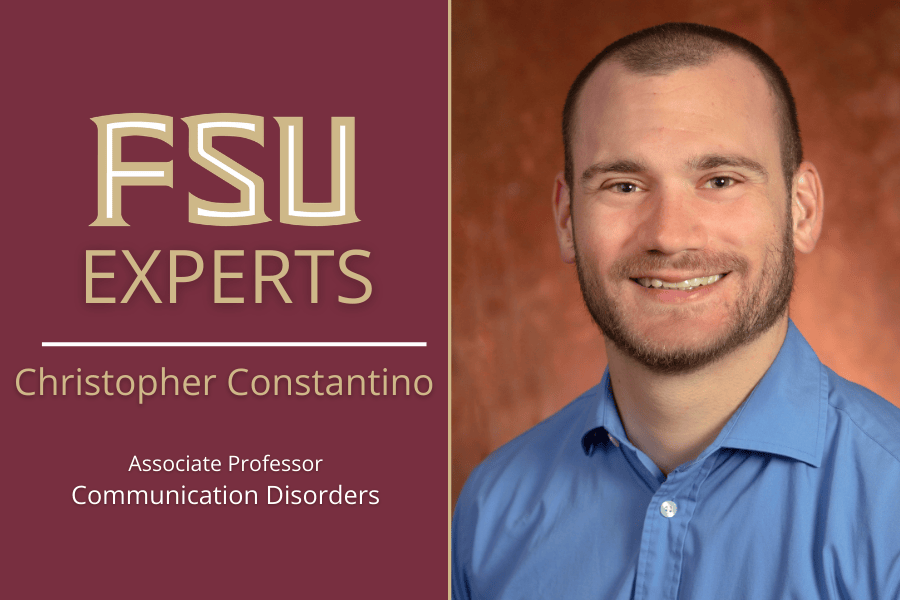
Christopher Constantino is an associate professor at the Florida State University School of Communication Science and Disorders in the College of Communication and Information. He studies how the lived experience of stuttering interacts with culture and society, and researches ways to improve the social experiences of stuttering. Constantino has appeared in several interviews and podcasts on the topic.
He notes that the common individual who stutters often deals with judgement from others, but these situations can be managed over time.
“There is a great deal of stigma around stuttering,” Constantino said. “In addition to the physical experience of getting stuck, people who stutter are contending with the judgement of others. Discrimination is very common. It is no wonder people who stutter try to avoid stuttering. To stutter openly and easily, speakers must learn to manage this societal prejudice. Advocacy is, therefore, just as important to the therapy process as learning how to speak differently.”
Media interested in speaking with Constantino on how stuttering interacts with culture and society can contact him via email at cconstantino@fsu.edu.
Christopher Constantino, associate professor, School of Communication Science and Disorders
Stuttering affects approximately 3 million Americans, according to the Stuttering Foundation. What are some of the social and emotional challenges individuals might face with this disorder?
Stuttering is a neurological condition that affects speech fluency, which is the ability to effortlessly move from one speech sound to the next. People who stutter experience a sense of being stuck on a sound, what is often described as a “loss of control.” When this happens, the speaker often intuitively reacts to this feeling of being stuck by fighting with it or by trying to avoid it. Unfortunately, fighting with the moment leads to a great deal of struggle and effort while speaking. Avoidance leads to restricting what is said and self-censorship. Both make speaking physically hard and attention demanding.
There are many prominent individuals who have been in the limelight and do plenty of public speaking with a stutter. What advice or suggestions do you have for individuals with a stutter who might fear public speaking?
Counterintuitively, the path out of struggle and avoidance is acceptance. The more a speaker lets their stutters happen, the easier they will be. This is, of course, much easier said than done and is why the guidance of a good speech-language therapist can be so helpful. Generally, the more your audience expects you to stutter, the easier it is to let yourself stutter. Therefore, I always recommend disclosing your stutter in high pressure situations. Something like, “I am a person who stutters, you might hear me repeat or stretch some sounds while I speak.”