



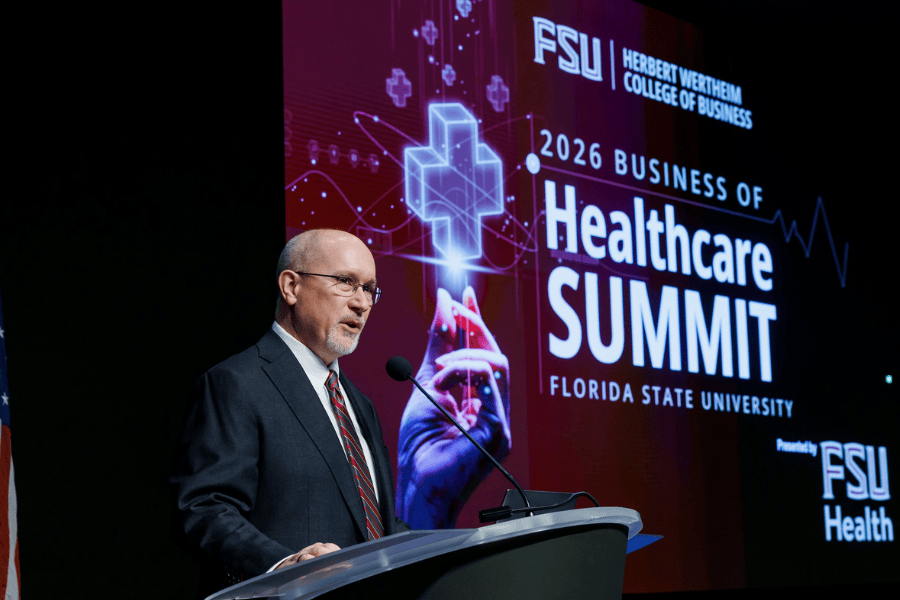
Shevaun Harris spoke for a moment not as a top state government official but as a patient and consumer.
“I just got fussed at by my doctor because I didn’t get my labs done, and I was like, ‘Honestly, I went in, and there was a three-hour wait. I can’t sit and wait for three hours,’” she said. “I think we really need to think about how we can have things more conveniently designed for consumers so that they put their healthcare first.”
Harris, secretary of the Florida Agency for Health Care Administration, thereby summed up the focus of last week’s 2026 Business of Healthcare Summit at Florida State University: to discuss and propose solutions to the most pressing issues facing the healthcare industry and to improve healthcare for Florida’s residents.
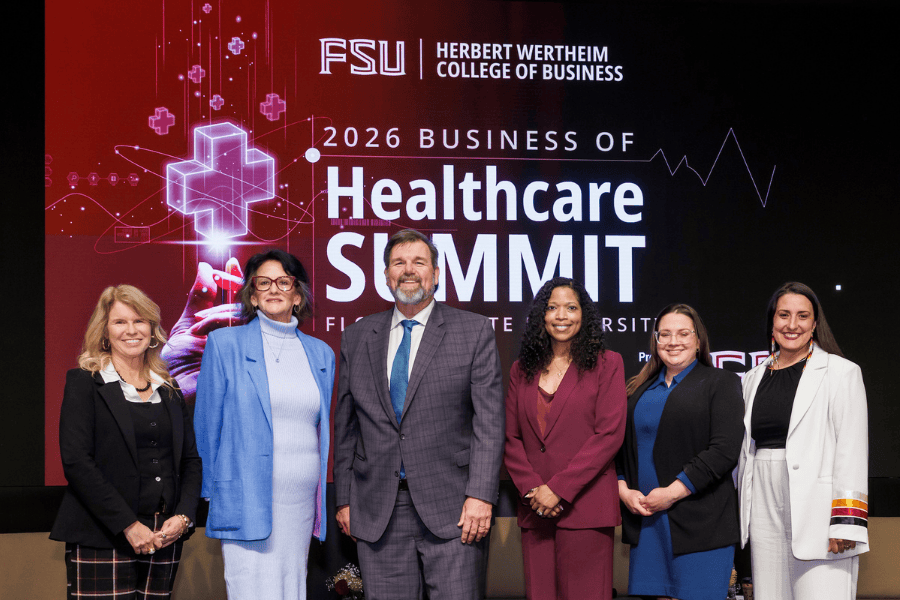
The summit featured Harris among about 20 distinguished speakers, panelists and moderators from industry, government, academia and the nonprofit sector. Panels emphasized operational excellence, including leadership, strategy, workforce, finances and technology. Discussions on the latter included the imperative and implementation of artificial intelligence.
“AI is not going to completely take over, but over time, those who can leverage it will be empowered, and that will give them the opportunity to do more,” said panelist Matt Feeney, an executive director and healthcare industry specialist at J.P. Morgan.
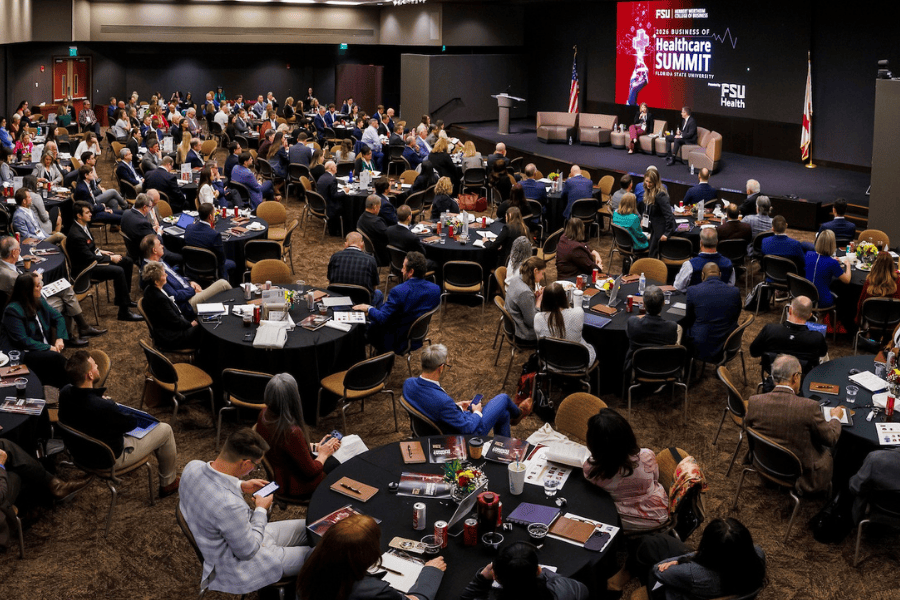
The annual event, which drew a standing-room-only crowd for a third straight year, is a product of FSU’s Herbert Wertheim College of Business and an extension of FSU Health, the university’s bold initiative to bring together scholars, educators and clinical partners under one umbrella to transform healthcare in Florida. FSU Health served as the presenting sponsor of the 2026 event.
Michael D. Hartline, dean of the Herbert Wertheim College of Business and summit emcee, emphasized the university’s increased healthcare-focused programs and research and its growing FSU Health infrastructure, including construction of a modern research center on the main campus of Tallahassee Memorial HealthCare and plans for an acute-care hospital in Panama City Beach.
“We are proud at Florida State University to be a partner in this region’s future,” Hartline told attendees. “We look forward to opening doors of these new facilities and a new era of healthcare that will benefit families and communities for generations to come.”
The ‘philosophy’ of FSU Health
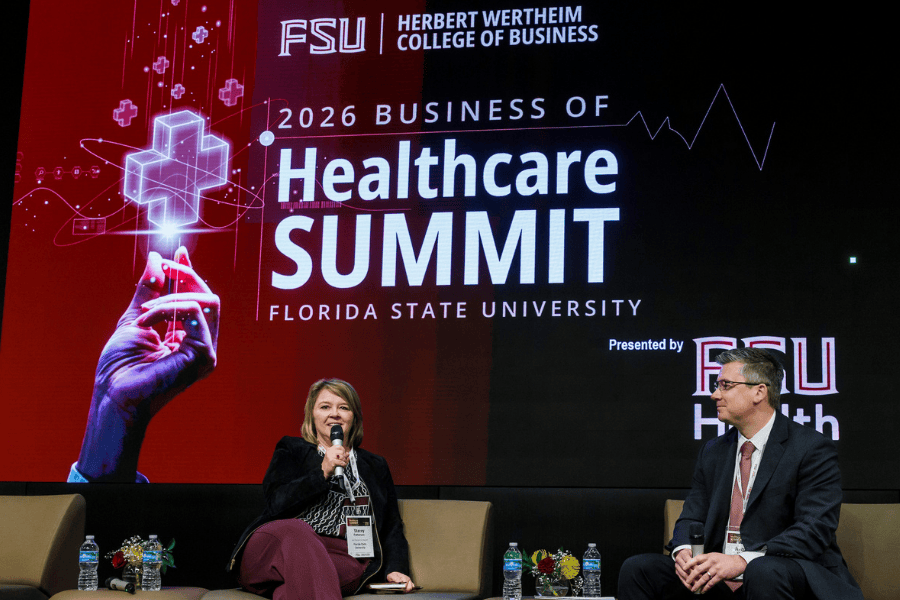
In a conversation about healthcare education and research at FSU, Stacey Patterson, the university’s vice president for research, touted the potential and capacity of FSU Health.
“I’ve been describing it as a philosophy … about anything and everything that FSU can do, should do and will do to improve health and healthcare in this region,” she said. “It includes everyone who has healthcare interests across our campus, and that’s one of the beautiful things about working at a place like FSU, where we have so many disciplines that come to play, to really impact all across Florida and beyond.”
Jeremy Slaga, FSU’s new vice president and chief clinical operations officer, who joined Patterson for the conversation, trumpeted the university’s strength in research and innovation and said multiple colleges and programs bring “that backbone” to FSU Health.
He added: “There are a tremendous number of great things that we can package and partner on, and align with new partners, and then avail that to the region.”
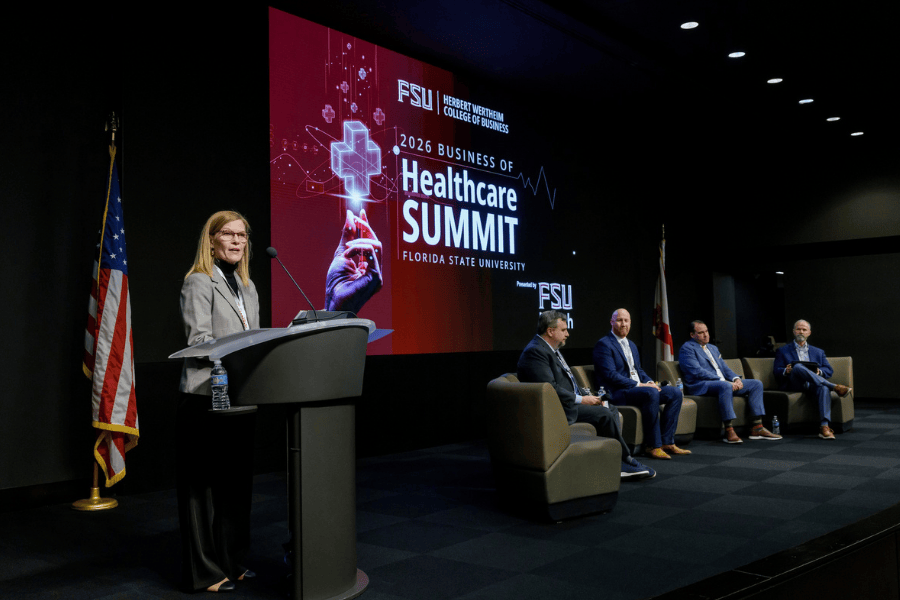
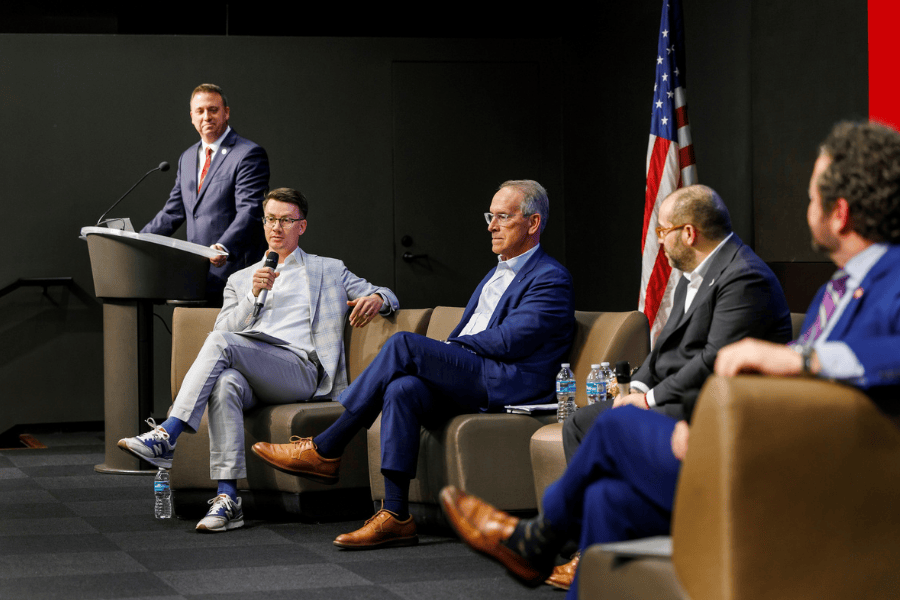
Marsha Hartline, associate dean for student affairs in the FSU College of Nursing, moderated a panel on operational excellence in healthcare and asked panelists to offer advice to students seeking roles in healthcare administration. Attendees included about 30 graduate-student volunteers who served as FSU ambassadors, answering visitors’ questions about the college and university.
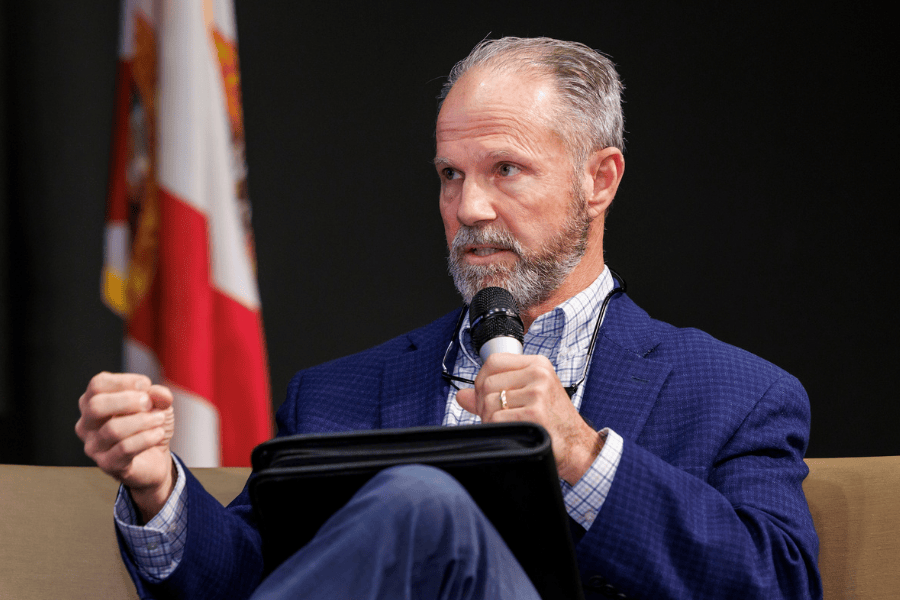
“Always be inquisitive,” responded Ross Nelson, who has earned medical and MBA degrees. A principal and leader of KPMG’s Healthcare Deal Advisory and Strategy Sector, Nelson said: “Look it up, get smart on it, and then ask a more advanced question. Know your market from a market perspective. Be hypothesis-driven. Always think about what question you’re trying to answer, what data you’re going to use, what are the outputs or what are the outcomes, etc.”
In general, Nelson said, physicians and healthcare executives will “react more positively if you … show them where the data leads you.”
AI: Topic of the day
Artificial intelligence emerged as a constant summit theme, including on Marsha Hartline’s panel. In response to a question from the audience, J.P. Morgan’s Feeney noted efforts of major pharmacy-based retailers to include small clinics in their stores.
“And there’s been a retraction,” Feeney said. He said he thinks consumers haven’t been comfortable with the concept.
“I think it’s the same way that folks approach AI,” he said. “I don’t think anybody wants to sign up to have a complete ‘teledoc’ visit, or a chatbots visit, where you’re just talking to an AI model about what’s wrong with you and what you think you need from a care delivery perspective. Maybe someday we are going to be comfortable with that. It’s just not right now.”
Jonathan Fozard, associate vice president and chief information officer at FSU, moderated a panel on data infrastructure, interoperability and artificial intelligence. He asked panelists what companies should consider before deploying AI.
Jeff Couch, co-founder and chairman of Ruvos, a healthcare data solutions company, said organizations should establish IT or data governance systems, which he called the “scaffolding that will give you the efficiencies you need to move and adapt quickly, without putting your organizations at risk.”
“Once you’ve done that,” Couch said, “what does the end look like? Work backwards from the end, and say, ‘How do we measure success?’ And put those key factors in place for everything you do, your procurements. Are your vendors able to meet your measures of success? And are they going to be held accountable?”
In a discussion about AI-readiness, Eyal Darmon, a managing director specializing in data and AI at Accenture, noted an “across-the-board” skills gap.
“We don’t have enough people who are AI-ready,” he said.
Workers who boast AI knowledge need to refine their skills for their new industry. And, in general, he said, “there needs to be a concrete focus on reskilling the workforce of today.”
The appeal of value
In a panel on public-policy impacts on healthcare business models, Lisa Rawlins, president of healthcare consulting group VTC Enterprise, said she expects the emergence of “value-based agreements” throughout the healthcare ecosystem.
She said her organization has made agreements whereby pharmaceutical manufacturers “will be paid over a period of time, dependent upon the outcome of that treatment and that rare cancer or that rare neurological disease that they’re not just treating, but curing.”
Those companies “will be paid for based on that outcome versus multiple episodes of care.”
On the same panel, moderated by Deanna Barath, assistant teaching professor at FSU’s College of Social Sciences and Public Policy, Secretary Harris of the Florida Agency for Health Care Administration trumpeted Florida’s recent $209 million federal-funding award as part of the U.S. Rural Health Transformation Program.
“It’s a huge opportunity for us to transform the landscape of rural healthcare access in our state,” Harris said. “We really want a ground-up approach where the rural areas are at the center, dictating and asking for what they think their community needs.”
Pointing out that 31 of Florida’s 67 counties are rural, she said: “We know that many of our urban counties are taking care of rural residents. So, we’re hoping that (the federal funding) will bring some of the innovation and technology and specialty care” of urban systems to rural residents.
At the close of the event, Michael Hartline encouraged attendees to return for next year’s fourth annual summit, which will include a job fair.
“We hope that you will partner with us,” he told attendees, “and bring your talent-acquisition colleagues with you, to help hire talent, whether they’re the master’s talent you see in the room, or any of the thousands of undergraduate students” in the Herbert Wertheim College of Business.