



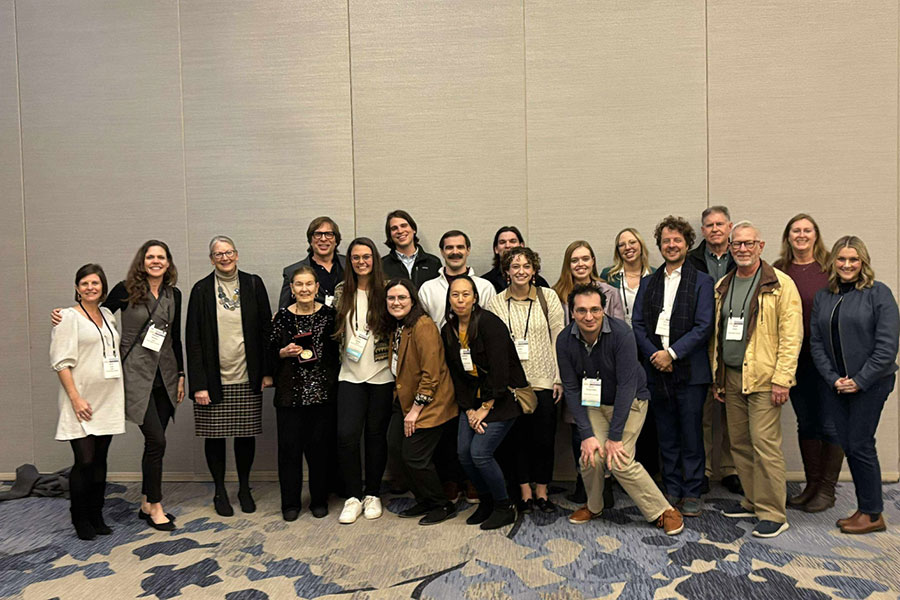
Florida State University’s Department of Classics recently celebrated a banner night at the Archaeological Institute of America’s (AIA) Annual Meeting in San Francisco.
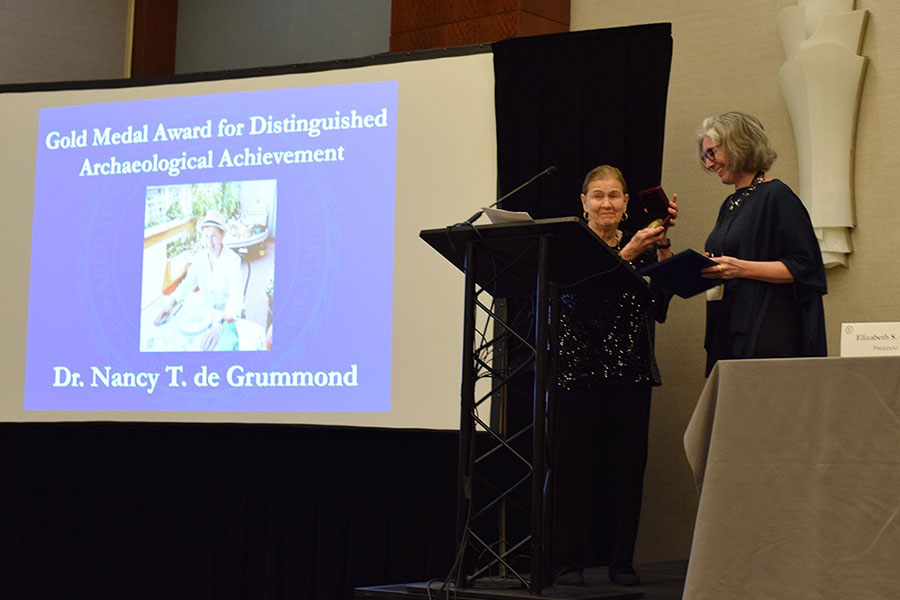
Nancy de Grummond, the M. Lynette Thompson Professor of Classics and Distinguished Research Professor and director of Excavations and Research at the Cetamura del Chianti archaeological site in Tuscany, was recognized with the 2026 Gold Medal Award for Distinguished Archaeological Achievement.
Two FSU graduates and alumni of the FSU Archaeological Field School at Cetamura del Chianti were also honored at the ceremony.
“The AIA awards dinner in San Francisco offered a snapshot of what FSU Classics is all about: a department filled with pathbreaking and influential professors who inspire excellence in their students, who in turn become pathbreaking and influential scholars, thus ensuring that the field remains at the forefront of the humanities,” said Tim Stover, chair of the Department of Classics.
The AIA supports archaeologists, their research and its dissemination, and the ethical practice of archaeology while promoting archaeological inquiry and public understanding of the material record of the human past to foster an appreciation of cultures and shared humanity. The Gold Medal, awarded to one archaeologist each year, recognizes distinguished contributions to the discipline through research and fieldwork. It’s considered analogous to a lifetime achievement award.
De Grummond has served as director of Excavations and Research at Cetamura since 1983, leading generations of FSU students to the site each summer. The site was discovered in 1964 by Italian archaeologist Alvaro Tracchi, and students from FSU’s Department of Classics started excavating the site in 1973 after the FSU Florence program obtained a permit from the Italian government.
Now known as the Archaeology in Tuscany Program, FSU students live in a Chianti hill town close to the site and excavate artifacts, study stratigraphy and learn how to process their finds while taking courses examining a variety of approaches to archaeology in the field, the lab and the museum. It is administered by International Programs.
“It is hard to describe the joy and satisfaction that comes with this kind of recognition,” de Grummond said. “In addition, the thrill of receiving the award was magnified when I found out that two of my students were sharing the podium at the ceremony. We are all so fortunate to have had the FSU International Programs and Department of Classics create the environment where our potential was nurtured.”
Two FSU alumni were also honored at the AIA’s Annual Meeting. Melanie Godsey (B.A. ‘13) was recognized for her contributions to the book, “Households in Context: Dwelling in Ptolemaic and Roman Egypt” (Cornell University Press, 2023), which focuses on the daily lives of families in Egypt, moving beyond elite narratives. The book won the 2026 James R. Wiseman Book Award from AIA, which honors an outstanding academic book in archaeology published within the past four years that advances the field through original research and synthesis. Godsey earned her bachelor’s degree in Classical Archaeology from FSU in 2013 and is an assistant professor of Classical Studies at Trinity University in San Antonio.
Taylor Cwikla (B.A. ‘19, M.A. ‘22) received the inaugural Gold Public Engagement Award from AIA, which recognizes members who make archaeology accessible to a broad range of non-specialist audiences. Cwikla earned her bachelor’s and master’s degrees in Classical Archaeology from FSU and serves as a museum educator at the American School of Classical Studies in Athens, Greece, building educational resources that educators worldwide can access for free.
During their time at FSU, Godsey and Cwikla both spent time at Cetamura. Cwikla served as a field archaeologist and research assistant in 2016 and as an excavation supervisor in 2017, 2018 and 2019. Godsey was a field archaeologist and research assistant at Cetamura in 2010 and has also worked at sites in Egypt and Greece.
Discoveries by FSU at Cetamura have unearthed a long and diverse history that encompasses successive settlements by the Etruscans (7th-1st centuries BCE), the Romans (1st century BCE-4th century CE), and Medieval Italians (11th-12th century CE). In 2023, FSU celebrated 50 years of discoveries at Cetamura with the inauguration of the new Civic Museum at the Origins of Chianti. Located 9 kilometers from the archaeological site, the museum collection highlights the archeological discoveries at Cetamura, including Etruscan and Roman artifacts.
“The research de Grummond has done on the material found at Cetamura has helped revolutionize our understanding of the Etruscans,” Stover said. “She has been an influential, inspirational and generous scholar, one whose work has not only changed the way we think about ancient Italy but has positively impacted the lives of countless students. Two of those students, Taylor Cwikla and Melanie Godsey, have gone on to have amazing careers, so it is no surprise that they too have been recognized by the AIA.”
For more information about FSU’s Department of Classics, visit classics.fsu.edu. To learn more about the Archaeology in Tuscany program, visit the International Programs website.