



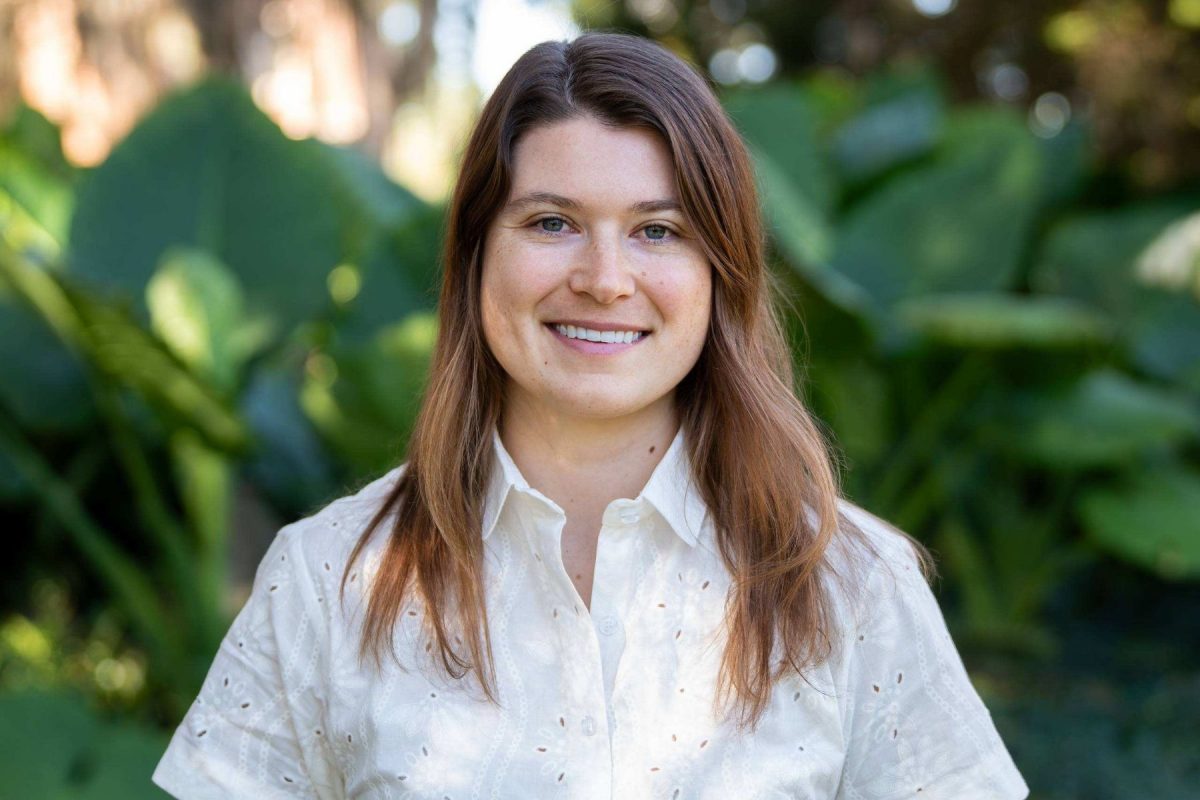
“I have been an active scientific diver at FSU for four years now, so I am excited to be representing our strong community of student divers.”
Fast Facts
- Favorite Animal: Horseshoe crab
- Favorite Hobby: Trying new recipes
- Proud Accomplishment: More than 230 scuba dives since 2021
- Favorite Tallahassee Activity: Indoor rock climbing
- Favorite Pastime: Reading seven books a month
Biological science doctoral student Laurel Field is studying the effects of climate change on coral reefs through research supported by $400,000 in grant funding.
Her research has connected residents of Bonaire, an island in the southern Caribbean, with resources to help protect coral reefs. Her work also raises awareness about how climate change threatens the reefs and the tourism industry that depends on them.
Through her dissertation research, she has involved 17 other students in coral reef conservation efforts within FSU’s Department of Biological Science.
Field was president of the Ecology and Evolution Research Discussion Group (EERDG) last year and is a member of the Florida State University Diving Control Board (FSUDCB). She has participated in the university’s academic diving program for four years and has led peers through workshops and events.
Field has earned three research fellowships this year: the Philanthropic Educational Organization Scholar Award, the American Association of University Women American Doctoral Fellowship and the Fulbright New Zealand U.S. Research Award, which will allow her to expand her research to New Zealand in the 2026-2027 academic year.
Why did you choose Florida State University?
When I was applying for doctoral programs, FSU was a top choice because the Department of Biological Science, Associate Professor Sarah Lester and her lab group were welcoming and supportive.
I liked that FSU guaranteed funding for biological science doctoral students through teaching assistantships. The annual funding to present at scientific conferences, professional development opportunities and support for fellowship applications also stood out to me.
Personally, I wanted to continue marine conservation research with international collaborators. I was excited to learn that Professor Lester and biological science faculty member Andrew Rassweiler had a strong joint research program in the remote Pacific and southern Caribbean.
What academic achievements have you accomplished at FSU?
My dissertation research assesses the impacts of climate change on coral reefs in Bonaire, an island in the southern Caribbean. I am working with researchers at FSU and STINAPA Bonaire, a local conservation organization, to assess patterns of coral bleaching and the reefs’ vulnerability to climate change and human stressors.
My goal is to help local researchers address climate change in Bonaire, protect the long-term reef health of its reefs and promote conservation practices. With the help of my research partners, we secured a grant from the Lenfest Oceans Program, part of the Pew Charitable Trusts, to fund this research.
How have you impacted your community?
I represent graduate students in the Department of Biological Science on the FSUDCB, which sets standards for the Florida State University Academic Diving Program. I also participate in board meetings, represent student interests and review diving plans.
In my research, I have involved 16 undergraduates and one master’s student in my dissertation research through Directed Individual Study, the Undergraduate Research Opportunity Program and the Women in Math, Science and Engineering Program.
Outside of FSU, I organized a series of outreach meetings to share my research findings with the Bonaire community. We are working to improve community awareness of how climate change is likely to impact Bonaire’s reefs and, by extension, its important tourism and fishing industries. We have developed informational posters on climate change, educational materials for classrooms and modules for open-water courses that teach divers how to help protect coral reefs.