



Love takes center stage every Valentine’s Day. But for many, connections are becoming embraced over commitment.
The modern dating scene is seeing a rise in ‘situationships,’ defined as relationships that are characterized by passion and intimacy but lacking formal commitment. These types of relationships are more common today than in the past, particularly among younger generations.
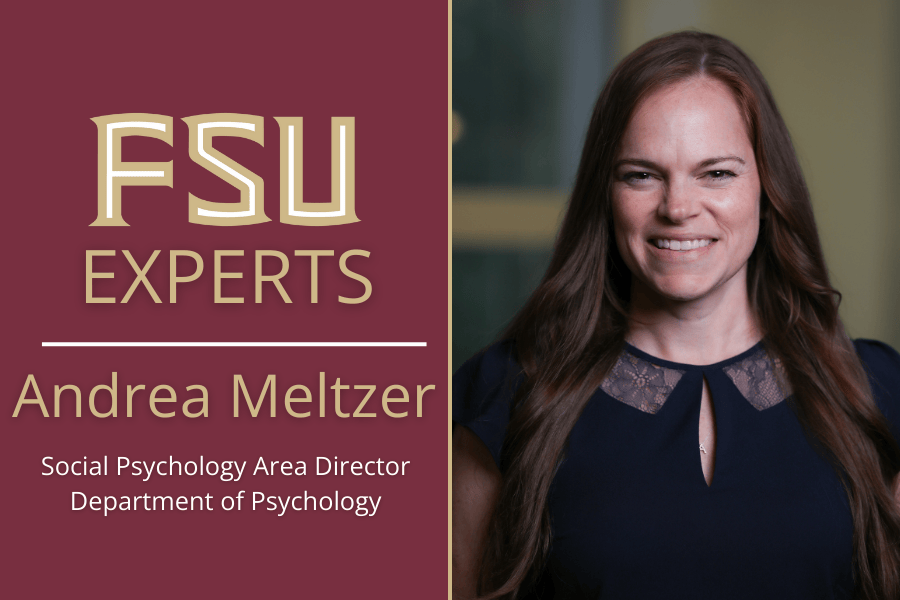
Florida State University’s Andrea Meltzer is the social psychology area director and a professor within the Department of Psychology. Her research uniquely integrates relationship science and evolutionary psychology to examine how evolved processes shape our closest relationships.
While it’s hard to select the single biggest driver of the rise in situationships among younger people, Meltzer points to individuals’ perception of availability as a big reason for the trend.
“We know from relationship science that, regardless of how happy people are in their relationships, the relative comparison of what people are getting out of their relationships versus what people think they could get outside of that partnership predict the extent to which they are committed,” Meltzer said.
Meltzer is head of The Attractions and Close Relationships (ACR) Lab at FSU. She utilizes both experimental and longitudinal methods and often draws from an evolutionary perspective to better understand established romantic relationships.
She asserts that social media is at the heart of modern dating habits.
“In our fast-paced, technology-drenched modern world, the available options seem endless,” Meltzer added. “When young people spend hours on their phones scrolling social media and dating apps, they are exposed to an endless stream of attractive others. Even if those attractive others are not realistically obtainable (because they live far away or because they are strangers), we likely unconsciously process those others as ‘potential options,’ driving lower commitment in our face-to-face relationships.”
For media interested in discussing the rise of situationships heading into Valentine’s Day, Andrea Meltzer is available for interviews. Requests can be made by contacting her via email at meltzer@psy.fsu.edu.
Andrea Meltzer, social psychology area director, Department of Psychology
What do you see as the main pros and cons of situationships?
Situationships can offer people many of the benefits of more committed relationships. They provide companionship, intimacy and emotional and physical support. Nevertheless, there is a growing literature demonstrating that such situationships are less satisfying than relationships characterized by more commitment. Furthermore, their ambiguity is associated with hypervigilance, lower self-esteem and poorer well-being (especially if the situationship ends and their partner “ghosts” them).
Talk about the role that dating apps have in this trend
I do think dating apps play a notable role. People who scroll these apps think their available options are endless. Even if they have considered all potential partners in a given area, they can expand their search to a wider area, offering more options. To me, social media plays an even bigger role. Compared to 10 minutes on a dating app, people are exposed to significantly more attractive people when endlessly scrolling on TikTok for 10 minutes.