



Florida State University will spotlight the growing field of medical humanities during the Arts-Health-Humanities Symposium VI 12-2:30 p.m. on Tuesday, Feb. 10, at FSU’s Claude Pepper Center.
The symposium involves faculty and students — from design, medicine, music education, music therapy and musicology — carrying conversations about current research and future interdisciplinary collaborations. It is part of the Festival of the Creative Arts, an annual campuswide event hosted by FSU’s Office of Research that features creative and innovative voices that span across university disciplines.
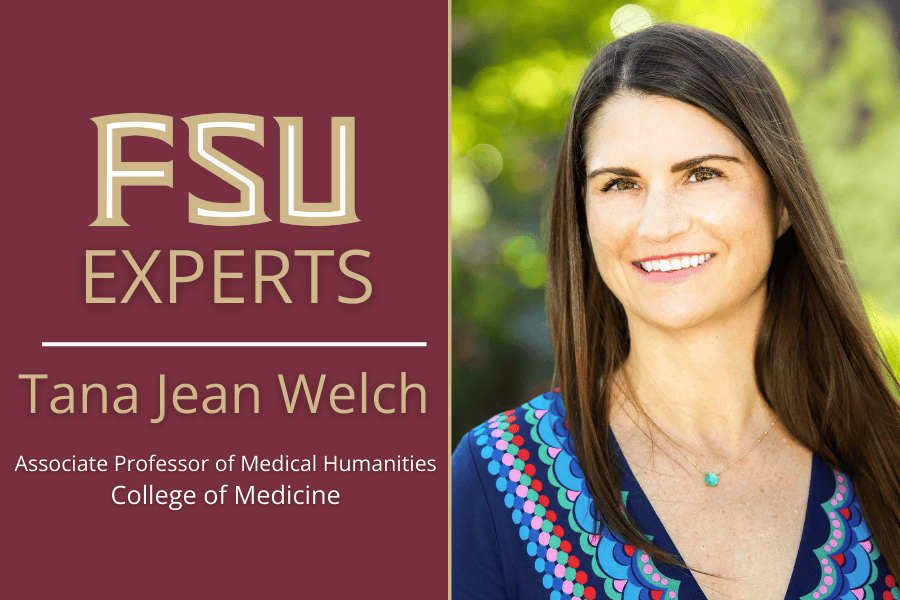
Tuesday’s symposium, a fusion of arts and medicine, includes FSU Associate Professor of Medical Humanities Tana Jean Welch, a poet and scholar of contemporary American poetry and medical humanities. In her field, she shows how reading and writing poetry, all forms of creative writing, can benefit those in the high-stress medical field.
Welch says that poetry echoes the human experience, drawing countless parallels between what is written and what is felt.
“Poetry’s use of blank space, collage, ambiguity, and fragmented language echoes our embodied experience in many ways,” Welch said. “The meaning of a poem, just like the meaning of a body, can shift from reader to reader or from day to day — in this way, poetry can be a truer representation of the body and bodily health. The way we feel in our bodies — emotionally, physically, psychologically — is constantly changing as our bodies encounter other bodies. Poetry provides space for variation.”
Welch teaches courses in literature, writing and humanities and serves as the director of the Chapman Humanities and Arts in Medicine Program (CHAMP), seeking to enhance the intellectual and emotional environment at the FSU College of Medicine through extracurricular arts and humanities programming.
She is also the managing editor for a journal called “HEAL: Humanism Evolving through Arts and Literature.” In the seasonal journal doctors, students and patients share stories, painting and poems about their lives in the medical world. Welch believes tapping into this creativity helps medical professionals in their everyday work.
“Creative and reflective writing is important for anyone in any field,” Welch said. “It is a critical thinking tool — the act of writing can reveal hitherto unknown knowledge and emotions. Searching for the right words forces us to think deeper. This can be quite valuable in the medical profession.”
Media interested in learning and covering medical humanities and how Welch’s teachings intersect with the medical community can reach her at tana.welch@med.fsu.edu.
Tana Jean Welch, associate professor of medical humanities, College of Medicine
How can poetry be interconnected to medicine and healing?
Another important connection between poetry, health and illness comes when one considers the task of poetry. Poetry’s purpose is to express the ineffable, to say what cannot be said any other way. There is much about our health that is difficult to communicate, including what pain feels like, what the body is experiencing, or the emotional feelings that accompany pain and illness. Poetry can bring us that much closer to feeling what someone else is feeling, thus, bringing us closer to empathy, connection and understanding. Poetry can help us articulate the complexity of life and help us change the language we use to construct conditions of health and illness.
In your work you discuss “the human entanglement.” What does it mean and why is it so important?
It is impossible to maintain opposition or separation between the human body and everything else. For example, one cannot speak of human health as independent from ecosystem health. Health is also not independent from economics or politics, weather or location, or a million other material or cultural entities. Recognition of our bodily entanglement reduces the emphasis placed on individual choice, and individual value, as health outcome predictors, while also encouraging us to acknowledge our kinship with all others. This recognition is vital for achieving true health equity.
How do your areas of focus benefit those working in the medical profession?
As the founder of the narrative medicine movement, Dr. Rita Charon, notes, ‘When health professionals write, in whatever genre and diction they choose, about clinical experiences, they as a matter of course discover aspects of the experience that, until writing, were not evident to them.’ Writing about a clinical experience offers providers a place to reflect on what could’ve been done differently, or what worked well. This speaks directly to HEAL’s primary mission — to serve as a venue for medical students and healthcare professionals to reflect and discover. HEAL also publishes narratives written by patients about their healthcare experiences to expand the perspectives available to our students and community. Our capacity for empathy is enlarged both when we read someone else’s story and when we write about our role in someone else’s life.