



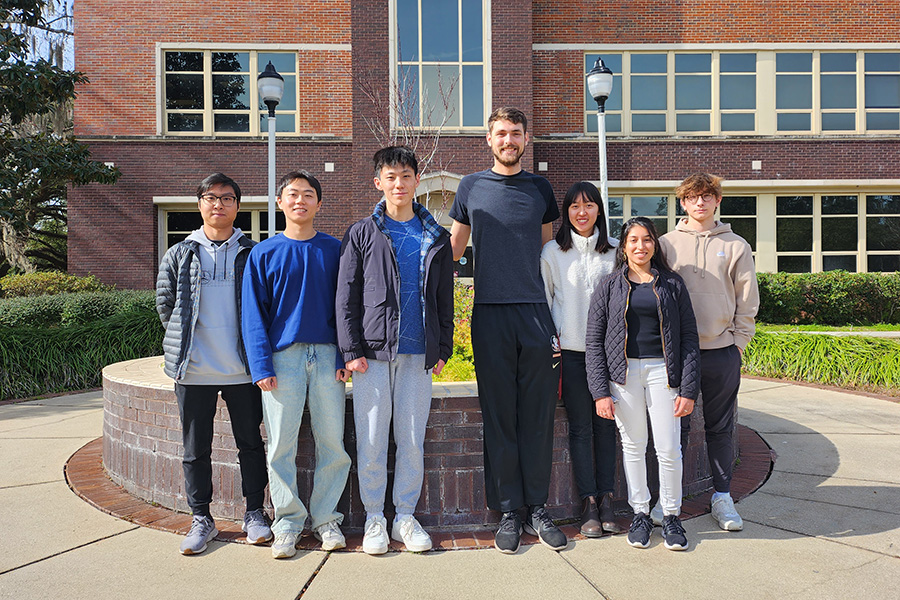
A doctoral student from Florida State University is using artificial intelligence to help make one of the planet’s most wasted foods easier to preserve.
Zhengao Li, currently pursuing his doctorate in measurement and statistics, joined two Oregon State University researchers to develop a smartphone-based AI system designed to accurately predict the firmness and internal quality of avocados.
Their findings were published in the journal Current Research in Food Science, and their work was supported by the U.S. Department of Agriculture’s National Institute of Food and Agriculture.
For Li, it was a chance to access AI’s powerful capabilities.
“The biggest thing I learned was how to connect model performance with real scientific processes,” Li said of his experience. “From collecting samples, preparing Raman spectra and image data, training the model, to checking how the model explains its results, I learned that every step should reflect how fruits move from being ripe to spoiled.”

The team of researchers used a dataset of 1,400 avocado images collected from a smartphone, occurring over an eight-day storage period at room temperature. A texture analyzer measured the firmness and served as a ripeness detector. Using trained AI models and deep learning-enabled imaging, the system predicted firmness – which measures ripeness – with nearly 92 percent accuracy.
The internal quality of the avocados, detecting whether they were considered fresh or rotten, also had an accuracy rate of just over 84 percent.
The deep-learning framework used in their AI system could offer a solution to evaluate avocado ripeness and internal quality in a rapid and non-destructive manner. Avocados were chosen in the study because of their high waste rate – hovering around 40 percent – while holding high market value and large demand among consumers.
Current estimates show that the United Kingdom wastes over 50,000 tons of avocados annually because of their difficulty to manage as a fresh-to-produce item – despite being at peak demand. With a booming market value expected to reach $23 billion by 2029, avocados are also high in waste because of damage, pests or diseases.
The potential of Li’s findings could offer a pathway to reduce food waste and make more informed decisions on preservability in the supply chain. As more images are added to the model, accuracy rates could improve for measuring an avocado’s ripeness and internal quality. An eventual goal is to develop the technology to where consumers can make informed decisions at home and better judge the optimal time to eat an avocado.
“If used widely, the system could help farmers avoid harvesting too early or too late, help companies plan stock rotation and delivery, and help consumers judge ripeness more accurately,” Li said. “In the long run, this can support a more sustainable and less wasteful food system.”
“In the long run, this can support a more sustainable and less wasteful food system.”
– Zhengao Li, Florida State University student
Li believes that the system is just scratching the surface, with the ability to detect the quality of other types of food coming soon.
“The system now uses both visual and spectral data to tell how ripe food is and whether it has any damage or dryness,” Li added. “In the future, smaller and faster models could run on IoT or edge devices, making real-time detection possible with little power and space. The idea is to use ‘shared visual and spectral features’ that work for many types of food, and then make small changes for each one, like adjusting which wavelengths or features to use.”
While at FSU, Li has built a versatile background. He is currently working as a research assistant with the Educational Psychology & Learning Systems department at the Anne Spencer Daves College of Education, Health, and Human Sciences (Anne’s College). He was also a research assistant in FSU’s Department of Health, Nutrition, and Food Sciences, and holds a master’s degree in computer science that he received in June 2025.
Being involved in groundbreaking innovation could produce further opportunities for Li as he continues his education at FSU.
“This research is my starting point for learning more about how to make AI models smaller, faster and more reliable.” Li said. “In my Ph.D., I plan to focus on topics like model compression, knowledge transfer, reinforcement learning and interpretability. I want to find ways for AI models to stay accurate while using fewer resources.”
For more information on Anne’s College, visit annescollege.fsu.edu.