



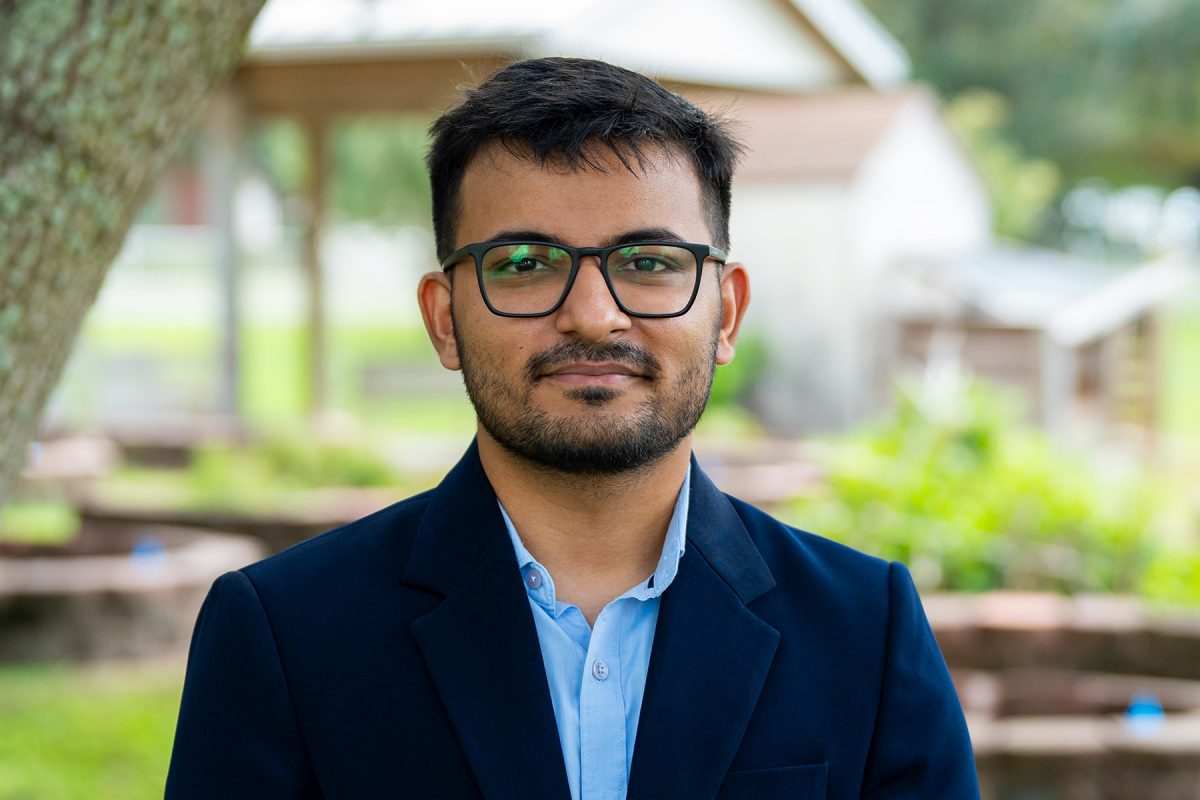
“FSU’s collaborative learning culture and access to cutting-edge computational facilities have been instrumental as I build the foundation for my doctoral degree.”
Fast Facts
- Hobbies: Learned Bachata dance at FSU
- Favorite Study Spot: The basement of Dirac Library
- Traveler: Loves traveling and photography
- Innovative: Once built a fully automated farm model using Arduino and sensors
Doctoral candidate Mani Tyagi is pursuing his doctoral degree in Computational Science within the Department of Scientific Computing. Tyagi’s mission is to advance the mathematical methods used to model materials, utilizing high-performance computing to solve complex challenges in physics. He aims to use his research to improve the accuracy of how we predict the behavior of materials simulations essential to modern technology.
Tyagi uses resources from the Research Computing Center and high-performance computing to make the complex and time-consuming calculations feasible. He has been working under the guidance of Chen Huang, associate professor in the Department of Scientific Computing, who has been helpful in mentoring him and guiding his research direction.
As a researcher, Tyagi has made significant contributions to the development of new computational models and mixing parameters. He is recognized for his work on approximating how electrons interact within atoms, an approach that allows researchers to more accurately simulate materials like transition metals and other highly correlated materials. For his academic contributions and research potential, Tyagi was honored with the Dean’s Award for Doctoral Excellence (DADE Scholarship).
Tyagi’s impact is felt across the FSU community through his service as a mentor for the Florida-Georgia Louis Stokes Alliance for Minority Participation (FGLSAMP), where he supports the professional development of the next generation of researchers. He holds key leadership roles as President of the Indian Students Association of Tallahassee (INSAT) and as the coordinator of his department’s student-run journal club, strengthening an environment of inclusivity and scientific communication.
Why did you choose to attend Florida State University?
I chose Florida State University because of its strong interdisciplinary program in Computational Science, which provides an ideal environment for advancing my research in DFT and materials modeling.
The Department of Scientific Computing at FSU has a reputation for combining high-performance computing with fundamental research in physics and materials science, a synergy that aligned perfectly with my academic interests. FSU’s collaborative learning culture and access to cutting-edge computational facilities have been instrumental as I built the foundation for my doctoral degree.
What are some projects you’ve been involved in?
One of my most significant projects at Florida State has been the development of the Spatial Mixing of Model Potentials (SMMP) method. In this work, I designed spatially dependent mixing parameters to improve exchange–correlation potentials by combining exact exchange with local density approximations. This project also involved implementing Optimized Effective Potential (OEP) methods with nonlocal pseudopotential forces, with the aim of improving predictions for strongly correlated systems.
Another important accomplishment has been my work on the Embedded Atom Approximation (EAA) for exchange–correlation energy. By partitioning electron density across atoms, this method provides a more realistic treatment of localized correlations, particularly in transition metals and rare earth materials. This work has enhanced our understanding of complex correlation effects in materials such as transition metal oxides.
In recognition of my academic contributions and research potential, I was awarded the DADE Scholarship at FSU. This highly competitive fellowship supports outstanding doctoral students across disciplines, and this award has been a strong motivation for me to continue advancing methodological developments in Density Functional Theory and materials modeling.
How have you impacted your community?
One of my most meaningful contributions at Florida State has been serving as a mentor in the FGLSAMP program for the past two years. In this role, I have mentored undergraduate students by supporting their academic growth, exposing them to research and guiding their professional development. This experience has been especially rewarding because it allowed me to contribute directly to FSU’s mission of broadening participation in STEM and fostering the next generation of researchers.
My research also serves the university’s broader mission; I have contributed to FSU’s reputation as a leader in computational science by developing advanced Density Functional Theory methods that improve the accuracy of electronic structure predictions in technologically important materials. This work not only strengthens the university’s standing in scientific research but also creates opportunities for future collaborations in materials modeling.
Beyond the lab, I serve as President of the Indian Students Association of Tallahassee (INSAT), where I organize cultural and social events that strengthen inclusivity and community engagement on campus. I also act as the coordinator of our department’s newly established student-run journal club, providing a collaborative platform for graduate students to critically discuss recent research and enhance scientific communication skills. Together, these contributions reflect my commitment to advancing scientific knowledge while also giving back to the FSU and Tallahassee communities.