



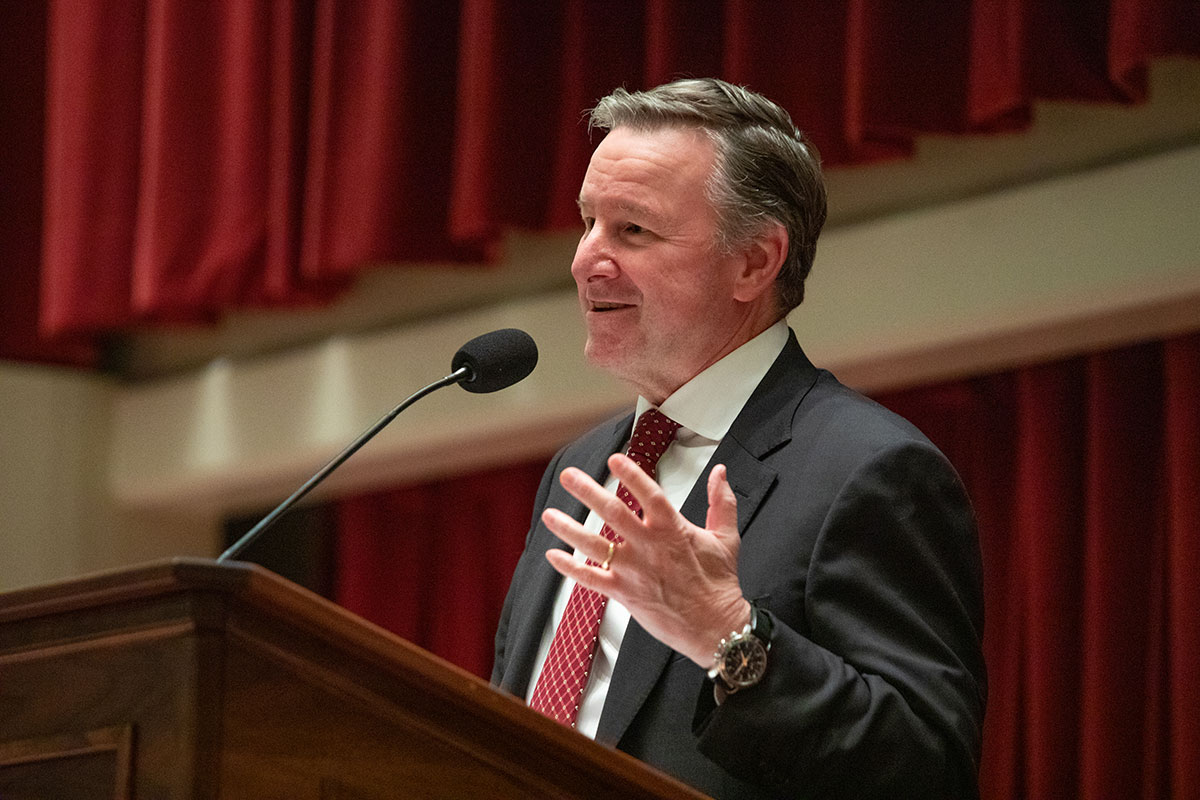
Florida State University’s Board of Trustees voted Wednesday to approve a three-year contract extension for President Richard McCullough, reaffirming the board’s confidence in his visionary leadership.
Since becoming president in 2021, McCullough has guided the university through an era of remarkable progress, strengthening FSU’s position as a leader in higher education.
“Our board could not have a better partner in moving Florida State University forward than President McCullough,” said Board of Trustees Chairman Peter Collins. “His vision and determination have led to historic achievements in student success, research and advancement. The board is confident that under his continued leadership, FSU will reach even greater heights.”
The extension is pending approval by the Florida Board of Governors.
“It has been my greatest honor to serve as Florida State University’s 16th president, and the opportunity to continue this work for another three years is both humbling and exciting,” McCullough said. “With this board’s guidance and stewardship, we are immensely proud of what the FSU family has accomplished together over the past five years. And I want to be clear — we’re just getting started.”
Under McCullough’s leadership, Florida State achieved its highest-ever national ranking, rising to No. 51 among all universities, according to U.S. News & World Report. FSU also ranks No. 21 among public universities by U.S. News & World Report, No. 11 in Niche’s 2026 America’s Top Public Universities, and No. 2 for student experience by The Princeton Review.
Student success and accessibility are hallmarks of McCullough’s tenure: the freshman retention rate climbed to a record 97 percent, four-year graduation hit 78 percent, and the transfer student graduation rate rose to 80 — the best in State University System history. FSU also maintains one of the lowest median federal student loan debt levels among public R1 universities, underscoring its commitment to affordability.
FSU has become one of the nation’s most sought-after universities, with nearly 95,000 applications submitted for about 6,000 spots in next fall’s freshman class — a testament to its reputation for world-class academics and an unparalleled student experience.
Over the past five years, the university expanded its Honors and Presidential Scholars programs and strengthened its CARE program for first-generation and Pell Grant-eligible students. Nearly a quarter of FSU students are the first in their families to attend college, highlighting the university’s commitment to opportunity and economic mobility.
Research momentum is at an all-time high under McCullough, with expenditures surging from $325 million in 2021 to $488 million, a 50 percent increase. Faculty submitted $1.22 billion in grant proposals last year, and the university launched major initiatives in aerospace, quantum science, advanced manufacturing and rare earth mineral extraction.
Through FSU Health, launched in 2022 with a $125 million appropriation from the Florida Legislature, the university is serving the community and driving breakthroughs in genomics and precision medicine, including pediatric rare disease research and the implementation of statewide genetic screening initiatives.
In January, FSU opened the Herbert Wertheim Center for Business Excellence, the largest academic building on campus and the new home of the Herbert Wertheim College of Business, made possible in part by a monumental $65 million philanthropic gift from Dr. Herbert Wertheim. This transformative gift includes a $50 million endowment — the largest in university history — supporting faculty development, student scholarships, and innovative academic programs.
Under McCullough, FSU opened the state-of-the-art Interdisciplinary Research and Commercialization Building, and started construction on the FSU Health Research Center, which is expected to be completed by the end of 2026. These projects are fueling innovation and supporting Florida’s economic goals, creating jobs, drawing top talent, and reinforcing FSU’s role as a statewide and national catalyst for progress.