



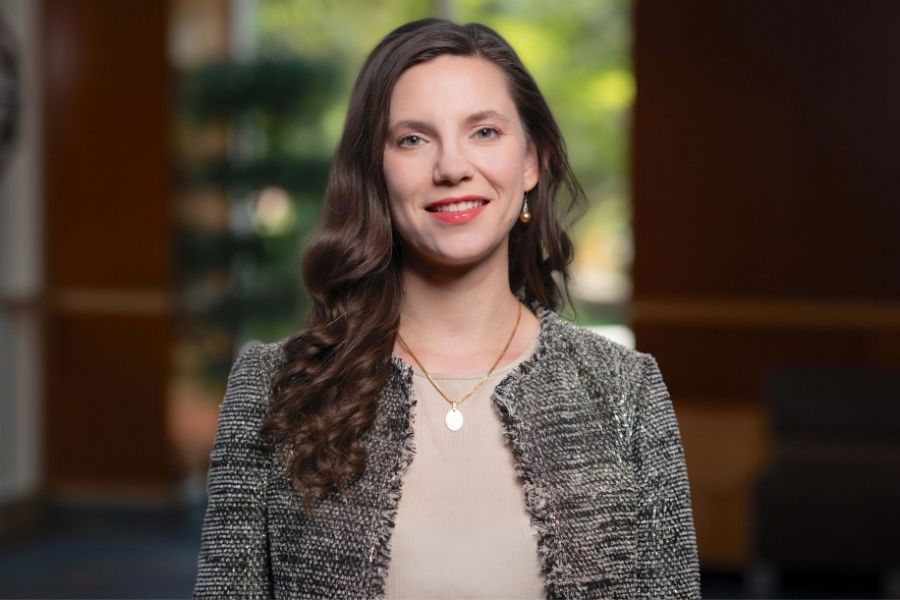
A Florida State University doctoral student has developed a new approach to destroying “forever chemicals” and is now taking the technology beyond the laboratory through the National Science Foundation’s I-Corps program.
Kimberley Christopher, a doctoral candidate in FSU’s Department of Chemistry and Biochemistry, studies new ways to destroy per- and polyfluoroalkyl substances, or PFAS. Because these synthetic chemicals persist in the environment for decades or longer, they have been nicknamed “forever chemicals” and have become a major environmental and public health concern.
Around 200 million people in the U.S. drink PFAS-contaminated water daily, and more than 97% of Americans have PFAS in their blood. Exposure to certain PFAS has been associated with a range of adverse health effects, including increased risk of some cancers.
Through NSF I-Corps, Christopher is expanding the scope of her research: not just whether the chemistry works, but where the technology could have the greatest impact.
“This program makes you think about how to translate your technology to have a much bigger and more meaningful impact,” Christopher said. “You start seeing a world of opportunity everywhere. Once you get that kind of mentality, it just doesn’t go away.”
I-Corps trains scientists and engineers to develop products based on their work. Program teams include a graduate student as the entrepreneurial lead, a technical lead with deep expertise in the technology area and an industry mentor who provides business experience and is independent from the technical development of the product.
When Christopher began pursuing a doctorate in computational physical organic chemistry, she had not thought about starting a business. I-Corps showed her possibilities that could help bring her research to more people.
Christopher is working with Professor Bruce R. Locke and Robert Wandell, director for engineering innovation, from the Department of Chemical and Biomedical Engineering in the FAMU-FSU College of Engineering, and Professor Igor Alabugin, a distinguished research professor in FSU’s Chemistry and Biochemistry Department. They will continue advancing a framework she developed that uses plasma and electrons to jumpstart a permanent and cost-effective breakdown of PFAS ‘forever chemicals.’
From idea to impact with regional and national I-Corps programs
Christopher’s work expands upon previous research by offering a permanent and more effective method for removing PFAS from the environment.
Current approaches transfer PFAS from one medium to another, generating hazardous waste that landfills are reluctant to accept. Whereas other treatment methods capture PFAS, Christopher’s patent-pending Radi-Reactor plasma process permanently destroys it.
Christopher heard about the NSF’s I-Corps regional program at an event organized by IGNITE-FSU, part of the National Science Foundation’s new Accelerating Research Translation program. IGNITE-FSU builds capacity for translational research through resources, programs and partnerships to help build an innovation ecosystem that benefits North Florida’s economy.
“Everything started with IGNITE,” she said. “After we went to IGNITE, things just started to click with the commercialization potential of this idea. We said, ‘Okay, we have a real business here.’”
During a regional I-Corps program, Christopher conducted 30 “discovery interviews” to understand how potential users currently address PFAS contamination, what problems remain unsolved and which customer segments might benefit most from the technology. PFAS are present in thousands of products as varied as non-stick cookware, firefighting foam, furniture, household cleaners, microwavable popcorn and more, so it was important to learn how customers’ needs might differ depending on their industry.
After the regional program concluded, Christopher was nominated by the Jim Moran College of Entrepreneurship to enter the Florida Venture Forum Collegiate Pitch Competition, where she presented her framework to investors, venture capitalists and other potential patrons. With IGNITE-FSU’s support, Christopher won first place at the pitch competition.
Christopher’s team began NSF’s National I-Corps program in early September. This opportunity offers up to $50,000 in federal funding and deeper immersion into the ecosystem for evaluating the commercial potential of their technology. As the entrepreneurial lead of the team, Christopher works primarily on commercial applications.
The team will complete 100 discovery interviews in just seven weeks from September through October to further refine their understanding of the market and learn more about how the invention can make an impact. Christopher plans to identify a specific customer segment to target and to secure investor backing for the technology.
“I thrive under pressure; it really forces you to be creative,” she said. “You have to take a step back and think, ‘What customer gains are you creating and what pains are you alleviating?’”
Christopher’s goal is to continue developing the effectiveness and cost-competitiveness of her PFAS-destroying technology to make it the cornerstone of her new company, Radical Solutions Corp.
“There’s no better place to start a business than a university,” she said. “You have all of the resources you can dream of available to you, and everybody wants to see you succeed.”
Interested in I-Corps? For more information about I-Corps at FSU, contact FSU Commercialization.