



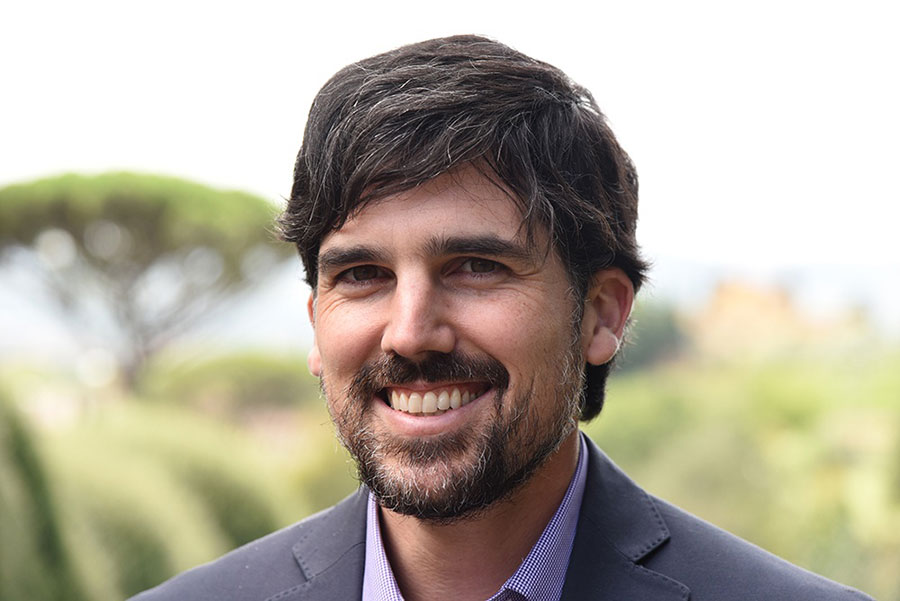
A Florida State University faculty member has been awarded the Herralde Novel Prize, a prominent literary honor in the Spanish language, for his novel exploring the concepts of ownership and plagiarism in memory and literature.
Associate Professor of English Pablo Maurette earned the honor for his recent novel, “El contrabando ejemplar,” which translates to “Exemplary Smuggling.” The Herralde Novel Prize is given to an author for an unpublished manuscript, which is common for several Spanish-language prizes. Maurette is only the fifth Argentinian writer to have won the award and is the first FSU faculty member to receive it.
“While this prize isn’t very well known in English writing, it might be the most prestigious literary award for young authors writing in Spanish,” Maurette said. “For that reason, and since my novel competed against almost 900 other novels, I feel extremely fortunate and proud to have earned it. I also feel very humbled because some of my favorite writers in Spanish have won this prize.”
The prize was established in 1983 by Jorge Herralde, the founder and publisher of Anagrama, a publishing house in Barcelona, Spain. Each year, Anagrama publishes the award-winning novel and provides the author a monetary reward of 25,000 euros.
“El contrabando ejemplar” is Maurette’s seventh publication, joining a roster of four books of essays and two other novels. His first novel, “Il tempo è un fiume” or “Time is a River,” was a contender for the Premio Gregor von Rezzori, an Italian prize for foreign fiction.
“Writing is what I do, and it’s what I’ve done since I can remember,” Maurette said. “Prizes are important in a writer’s career as they tend to give you, at least for some time, a lot more visibility. Even if I didn’t receive any awards or recognition, however, I would continue to write as long as I live quite simply because it’s how I express myself. I feel lucky that I understood this a long time ago, and I’ve put all my energy and effort into it.”
Maurette’s novel tells the story of two aspiring writers who are close friends despite having a significant age gap. The older writer is working on a novel about Buenos Aires in the 1600s, which shaped its economy at the time with a sophisticated and clandestine trade system known as “exemplary smuggling.” When this writer passes, the younger writer steals the manuscript, determined to plagiarize it.
“Everything we write, even if we think it’s original, comes from something we’ve read and forgotten about,” he said. “Literature is a type of paramnesia, that phenomenon by which you attribute to yourself memories that happened to others. In relation to the millennia that human beings have spent on this earth telling one another stories, we need to convince ourselves that we create out of nothing, that we are original, that we own what we write. That’s very naive.”
In its synopsis of the award-winning novel, Anagrama writes, “‘Exemplary Smuggling’ questions the meaning of what is lost and what is invented. A celebration of the personal and the collective, it transforms the act of storytelling into a unique and moving literary experience. A novel that finds its place within the great tradition of the best Latin American narrative.”
The Herralde Novel Prize has been awarded in the past to a long list of distinguished writers, including Roberto Bolaño, Javier Marias, Álvaro Enrigue and Guadalupe Nettel.
“The Department of English is absolutely thrilled that Pablo has been given this wonderful award for his new novel — he’s in very elite company,” said Andrew Epstein, department chair and Caldwell Professor of English. “The Herralde Novel Prize further solidifies Pablo’s international reputation as both a celebrated novelist and a scholar of literature. We couldn’t be happier about this amazing and well-deserved recognition.”
Maurette, a native of Buenos Aires, earned his doctorate from the University of North Carolina at Chapel Hill in 2013. He joined the FSU Department of English in 2019 and teaches in the department’s Literature, Media, and Culture Program. In May 2023, he worked as a writer in residence for Italy’s Fondazione Santa Maddalena, and from April to June 2024, he was a research fellow at The Huntington Library, Art Museum, and Botanical Gardens in California.
For more information about the FSU Department of English and its research and publications, visit english.fsu.edu.