



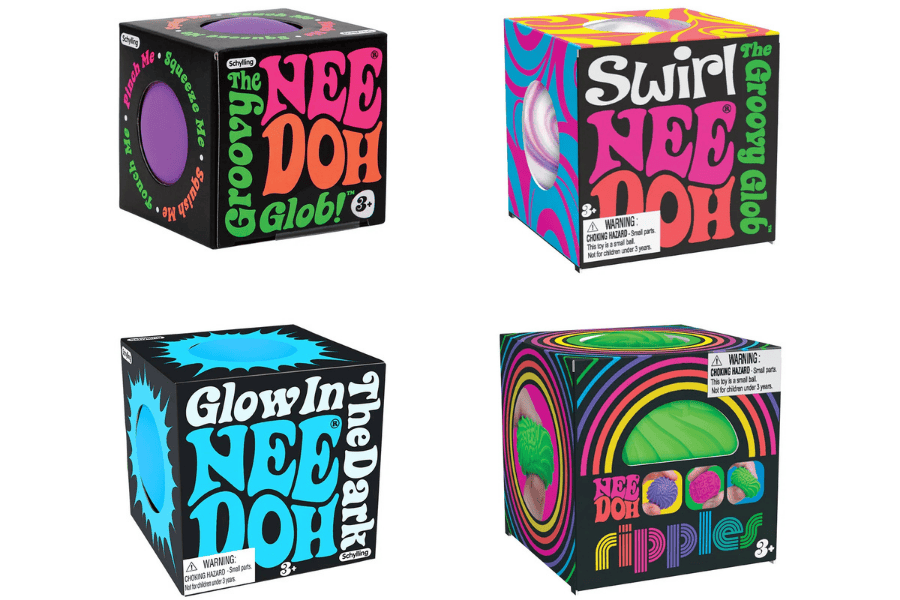
Soft, squishy stress toys known as NeeDohs have become a fixture on office desks, in backpacks and across social media feeds, transforming from children’s playthings into mainstream tools for stress management and focus. According to two Florida State University experts, their rise reflects an understanding of simpler mental health techniques and a savvy blend of sensory appeal and digital‑era marketing.
Brad Schmidt, director of the Florida State University Anxiety and Behavioral Health Clinic, says that squeezing objects like NeeDohs can help calm the brain and body by offering a simple, repetitive sensory‑motor task. That physical engagement can shift attention away from racing thoughts and help ground people in the present moment. Predictable tactile input, Schmidt said, can feel regulating because touch is one of the brain’s most basic signals of safety and bodily awareness.
NeeDohs are increasingly visible in workplaces, a sign that adults are seeking accessible, discreet ways to manage daily stress. Schmidt said portable tools like these fit naturally into office settings, though they are not a substitute for addressing more serious anxiety issues.
From a consumer behavior perspective, Cammy Crolic, assistant professor in FSU’s Herbert Wertheim College of Business, said NeeDohs combine fun, sensory gratification and emotional regulation — a mix that fuels demand. Unlike traditional toy fads, their appeal is “process‑oriented,” meaning enjoyment comes from ongoing use rather than completion, which can extend their lifespan.
Crolic also points to NeeDohs as a standout example of haptic marketing. Though consumers can’t touch them through screens, viral videos succeed because the sensory experience is easy to imagine. In times of economic and political uncertainty, she added, consumers often gravitate toward small, affordable indulgences that provide comfort and a sense of control — making NeeDohs well‑timed for the moment.
Media interested in interviewing Director Brad Schmidt about the stress management components that make NeeDohs effective may reach out to him at schmidt@psy.fsu.edu.
Media looking for marketing expertise at how NeeDohs are resonating with consumers can email Professor Cammy Crolic at ccrolic@wertheim.fsu.edu.
Brad Schmidt, director, FSU Anxiety and Behavioral Health Clinic, FSU College of Arts and Sciences
NeeDohs are being seen more on office desks, not just in playrooms at home. Is this an example of adults seeking alternative ways to reduce daily stress?
I think that’s exactly what it reflects. Adults are willing to use a wide array of tools for self-regulation. Discreet and portable tools like a NeeDoh would make sense for a work environment. The literature suggests that use of a toy like a NeeDoh could be beneficial to some, and it’s more adaptive than the “three martini lunch” but it’s not likely to be a solution to a more significant problem with stress and anxiety.
Cammy Crolic, assistant professor and Dean’s Emerging Scholar, FSU Herbert Wertheim College of Business
NeeDohs aren’t just for kids — many adults use them in their workplaces. How much does this cross-generational marketing benefit them?
The cross-generational adoption of NeeDoh can be understood from a consumer behavior context situated within the current macro-environment. First, adults using NeeDohs reframe the product from a toy into a functional consumption object that helps with stress management and attentional regulation. This repositioning from a “toy” for play to a “tool” that facilitates goal attainment helps create social legitimacy and widespread cross-generational acceptance and adoption. Further, it is unsurprising that people are turning to childlike, nostalgic NeeDohs that help with stress management right now. We are going through a time of war and geopolitical instability, political polarization and economic downturn. During these times, consumers gravitate to products that create fun, a controllable sensory experience (in an uncontrollable world), that help with stress and emotional coping. Historically, in highly uncertain environments, consumers often shift toward small, affordable indulgences, referred to as the “lipstick effect.” NeeDoh fits with that pattern of behavior because it is inexpensive, fun to use and collect and emotionally comforting.