



Key Points
- The U.S. Open Tennis Championship raised a broader issue in the influencer marketing and content creation industry: When does content creation enhance an event, and when does it become a distraction?
- Florida State University Sport Management Professor Kris White believes the answer is not to shut creators out. It is to better define how they fit into the fan experience without pulling focus from the competition itself.
The U.S. Open has long separated itself from tennis’ other majors with its noise, celebrity energy and New York spectacle. This year, however, one post-match conversation raised a broader question for sports: When does content creation enhance an event, and when does it become a distraction?
Influencers and content creators have become fixtures at sporting events, concerts and other entertainment venues, helping brands reach younger and highly engaged audiences. With large followings and a steady stream of viral content, they can shape how fans discover events, athletes and teams.
But after tennis superstar Naomi Osaka’s first-round win at the U.S. Open, attention turned to individuals in a luxury suite whose ring lights and commotion disrupted the atmosphere around play. The match’s chair umpire even asked the group to keep quiet, turning a familiar etiquette issue into a wider discussion about the growing presence of creators in live sports.
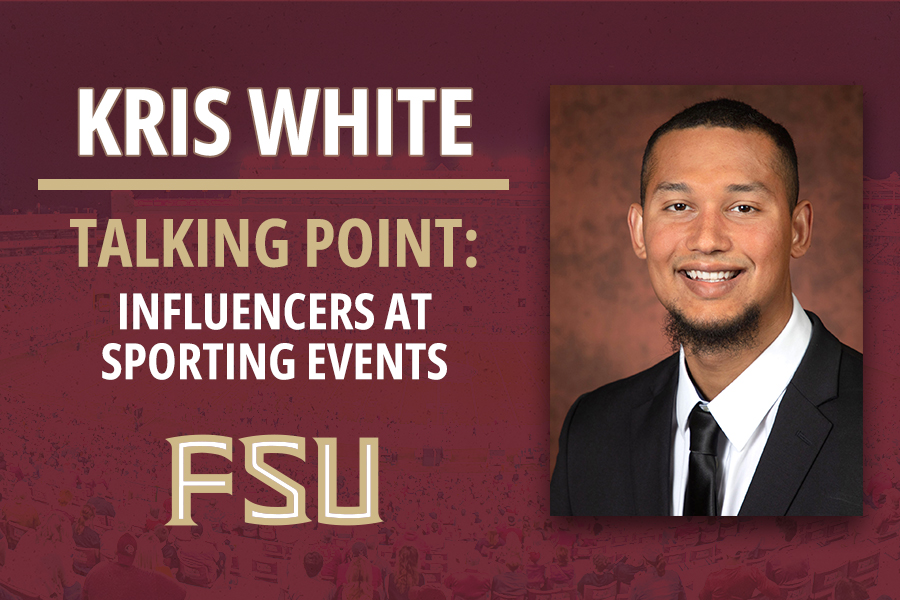
For Florida State University’s Kris White, a specialized teaching professor in the Department of Sport Management, the answer is not to shut creators out. It is to better define how they fit into the fan experience without pulling focus from the competition itself.
White teaches courses that connect athlete branding, Name, Image and Likeness (NIL), and content creation with intercollegiate athletics. He sees social media and influencer marketing as essential to sports branding, especially for college athletes building personal platforms alongside their teams and universities.
“In a way, athletes are more so becoming like individualized media entities,” White said.
That shift accelerated after the NCAA adopted NIL in July 2021, creating new value around athletes’ personal brands and new demand for videographers, editors, social media managers and strategists who can help tell those stories.
“When you opened up the market to athletes, in terms of NIL, you also opened up a marketplace around creating that content,” White said. “Now there is value for athletes to have content created all around them, and the people who are able to create that value, now there’s a marketplace for that.”
White understands that evolution from both academic and personal experience. A Clermont, Florida, native, he played wide receiver at Kent State from 2013-17, during an era of college athletics that feels distant from today’s NIL-driven landscape. His research into athlete branding emphasizes that the strongest content starts with authenticity, a point echoed by current FSU football punter Daniel Hughes at a recent NIL Sports Summit.
“You have to start with who you are as a brand, and what that means to you,” White said. “What are you trying to bring and provide to the world and to your audience?”
The concern at the U.S. Open was not that creators were present, but that their presence risked overshadowing the athletes. Tennis players later voiced support for creators while also stressing that content should not interfere with play on the court. The United States Tennis Association credentialed around 100 content creators for this year’s tournament, nearly doubling last year’s total of 54 according to ESPN.
White said creators can help make sports more accessible, especially for people who may first encounter an athlete, team or event through social media. But that visibility works best when creators add to the experience rather than compete with it.
“It is an activation management issue. How are you making sure these creators are adding and enhancing to this experience, rather than taking away from it and making their thing the actual spotlight?” White asked. “You want to keep the main thing the main thing.”
“It is an activation management issue. How are you making sure these creators are adding and enhancing to this experience, rather than taking away from it and making their thing the actual spotlight? You want to keep the main thing the main thing.”
– Kris White, Florida State University Sport Management Professor
The debate has already produced consequences. Wimbledon announced it would not accredit influencers for its 2027 tournament and would ban disruptive equipment, including ring lights, that can interrupt play. Some have viewed the move as a necessary protection of tennis culture; others have questioned whether it goes too far at a time when sports are competing for attention across digital platforms.
White believes the better long-term approach is not a blanket rejection of creators, but a clearer system: selecting creators whose audiences align with the event, establishing designated content zones, setting expectations in advance and holding creators accountable when they disrupt the competition.
“You don’t want to move the tent,” White said. “You want to make sure that you expand the tent to allow more people in.”
For White, the future of creators in sports should be guided by balance. Content can introduce new fans, deepen connections with athletes and expand the reach of an event. But the value is strongest when creators understand their role: Support the spectacle, capture the moment and never become the main event.