



Key Points
- FSU chemist Justin Kennemur is part of a multi-institutional team funded by the U.S. Department of Energy that is investigating how specific ions are transported in polymer membranes.
- The research could lead to improved electrolyzers, which are store excess electricity produced by power grids, and fuel cells that generate electricity for electric vehicles.
A Florida State University polymer chemist is part of a multi-institutional team working to improve energy storage and production in technologies like fuel cells and electrolyzers through the synthesis of novel polymer membranes.
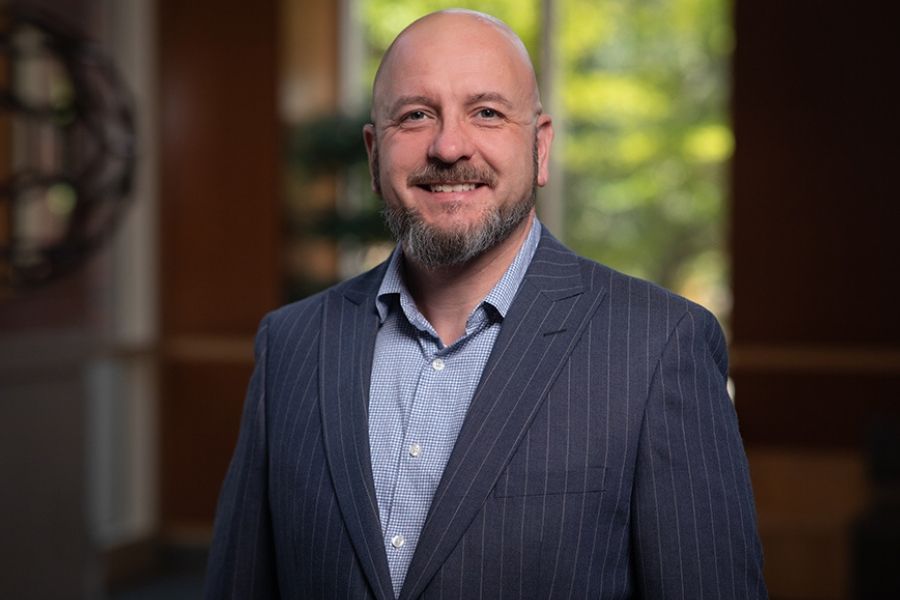
Professor of Chemistry and Biochemistry Justin Kennemur and his collaborators have earned a $2.64 million grant from the U.S. Department of Energy’s Basic Energy Sciences program, one of the country’s largest sponsors of research in the physical sciences, to explore how specific ions are transported in polymer membranes, to develop new fluorine-free alternatives based on the underlying mechanisms and to apply this science to energy-related technologies. Nearly $800,000 of the grant will come to FSU.
“Society’s need for abundant and accessible energy is a frontline challenge in scientific research,” Kennemur said. “It’s critical that this research is supported so we can continue exploring this area and prepare for the ever-growing demand for energy.”
Heavily fluorinated polymers are frontrunners in the energy industry for their versatile properties and high performance when transporting ions. They’re used in energy-related applications like electrolyzers, which are used to store excess electricity produced by power grids for later use, and fuel cells that generate electricity for electric vehicles and spacecrafts. They’re also used in solar panels, wind turbines, heat generators, and other energy-storage and -production technologies.
By breaking down the architectural design of fluoropolymers and investigating how structure correlates to dynamics, the research team aims to understand why they perform so well and whether fluorine is necessary for a polymer to transport materials efficiently.
“We plan to reveal fundamental principles promoting fast proton, hydroxide, or salt transport in fluorinated membranes, such as Nafion, which are industry standards for conducting specific ions through the membrane,” Kennemur said. “Understanding these principles and ion-transport mechanisms will accelerate the development of new materials, in this case, analogous non-fluorinated polymers, that can optimize energy storage and production.”
Based on these findings, Kennemur will develop fluorine-free hydrated polymers that exceed current performance levels by increasing ion transportation speeds, making them more capable of storing or producing large amounts of energy.
“Rising concerns and regulations over ‘forever chemicals,’ which are potential by-products of fluoropolymer production that don’t break down naturally and have negative effects on human health and the environment, have revived interest in developing fluorine-free alternatives,” Kennemur said.
The Basic Energy Sciences program supports fundamental scientific research that lays the foundation for new technologies and innovation in energy, environmental science and national security. This grant supports Kennemur and his collaborators — Karen Winey, the Harold Pender Professor of Engineering and Applied Science at the University of Pennsylvania; principal investigator Amalie Frischknecht, a physicist at Sandia National Laboratories; and Michael Hickner, the Craig A. Rogerson Endowed Professor of Chemical Engineering and Materials Science at Michigan State University — as well as student research assistants and postdoctoral scholars across the team’s labs.
“This is a collaborative project connecting my chemistry research team with experts in chemical engineering, materials science and computation related to polymer science,” Kennemur said. “In addition to supporting our scientific discoveries in the laboratory, this grant is helping train future STEM leaders.”
Kennemur received his doctorate in chemistry from North Carolina State University in 2010 and completed postdoctoral research at the University of Minnesota, Twin Cities, before joining FSU’s faculty in the Department of Chemistry and Biochemistry in 2014. During his time at FSU, he has earned the National Science Foundation’s Faculty Early Career Development Program (CAREER) Award, the Distinguished Service Award from the American Chemical Society’s Division of Polymer Chemistry, or POLY and the William R. Jones Outstanding Mentor Award from the Florida Education Fund.
“Dr. Kennemur is a thoughtful, conscientious faculty member who has brought visibility to FSU through both his research re-energizing the field of low strain monomers to effectively expand its range of applications and his professional service,” said Wei Yang, chair of the Department of Chemistry and Biochemistry. “He’s not only an emerging leader in the field of polymer chemistry but also a committed, effective and skillful mentor.”
To learn more about Kennemur’s work and research conducted in FSU’s Department of Chemistry and Biochemistry, visit chem.fsu.edu.