



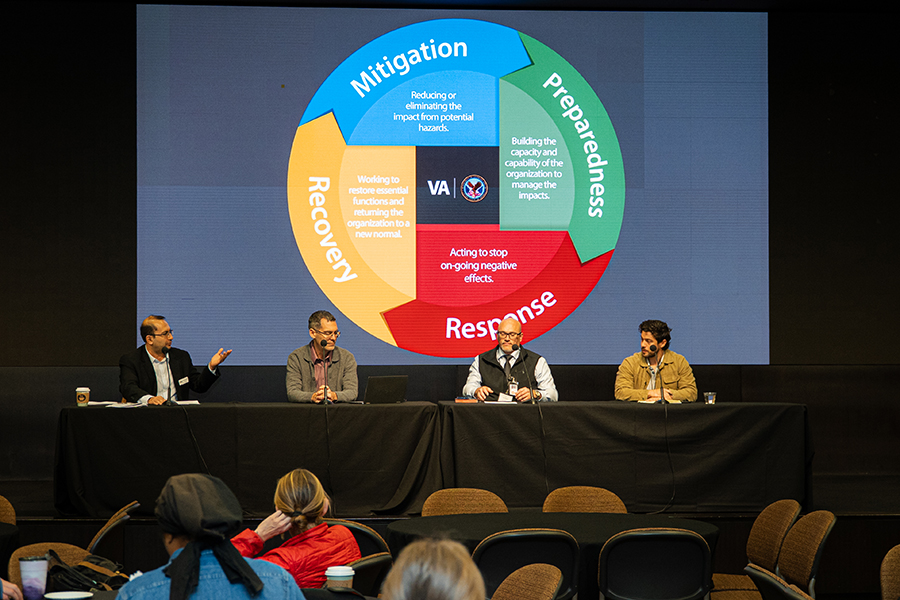
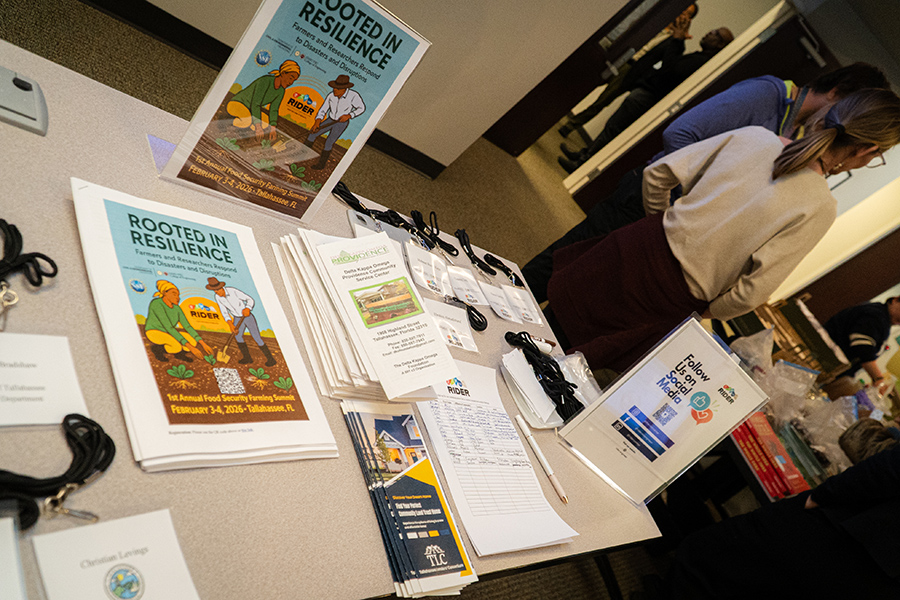
Florida State University’s Resilient Infrastructure and Disaster Response (RIDER) Center recently convened farmers, researchers and emergency management leaders from across the Southeast to examine how disasters disrupt food production and what communities can do to strengthen resilience.
The summit, “Rooted in Resilience: Farmers and Researchers Respond to Disasters and Disruptions,” focused on food production, food system resilience and emergency management.
The event brought together local and regional leaders from Northwest Florida along with farmers and researchers from the Southeast and Appalachian regions.
“This summit reflects something Florida State University believes deeply: that the most important work we do happens at the intersection of research and real lives,” said Provost James Clark. “At FSU, resilience is a priority across disciplines, including engineering, the social sciences, public policy, and environmental and biological sciences. It’s central to our work with communities who live with risk every day.”
This summit connected farmers and food practitioners with researchers focused on disaster resilience. The event was sponsored by the National Science Foundation and co-hosted by the RIDER Center and the Department of Civil and Environmental Engineering in the FAMU-FSU College of Engineering.
“Building resilience in our food ecosystems has many challenges,” said Eren Ozguven, director of the RIDER Center and a professor in the FAMU-FSU College of Engineering. “With this inaugural event, RIDER takes the lead to focus on adapting to the challenges posed by natural disasters and other disruptions in the food ecosystems of the Southeast region.”
Regional food resilience
The summit started with presentations and panels examining ways to build resilience into food production. Presentations focused on themes such as incorporating lessons from urban food production in 4-H programming, mutual aid and experiences in the aftermath of disasters, information from Assistant Professor Jeffrey Farner on the impact of floods and microplastics on food production, farmer-researcher collaborations and more.
Florentina Rodriguez visited the summit from Agraria Farm in Yellow Springs, Ohio, where she is the programs director and administration manager for the 138-acre research and education farm.
She appreciates events like the summit as an opportunity for farmers and researchers to learn from each other and think about how they can collaborate. Her farm has partnered with Central State University in Wilberforce, Ohio for farmer-to-farmer skill sharing programs. Rodriguez and her colleagues use knowledge developed by researchers, apply it on their own farm, and teach what they have learned to fellow farmers and gardeners.
“We were finding that information wasn’t being readily adopted by farmers or gardeners when the folks who were coming in and doing the education were just institutional partners,” she said. “We said ‘Hey, if you want this to really take off, you have to partner with farmer peer educators because they’re the ones who can say ‘I learned this at Central State and I have been practicing it on my farm and I know that it works.’ When it’s a farmer teaching a farmer, that trust just really accelerates the adoption rate.”
Information sharing among peers helps farmers adapt broad-based guidance to the best practices that will work for their particular site.
“We found that people often try to make efforts on a national scale or global scale, and that’s difficult when you start big and try to distill it down, because so much adaptation has to happen,” Rodriguez said. “When you put different communities together to figure out what is a resilient strategy for each of them, you have resilient communities linked together, and then the whole region is resilient.”
Emergency management
The summit’s second day examined lessons from emergency management and environmental research.
Panelists Brian Bradshaw from the Tallahassee Fire Department, Department of Geography Professor Mark W. Horner, Christian Levings of the Apalachee Regional Planning Council, and Ozguven discussed how disasters obstruct distribution of food and other resources and how researchers and emergency management professionals can work together to minimize disruptions.
A key part of responding to disasters is knowing a community’s needs, transportation network, chokepoints and other key information before disruptions change the map. Projects such as vulnerability assessments allow emergency management planners to understand the needs of an entire region and respond appropriately to natural disasters that don’t follow county borders, Levings said.
Add the dynamic changes brought on by disasters, and responding to disruptions becomes a multi-dimensional, multi-temporal problem, Horner said.
When managers and planners are faced with a need to reconcile all those variables, that’s where research can make a big impact.
“Our students love to work on data that can help connect research and practice in resilience,” Ozguven said.
Another panel featured Associate Professor Youneng Tang, researcher Xiuming Sun, Assistant Professor Ebrahim Ahmadisharaf and Institute for Water and Health post-doctoral researcher Whitley Stewart. It focused on how disasters such as hurricanes and heavy rainfall affect farming, water quality, and human health.
Collaboration is key for finding effective methods for dealing with the problems posed by these disasters, Ahmadisharaf said.
“The nonacademic piece is really important,” he said. “We need to know more about localized issues, such as what farmers are seeing or fish kills, to get a clearer picture. It is through collaboration with communities that we can extend our research impact.”
Working with the community is a way to supplement data collection, Stewart said. Volunteer citizen-scientists can provide on-ground information quickly after disasters.
“Not everyone can get to the field or work with field-based science, so efforts like those can help tremendously,” she said.
Visit the RIDER Center website for more information about how research at RIDER helps build communities in Florida and around the country that remain resilient against natural disasters.