



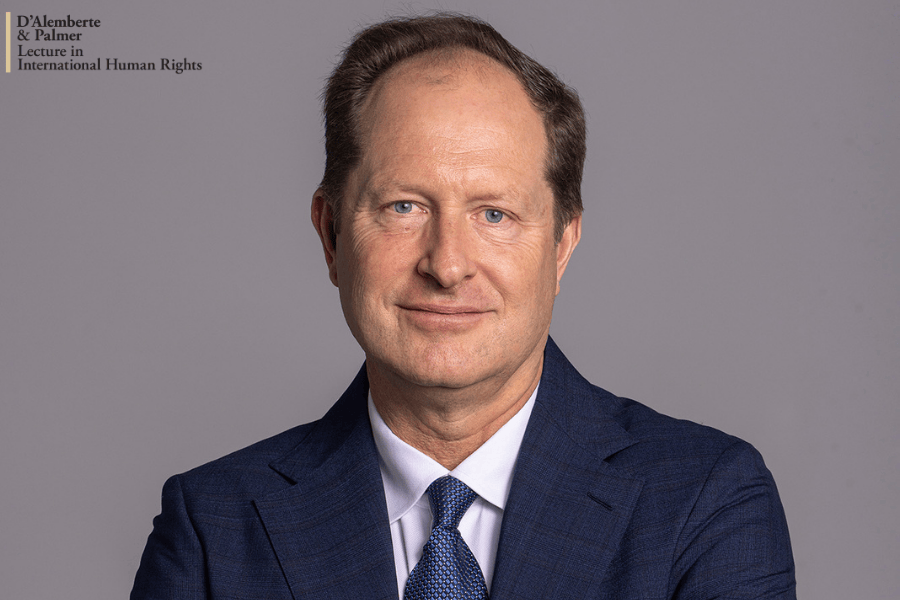
The Florida State University College of Law will welcome Mark F. Brzezinski, former United States Ambassador to Sweden and Poland, as the featured speaker for the 2026 D’Alemberte & Palmer Lecture in International Human Rights.
Brzezinski will deliver a lecture titled “U.S. Embassies as ‘Force Multipliers’ for Democracy and Human Rights: The Case of Poland, 2021-25” at 3:30 p.m. on Thursday, March 12, at the College of Law. The event is free and open to the public.
“We are honored to welcome Ambassador Brzezinski to FSU Law,” said Erin O’Hara O’Connor, dean of the FSU College of Law. “His career at the intersection of diplomacy, law and human rights offers a powerful opportunity for our students and the broader community to engage with the real-world challenges of advancing democratic values and protecting human rights globally.”
“We are honored to welcome Ambassador Brzezinski to FSU Law. His career at the intersection of diplomacy, law and human rights offers a powerful opportunity for our students and the broader community to engage with the real-world challenges of advancing democratic values and protecting human rights globally.”
– Erin O’Hara O’Connor, dean of Florida State University College of Law
Brzezinski brings decades of experience in public service, international law and global affairs. He served as U.S. Ambassador to Poland from 2021 to 2024, where he played a key role in strengthening democratic institutions and advancing human rights during a pivotal period. Previously, during the Obama administration, he served as U.S. Ambassador to Sweden from 2011 to 2015.
Brzezinski is president and CEO of Brzezinski Global Strategies, a geostrategic advisory firm. He previously served as a managing director at Makena Capital Management, where he led sustainability initiatives and advised on environmentally and socially responsible investment strategies.
Earlier in his career, Brzezinski was a partner at McGuireWoods LLP in Washington, D.C., where he helped build the firm’s international compliance practice. He is a member of the Council on Foreign Relations, where he has served on the board of advisers for the organization’s Corporate Program. From 1991 to 1993, he was a Fulbright Scholar in Poland. In 2010, President Barack Obama appointed him to the U.S. State Department’s Fulbright Foreign Scholarship Board. He has also served as an adjunct professor at the University of Virginia’s McIntire School of Commerce.
The D’Alemberte & Palmer Lecture in International Human Rights is made possible by Patsy Palmer, Esq., and was established to educate the community about the critical field of international human rights, inspire FSU Law students and contribute to the global discussion on human rights issues. Previous speakers in the lecture series include Former President of Ireland Mary Robinson (2025), Ambassador David Scheffer, the first U.S. Ambassador-at-Large for War Crimes Issues (2024) and former General Counsel of the U.S. Navy Alberto J. Mora (2023).
Palmer is an FSU College of Law alumna and former FSU First Lady, known as a champion of the university’s academic and cultural initiatives.
“We are deeply grateful to Patsy Palmer for making this important lecture series possible,” O’Hara O’Connor added.
For more information, visit law.fsu.edu/humanrightslecture.
Synopsis of 2026 D’Alemberte & Palmer Lecture in International Human Rights
Ambassador (ret.) Mark Brzezinski argues that U.S. embassies are the most effective — and underappreciated — tools for defending democracy and human rights. Drawing on his experience as Ambassador to Poland, he demonstrates how embassies function as “force multipliers” by converting American interests into effective diplomacy through precise leverage, local knowledge and side-by-side partnerships with civil society. From blocking anti-democratic legislation in Warsaw to supporting election integrity in Guatemala and Brazil, embassies advance American interests not despite their focus on democracy and human rights, but because rule of law, judicial independence and press freedom form the institutional infrastructure that makes reliable partnerships possible. As the liberal international order fragments and U.S. policy shifts, Brzezinski calls on the next generation to preserve this operational knowledge and reimagine democracy support for a more complex world — one that demands less prescription from distant capitals and more grounded, tactical collaboration on the frontlines where rights are actually won or lost.