



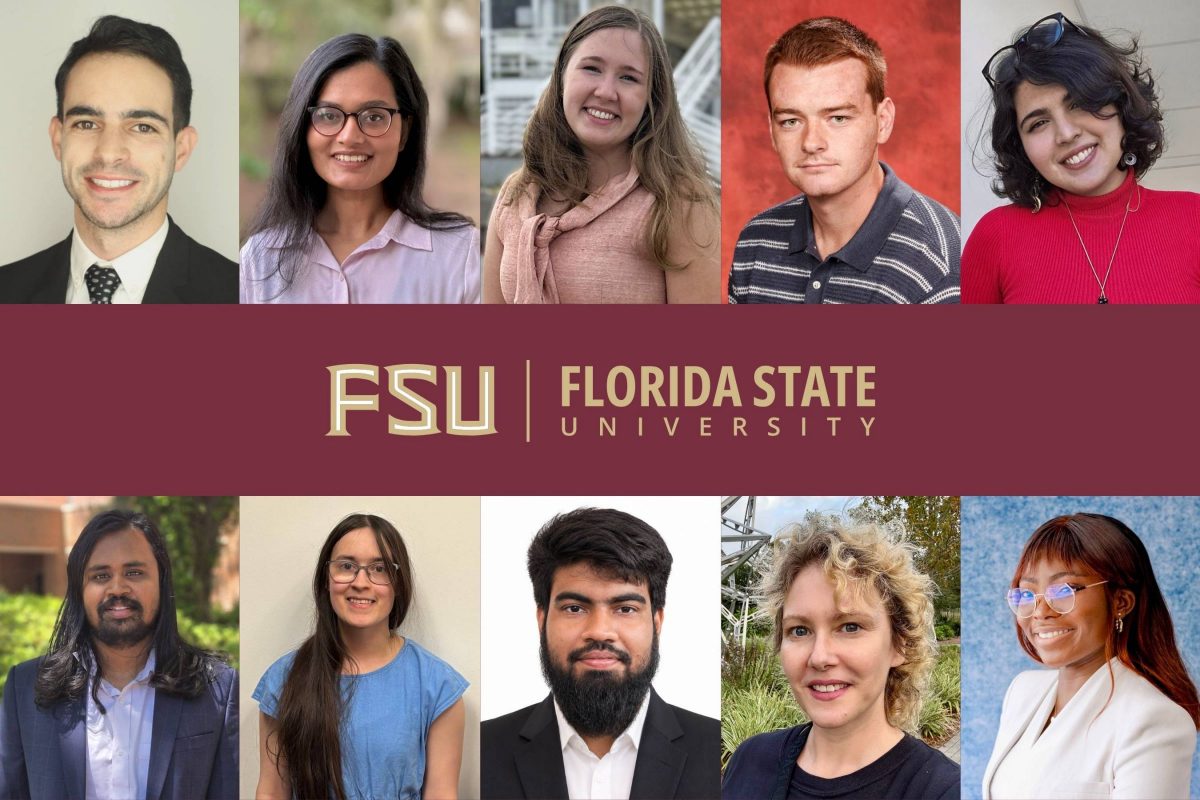
Florida State University’s Graduate School has recognized 10 students through its annual Op-Ed Competition.
The competition, organized by the Office of Graduate Fellowships and Awards and funded by the Congress of Graduate Students, drew 54 entries from across academic disciplines.
“For research and scholarship to matter, it needs to reach people,” said Keith McCall, assistant director of the Office of Graduate Fellowships and Awards. “The Op-Ed Competition is an important opportunity for graduate students to bring their ideas and expertise to bear on pressing questions and challenges. We’re thrilled to see so many students participate in this competition, stretching beyond academic audiences to engage broad, nonspecialist readers.”
Fourteen staff members and administrators from the Graduate School, University Libraries, the Office of Research and the Center for Undergraduate Research and Academic Engagement served as judges. They scored each submission for focus and importance of topic, strength of supporting evidence, clarity of language and overall persuasiveness.
“These students’ op-eds show how impactful the work of FSU’s graduate students can be,” said Greg Bell, dean of the Graduate School. “Translating complex ideas into a meaningful, relatable context reinforces the value of graduate student contributions to our communities, our state and beyond. I’m grateful to the judges and the Congress of Graduate Students for their support. Most importantly, thanks to every student who shared their perspective and insight with us. Congratulations to all the awardees.”
2026 awardees:
Most Persuasive Op-Ed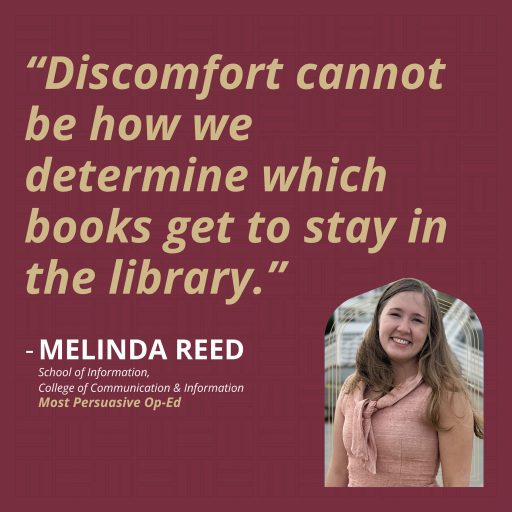
Melinda Reed
Master’s student in the School of Information, College of Communication & Information
As a library worker, Melinda Reed said opposing book bans and censorship is a “no-brainer.” But writing her op-ed challenged her to examine opposing views to strengthen her argument.
“I’m incredibly honored and excited to win this award,” Reed said. “As a new student, it’s been a really great way to feel like part of the broader FSU community, and I loved getting the chance to write about something so important.”
Best Use of Evidence 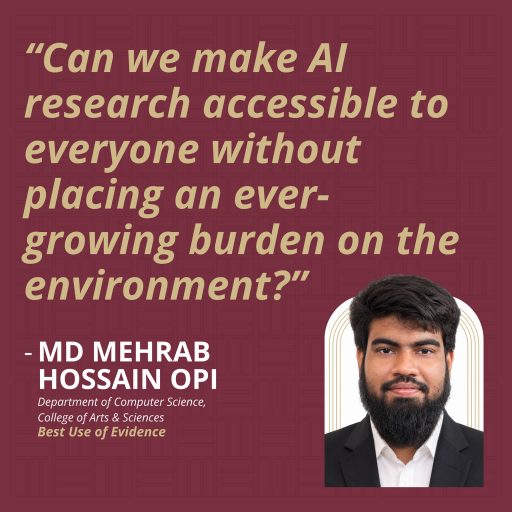
Md Mehrab Hossain Opi
Doctoral student in the Department of Computer Science, College of Arts & Sciences
“AI Innovation Shouldn’t Cost the Earth”
Md Mehrab Hossain Opi drew inspiration from his experience teaching undergraduates who had big ideas but lacked funding to pursue them. His op-ed explores unequal access to AI research resources and the technology’s environmental impact, making the case for greener, more accessible AI.
“It was my first time writing something like this,” Opi said. “As a student from STEM, we write mostly technical reports. I was experimenting with this one; can I actually show other people what I’m doing? It was a new experience for me.”
Best Explanation of a Complicated Subject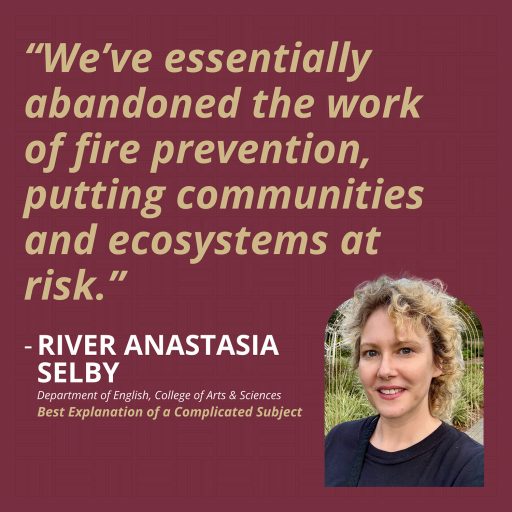
River Anastasia Selby
Doctoral student in the Department of English, College of Arts and Sciences
“Fire Seasons Are Getting Worse. We Need to Meet the Moment with Prevention.”
River Anastasia Selby worked as a wildland firefighter for seven years, which gave her insight into the importance of fire mitigation. Selby’s op-ed aims to help readers understand the difference between preventing wildfires and putting them out after they start.
“The op-ed requires a clear and succinct argument with a defined focus,” Selby said. “With this one, I worked hard to stay focused while pulling in as much evidence as I could without straying from the primary argument. Given the time and effort I put into this piece, it feels really good to have my hard work rewarded.”
Best Call to Action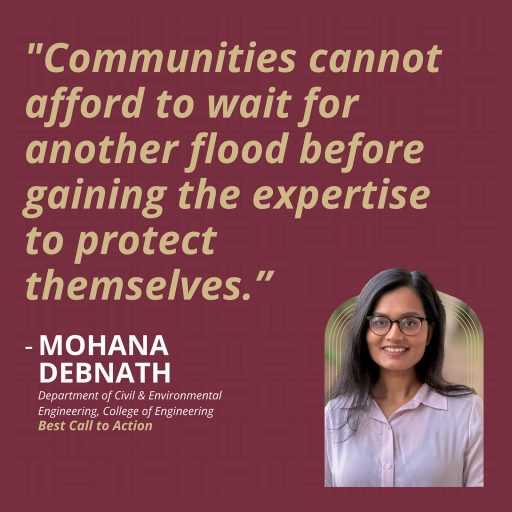
Mohana Debnath
Doctoral student in the Department of Civil and Environmental Engineering, FAMU-FSU College of Engineering
“Secure Structures, Safe Streets: Flood Protection Cannot Be a Prerogative”
Mohana Debnath argued that modern flood-management solutions exist, but they aren’t always made accessible to communities that need them most, both in Florida and around the world.
“I am asking … federal and state agencies to support local flood risk assessments, shared engineering experts and ongoing maintenance,” she said.
Debnath, who also entered last year’s competition, said she felt more connected to her topic this year. Growing up in Bangladesh, where flooding is a recurring challenge, inspired her to write about the need for better flood protection.
“I’m aware of how deeply it can affect people’s homes, livelihoods and everyday lives,” she said.
Best Organized Op-Ed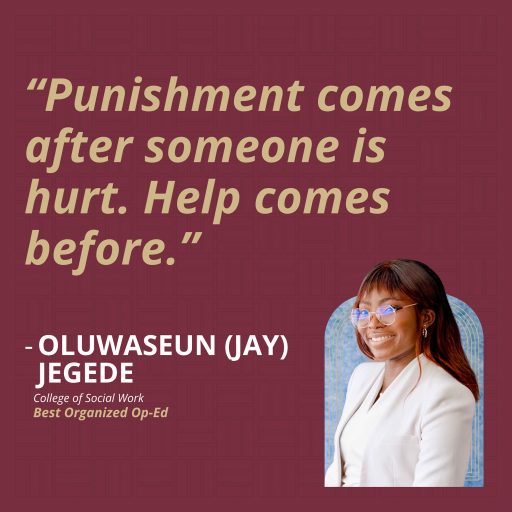
Oluwaseun (Jay) Jegede
Doctoral student in the College of Social Work
“Florida’s Youngest Domestic Violence Victims are Hiding in Plain Sight”
Oluwaseun (Jay) Jegede came to FSU in part to work with the Florida Institute for Child Welfare, a legislatively supported research and training organization housed in FSU’s College of Social Work. Her op-ed examines how domestic violence policies shape practices and prevention efforts.
“This award reassures me that researchers can explain even policy and trauma in a way the public understands, and in a way that shows why action is urgent,” Jegede said. “I think every researcher should be able to explain their work that simply.”
Honorable Mentions:
Best Use of Evidence
Abdul Mobin Ibna Hafiz
Doctoral student in the Department of Civil and Environmental Engineering, FAMU-FSU College of Engineering
Plastic Pollution in Agriculture: Are We Doing Enough?
Best Explanation of a Complicated Subject
Carson Mickey
Doctoral student in the Department of Biomedical Sciences, College of Medicine
Teaching Cells to Forget: A New Direction in the Fight Against Type 2 Diabetes
Best Call to Action
Sara Crippen
Doctoral student in the Department of English, College of Arts and Sciences
The AI Detector Mirage: The Dangers of Technological Solutions to Education’s AI Problem
Most Persuasive Op-Ed
Julian Kafka
Doctoral student in the Department of Educational Psychology & Learning Systems, Anne Spencer Daves College of Education, Health, and Human Sciences
Cognitive Disengagement Syndrome: Too Early for the DSM, Too Important to Ignore
Best Organized Op-Ed
Saba Belyani
Doctoral student in the Department of Health, Nutrition, and Food Sciences, Anne Spencer Daves College of Education, Health, and Human Sciences