



Key Points
- Assistant Professor Ebrahim Ahmadisharaf uses computer simulations, satellite observations, statistical methods and AI to study the impacts of extreme weather.
- His research helps communities improve risk assessment and planning to prepare for flooding and other weather hazards.
Torrential storms wash through the southern United States each year, leaving behind debris, pollutants and infrastructure damage. Using physics-based models, satellite observations and artificial intelligence, Florida State University researcher Ebrahim Ahmadisharaf is identifying climate trends and solutions to best equip communities to handle these extreme weather events.
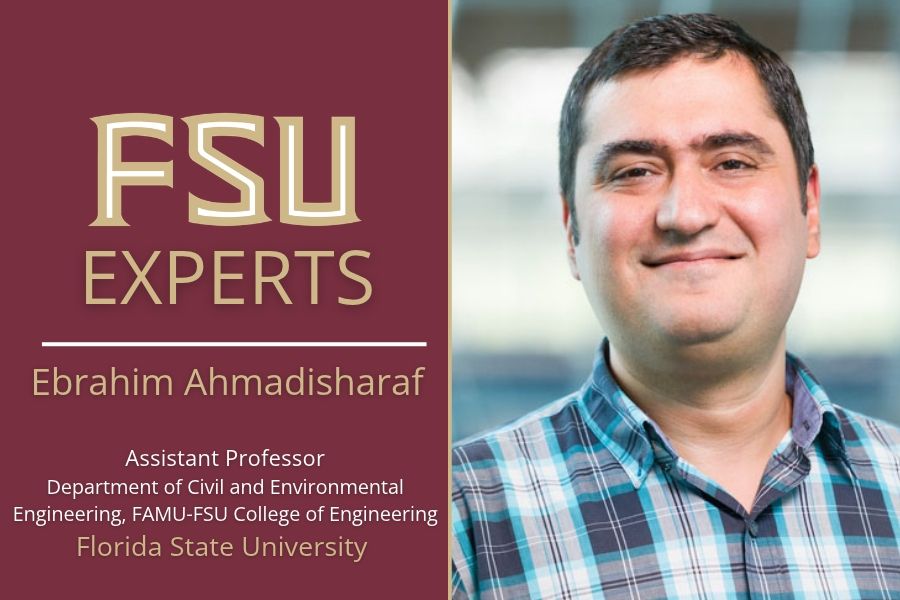
Ahmadisharaf is an assistant professor in the Department of Civil and Environmental Engineering at the FAMU-FSU College of Engineering and the Resilient Infrastructure & Disaster Response (RIDER) Center. He helps improve forecast accuracy, emergency management and planning for communities at risk of flooding and other water hazards.
He has been awarded more than $4.3 million for his work examining how soil moisture, rainfall, storm tide and other variables affect hydroclimatic events like hurricanes and flooding. Recent research has examined levels of dirt and microplastics after hurricanes and harmful algae blooms or “red tide.”
Media interested in learning more about how data and infrastructure can help reduce the impacts of extreme weather can contact Assistant Professor Ebrahim Ahmadisharaf at eahmadisharaf@eng.famu.fsu.edu.
What made you interested in this field and what is the focus of your current research?
My research focuses on understanding floods and surface water quality, especially the impacts on infrastructure, the ecosystem and human health. My research group uses computer simulations, satellite observations, statistical methods and AI. I have been interested in how engineering and science can help solve real-world problems, particularly those that directly affect people’s safety and quality of life. We explore beyond the conventional, short-term consequences of extreme weather. Our ultimate goal is to translate scientific advances into practical solutions that help communities become safer and more resilient.
What’s the most important lesson that the public should know?
Perhaps the most important lesson is that the impacts of a natural disaster are not limited to the event itself, and the danger does not necessarily end when the storm passes. For example, our research has shown how water damage and indoor mold can contribute to respiratory health problems like allergy and asthma months after floodwaters recede. Hurricane-related floods may cause deaths and structural damage, but they can also spread pollutants to rivers, lakes and coastal waters that lead to harmful algal blooms and fish kills. Environmental problems like these do not receive enough attention, as they are less visible than damaged roads or buildings.
What are the best ways to mitigate damage from extreme weather events?
We cannot prevent hurricanes, floods or extreme rainfall, but we can predict them and reduce their impacts through better planning, appropriate regulations, infrastructure and nature-based solutions. We need to improve how we assess risks, including how those risks may change over time. Infrastructure designed using historical conditions alone may not provide sufficient protection against future extremes. Appropriate communication is also important to support effective mitigation. This is not doable without true interdisciplinary research and synergy between researchers, operational modelers, policymakers and local communities.
If you had one suggestion for how communities affected by extreme weather and can protect themselves, what would you recommend?
I would recommend that they pay attention to a range of potential consequences and be prepared for them before a disaster happens. People should follow official warnings and pay attention to non-extreme events like back-to-back rainfall, which we often get in tropical and sub-tropical areas like Florida. Even relatively minor flooding should be taken seriously because there may be less visible impacts beyond immediate property damage. At the community level, I would encourage residents to advocate for better flood risk information, resilient infrastructure and preparedness programs, particularly in neighborhoods with limited resources.