



Key Points
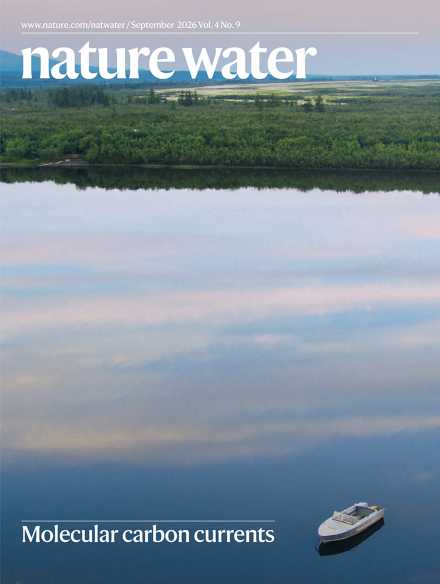
- FSU research reviewing the use of ultrahigh-resolution mass spectrometry to investigate environmental changes was featured as a cover article in the journal Nature Water.
- Researchers use mass spectrometry to understand the composition of dissolved organic matter in water samples, which can provide information about how an environment is changing.
A Florida State University-led review of the applications of ultra-high resolution mass spectrometry has shown how use of the technique gives researchers and policymakers a front-row seat to the human-driven impacts playing out in our global water systems.
Verta Cox Professor of Oceanography Rob Spencer and his lab have used ultrahigh-resolution mass spectrometry to investigate the changing world around us for almost 20 years, and they recently published an invited review of this technology, “The use of ultrahigh- and high-resolution mass spectrometry to examine the anthropogenic signature of dissolved organic matter in aquatic systems,” in the journal Nature Water.
“Our research aims to understand how organic matter within a water sample from anywhere in the world can tell us something about human-induced change in that aquatic environment,” said Spencer, the review’s lead author. “Security and stability of our water resources are important, and we found a new way to address it in ways we never thought possible. With application of this technology, we’re seeing an almost diagnostic response to human activities at the molecular level.”
Dissolved organic matter, or DOM, is an extremely complex mixture found in all global waters that plays many roles in the environment including as an energy source for aquatic life, has implications for drinking water treatment, and is important for our major biogeochemical cycles. Understanding the composition of DOM is critical to distinguish the roles it plays in the environment. Ultrahigh- and high-resolution mass spectrometry, or UHRMS, has transformed the ability to understand how human activities alter that mixture.
“By synthesizing what we’ve learned across many different aquatic systems, Rob and his colleagues highlight both the power and current limitations of UHRMS and help chart a path toward better identifying and understanding the molecular fingerprints of human impacts, combining aquatic biogeochemistry with cutting-edge analytical techniques to address fundamental questions about our changing planet,” said Mike Stukel, chair of the FSU Department of Earth, Ocean, and Atmospheric Science.
At the National Science Foundation-funded, FSU-headquartered National High Magnetic Field Laboratory, researchers like Spencer pair mass spectrometry with high magnetic fields to conduct UHRMS for various research applications through the Ion Cyclotron Resonance Facility. UHRMS differs from regular mass spectrometry thanks to its extreme accuracy and precision, allowing researchers to examine tens of thousands of data points — in this case, organic markers and molecular formulae — providing a wealth of diagnostic data.
“At FSU, we’re uniquely positioned to conduct this research thanks to the National MagLab’s facilities,” Spencer said. “When analyzing tens of thousands of molecular formulae in a sample, we might end up with ten diagnostic markers in the Amazon River Basin that track land-use change, for example. Similar research in the Mississippi Basin found a small number of organic markers linked to agriculture, and noted these molecular formulae were very similar to those from the Amazon. This ties big human impacts, like converting pristine lands to agricultural land, to molecular-level changes in our global water systems.”
Changes in DOM’s molecular composition can also indicate impacts stemming from urbanization, fires, and overall changes in climate and precipitation patterns.
“One motivation for this review was to encourage researchers to make their data openly accessible so we can improve identification of these diagnostic indicators and organic markers in conjunction with different human impacts,” Spencer said. “Ultimately, that tells us how things will respond to changes downstream. It was really interesting to look across different temperate and tropical systems and see similar responses at the molecular level with common major human impacts.”
Another focus of the review was centered on Arctic change, as the region is warming faster than anywhere else on Earth. Along with that change, nearly two-thirds of all soil carbon on Earth is frozen in Arctic permafrost; but as the region thaws, carbon that has been stored for thousands of years will be mobilized into the modern carbon cycle. By identifying organic markers linked to thawing permafrost, scientists can more confidently predict how this carbon will interact with the environment, whether that’s moving from long-term storage in soils to long-term ocean storage, or being used by microbes and ending back up in the atmosphere as carbon dioxide.
“In addition to advancing our understanding of the global carbon cycle, this work addresses societally important issues such as agriculture, urbanization, fire effects and climate change,” Stukel said. “Rob’s work also highlights the tremendous opportunities created by combining EOAS expertise with the world-class analytical capabilities of the National MagLab. This invited review reflects both his team’s leadership in aquatic biogeochemistry and their ability to help define where the field should go next.”
For more on research conducted in FSU’s Department of Earth, Ocean, and Atmospheric Science, visit eoas.fsu.edu. To learn more about the National High Magnetic Field Laboratory, visit nationalmaglab.org.